Alabama Math GDA.GM.H
Standard Cluster
Proof is the means by which we demonstrate whether a statement is true or false mathematically, and proofs can be communicated in a variety of ways (e.g., two-column, paragraph).
2019 Alabama Course of Study: Mathematics · Geometry with Data Analysis
Cluster contents
Standards in This Cluster
GDA.GM.H is a cluster heading. These are the individual standards under it.
- GDA.GM.H.30
Develop and use precise definitions of figures such as angle, circle, perpendicular lines, parallel lines, and line segment, based on the undefined notions of p...
- GDA.GM.H.31
Justify whether conjectures are true or false in order to prove theorems and then apply those theorems in solving problems, communicating proofs in a variety of...
- GDA.GM.H.31.a
Investigate, prove, and apply theorems about lines and angles, including but not limited to: vertical angles are congruent; when a transversal crosses parallel ...
- GDA.GM.H.31.b
Investigate, prove, and apply theorems about triangles, including but not limited to: the sum of the measures of the interior angles of a triangle is 180˚; the ...
- GDA.GM.H.31.c
Investigate, prove, and apply theorems about parallelograms and other quadrilaterals, including but not limited to both necessary and sufficient conditions for ...
Teacher's field guide
What This Cluster Means
What Students Need to Do
- Students decide whether a geometry claim is always true. They use known facts to prove a true claim, or give a counterexample to show a claim is false. They can write a proof in two columns or as a paragraph.
What Mastery Looks Like
- Given intersecting lines, students can prove that opposite angles are equal because adjacent angles sum to 180 degrees. They can explain why measuring one drawing does not prove the claim.
Common Misconceptions
- Students may treat several matching measurements as proof for every case. They may trust how a diagram looks, or give a reason that just repeats the claim.
How to Assess It
- Exit ticket: Sketch intersecting lines and label the four angles 1 through 4 in order. Prove angles 1 and 3 are equal using adjacent supplementary angles, then explain why measuring them once is not proof.
Lesson moves
Ways to Teach It
Cross two paper strips, mark opposite angles, then use adjacent angles summing to 180 degrees to write a proof instead of relying on measurements.
Ask, 'Do three rectangles with unequal sides prove all rectangles have unequal sides?' Have students draw a square and explain their answer.
Hand out cards showing two adjacent angle sums, subtraction of the shared angle, and equal opposite angles; students order them into a proof.
Draw two crossing streets on a map and ask students to prove the opposite intersection angles match before checking with a protractor.
Free download
Printable GDA.GM.H Worksheet
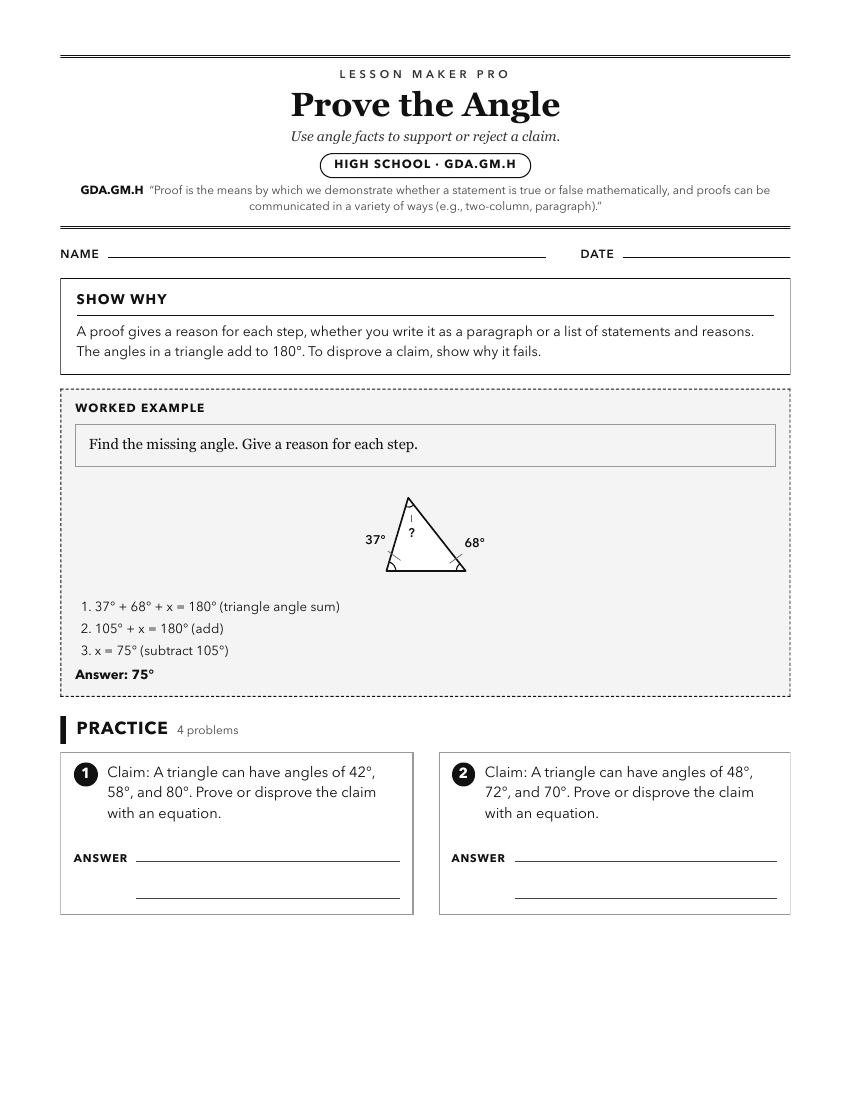
A ready-to-print activity worksheet aligned to GDA.GM.H, with an answer key for the teacher on its own page. No account needed.
PDF, US Letter, prints cleanly in black and white.
Download the worksheetKeep exploring
Related Standards
- GDA.GM.I
Proofs of theorems can sometimes be made with transformations, coordinates, or algebra; all approaches can be useful, and in some cases one may provide a more a...
- FM.LR.A.5
Prove a statement indirectly by proving the contrapositive of the statement.
- FM.LR.A.1
Represent logic statements in words, with symbols, and in truth tables, including conditional, biconditional, converse, inverse, contrapositive, and quantified ...
Turn this cluster into a lesson
Grade, subject, topic, and the complete cluster are prefilled. Create one free, no account needed.
Also for this cluster:Make a WorksheetMake a QuizMake a Sub Lesson