Alabama Math GDA.GM.D.21.b
The Standard
- GDA.GM.D
- Applying geometric transformations to figures provides opportunities for describing the attributes of the figures preserved by the transformation and for describing symmetries by examining when a figure can be mapped onto itself.
- GDA.GM.D.21
- Represent transformations and compositions of transformations in the plane (coordinate and otherwise) using tools such as tracing paper and geometry software.
Compare transformations which preserve distance and angle measure to those that do not.
2019 Alabama Course of Study: Mathematics · Applying geometric transformations to figures provides opportunities for describing the attributes of the figures preserved by the transformation and for describing symmetries by examining when a figure can be mapped onto itself.
Teacher's field guide
What This Standard Means
What Students Need to Do
- Students compare slides, turns, flips, enlargements, and one-direction stretches. They check whether matching side lengths and angle measures stay the same.
What Mastery Looks Like
- Students can show that slides, turns, and flips keep lengths and angles unchanged. They can show that an enlargement keeps angles but changes lengths, while a one-direction stretch can change both.
Common Misconceptions
- Students may think an enlargement keeps lengths the same because the shape looks the same. They may think a flip changes angles because the figure faces the other way. Some treat a one-direction stretch like an enlargement.
How to Assess It
- Draw the triangle with vertices (0,0), (2,0), and (0,2). Ask students which of these rules keep its side lengths and angles unchanged: (x+3,y), (2x,2y), and (2x,y). Have them use one side length and one angle to defend their answers.
Lesson moves
Ways to Teach It
Trace a triangle on grid paper, then slide, turn, and flip the tracing; measure matching sides and angles with a ruler and protractor.
Ask, "Why does doubling both coordinates keep angles, while doubling only x-coordinates may change them?" Have students defend their answer with a sketch.
Give partners transformation rule cards and triangle image cards; have them match pairs and mark whether lengths and angles stay the same.
Photocopy a simple street map at 200%; students measure one printed road and one intersection angle before and after enlargement.
Free download
Printable GDA.GM.D.21.b Worksheet
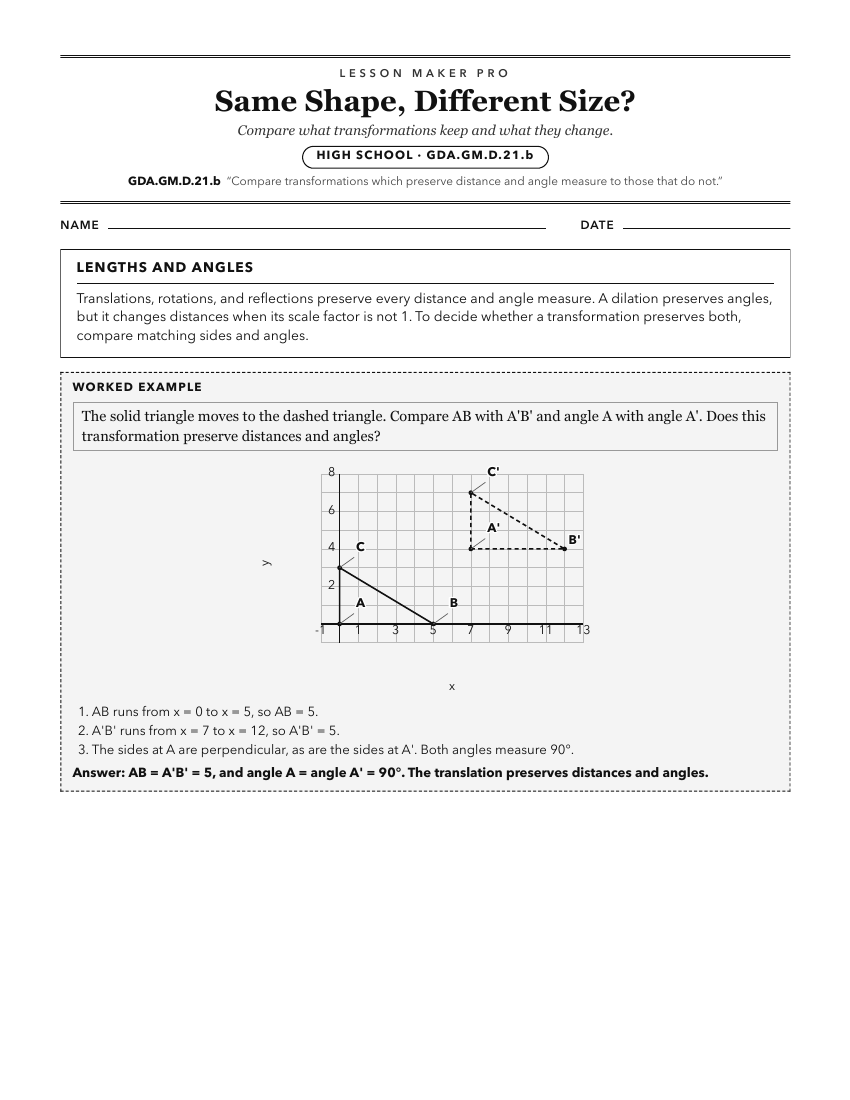
A ready-to-print activity worksheet aligned to GDA.GM.D.21.b, with an answer key for the teacher on its own page. No account needed.
PDF, US Letter, prints cleanly in black and white.
Download the worksheetKeep exploring
Related Standards
- GDA.GM.F.27
Given two figures, determine whether they are similar by identifying a similarity transformation (sequence of rigid motions and dilations) that maps one figure ...
- GDA.GM.F.28
Verify criteria for showing triangles are similar using a similarity transformation (sequence of rigid motions and dilations) that maps one triangle to another.
- GDA.GM.D
Applying geometric transformations to figures provides opportunities for describing the attributes of the figures preserved by the transformation and for descri...
- GDA.GM.F
Showing that two figures are similar involves finding a similarity transformation (dilation or composite of a dilation with a rigid motion) or, equivalently, a ...
Turn this exact standard into a lesson
Grade, subject, topic, and the complete standard are prefilled. Create one free, no account needed.
Also for this standard:Make a WorksheetMake a QuizMake a Sub Lesson