Alabama Math GDA.GM.D
Standard Cluster
Applying geometric transformations to figures provides opportunities for describing the attributes of the figures preserved by the transformation and for describing symmetries by examining when a figure can be mapped onto itself.
2019 Alabama Course of Study: Mathematics · Geometry with Data Analysis
Cluster contents
Standards in This Cluster
GDA.GM.D is a cluster heading. These are the individual standards under it.
- GDA.GM.D.21
Represent transformations and compositions of transformations in the plane (coordinate and otherwise) using tools such as tracing paper and geometry software.
- GDA.GM.D.21.a
Describe transformations and compositions of transformations as functions that take points in the plane as inputs and give other points as outputs, using inform...
- GDA.GM.D.21.b
Compare transformations which preserve distance and angle measure to those that do not.
- GDA.GM.D.22
Explore rotations, reflections, and translations using graph paper, tracing paper, and geometry software.
- GDA.GM.D.22.a
Given a geometric figure and a rotation, reflection, or translation, draw the image of the transformed figure using graph paper, tracing paper, or geometry soft...
- GDA.GM.D.22.b
Specify a sequence of rotations, reflections, or translations that will carry a given figure onto another.
- GDA.GM.D.22.c
Draw figures with different types of symmetries and describe their attributes.
Teacher's field guide
What This Cluster Means
What Students Need to Do
- Students slide, flip, turn, and enlarge figures, then describe which lengths and angles stay the same. They find reflection lines and rotation angles that map a figure onto itself.
What Mastery Looks Like
- A student can show that a reflection keeps side lengths and angles, while a dilation by 2 keeps angles but doubles lengths. They can check that every vertex lands on the figure when they claim it has symmetry.
Common Misconceptions
- Students may call a figure symmetric when only one corner lands on another. They may also say a dilation by 2 keeps side lengths or miss a rectangle's half-turn symmetry.
How to Assess It
- On a grid, draw a 4-by-2 rectangle, rotate it 90° about its center, and name two properties that stay the same. Then mark one reflection line and the smallest nonzero rotation that maps the original rectangle onto itself.
Lesson moves
Ways to Teach It
Trace a scalene triangle on transparent paper, slide, flip, and turn it over a grid, then record matching sides and angles.
Draw a 4-by-2 rectangle and write why a half-turn maps it onto itself but a quarter-turn does not.
Give pairs grid cards showing a reflected, quarter-turned, or doubled triangle; have them sort the cards by whether side lengths changed.
Show a photo of a square floor tile and have students mark its reflection lines and smallest rotation that leaves it unchanged.
Free download
Printable GDA.GM.D Worksheet
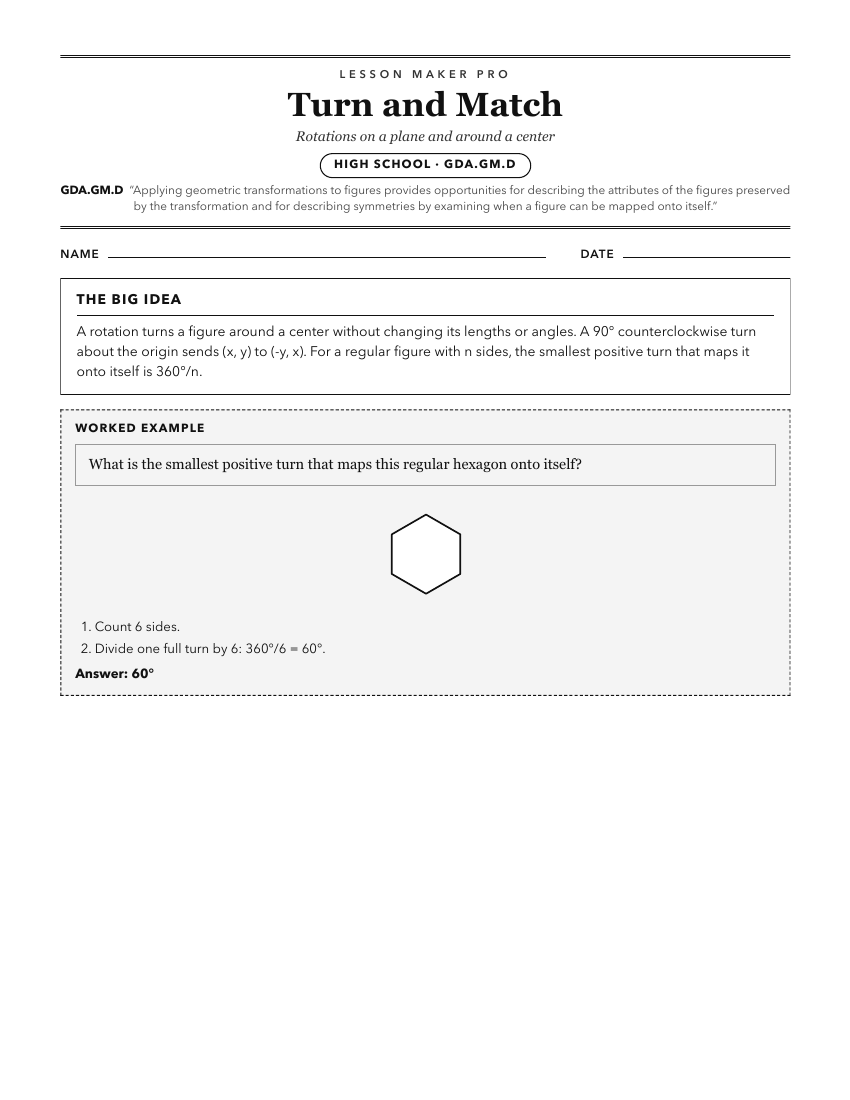
A ready-to-print activity worksheet aligned to GDA.GM.D, with an answer key for the teacher on its own page. No account needed.
PDF, US Letter, prints cleanly in black and white.
Download the worksheetKeep exploring
Related Standards
Turn this cluster into a lesson
Grade, subject, topic, and the complete cluster are prefilled. Create one free, no account needed.
Also for this cluster:Make a WorksheetMake a QuizMake a Sub Lesson