Alabama Math GDA.GM.F.27
The Standard
- GDA.GM.F
- Showing that two figures are similar involves finding a similarity transformation (dilation or composite of a dilation with a rigid motion) or, equivalently, a sequence of similarity transformations that maps one figure onto the other.
Given two figures, determine whether they are similar by identifying a similarity transformation (sequence of rigid motions and dilations) that maps one figure to the other.
2019 Alabama Course of Study: Mathematics
Teacher's field guide
What This Standard Means
What Students Need to Do
- Students match corresponding points on two figures. They test whether a dilation, with slides, turns, or flips as needed, maps one figure onto the other. If it does not, they explain why.
What Mastery Looks Like
- A student names a scale factor and the motions needed to align the figures. They check every corresponding vertex, not just one side or one angle.
Common Misconceptions
- Students may think a turned or flipped figure cannot be similar. They may use different scale factors for width and height, or match the wrong vertices.
How to Assess It
- On a grid, show triangles with vertices (0,0), (2,0), (0,3) and (4,1), (4,5), (-2,1). Ask students to name a dilation and motions that map the first onto the second.
Lesson moves
Ways to Teach It
Give pairs two grid triangles, tracing paper, and rulers; have them test whether one dilation plus any needed slides, turns, or flips aligns the vertices.
Show a 2-by-3 rectangle and a 4-by-5 rectangle; ask, 'Can one scale factor match both pairs of sides? Explain.'
Put triangle pairs on coordinate cards; partners race to name a scale factor and the motions that align corresponding vertices.
Compare a 4-by-6 photo with a 6-by-9 print; mark corresponding corners and show how a dilation maps one onto the other.
Free download
Printable GDA.GM.F.27 Worksheet
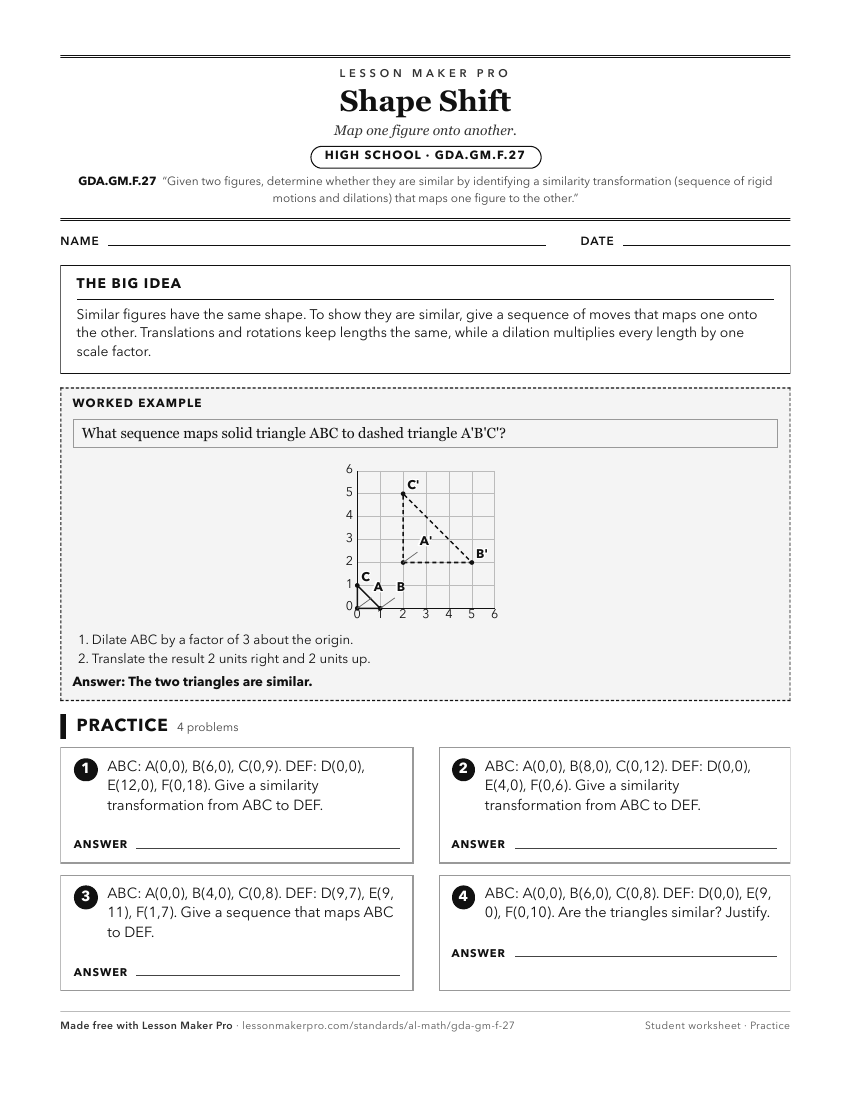
A ready-to-print activity worksheet aligned to GDA.GM.F.27, with an answer key for the teacher on its own page. No account needed.
PDF, US Letter, prints cleanly in black and white.
Download the worksheetKeep exploring
Related Standards
- 8.GM.A.24
Given a pair of two-dimensional figures, determine if a series of dilations and rigid motions maps one figure onto the other, recognizing that if such a sequenc...
- 7A.GM.C.44
Given a pair of two-dimensional figures, determine if a series of dilations and rigid motions maps one figure onto the other, recognizing that if such a sequenc...
- GDA.GM.F
Showing that two figures are similar involves finding a similarity transformation (dilation or composite of a dilation with a rigid motion) or, equivalently, a ...
Turn this exact standard into a lesson
Grade, subject, topic, and the complete standard are prefilled. Create one free, no account needed.
Also for this standard:Make a WorksheetMake a QuizMake a Sub Lesson