Alabama Math 8.GM.A.24
The Standard
- 8.GM.A
- Understand congruence and similarity using physical models or technology.
Given a pair of two-dimensional figures, determine if a series of dilations and rigid motions maps one figure onto the other, recognizing that if such a sequence exists the figures are similar; describe the transformation sequence that exhibits the similarity between them.
2019 Alabama Course of Study: Mathematics · Geometry and Measurement
Teacher's field guide
What This Standard Means
What Students Need to Do
- Students compare matching sides and angles in two figures. They test whether one uniform resize and a sequence of slides, turns, or flips make the figures line up exactly. They describe the steps in order.
What Mastery Looks Like
- Students find one scale factor that works for every matching side. They name the dilation center and factor, then describe the moves needed to line up every vertex. They can explain why unequal side ratios rule out a match.
Common Misconceptions
- Students may call figures similar because they look alike without checking side ratios. They may use different scale factors for different sides or forget a flip when the target has reversed orientation.
How to Assess It
- On a grid, plot triangles A(0,0), B(1,0), C(0,1) and P(3,1), Q(3,3), R(1,1). Name a dilation, rotation, and translation that map A to P, B to Q, and C to R.
Lesson moves
Ways to Teach It
On grid paper, enlarge a 2-by-3 rectangle by factor 2, cut it out, and rotate it onto a 6-by-4 outline.
Show 2-by-3 and 4-by-5 rectangles. Ask, "Can one dilation and some moves make them match? Which lengths prove your answer?"
Give groups four grid-figure pairs, including one mismatch; award points for each correct scale factor, transformation sequence, or side-ratio rejection.
Give students two room plans of a 4 m by 6 m room at 1:100 and 1:50, one rotated; ask how they match.
Free download
Printable 8.GM.A.24 Worksheet
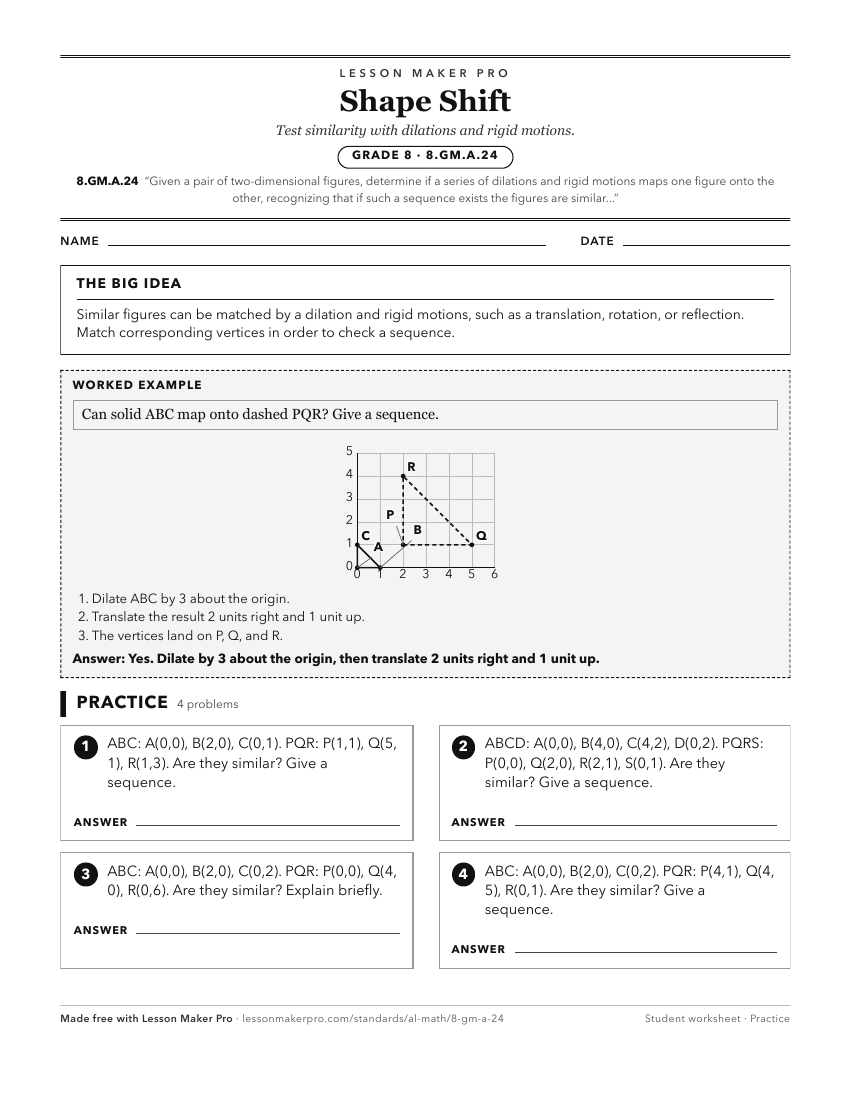
A ready-to-print activity worksheet aligned to 8.GM.A.24, with an answer key for the teacher on its own page. No account needed.
PDF, US Letter, prints cleanly in black and white.
Download the worksheetKeep exploring
Related Standards
- 7A.GM.C.44
Given a pair of two-dimensional figures, determine if a series of dilations and rigid motions maps one figure onto the other, recognizing that if such a sequenc...
- GDA.GM.F.27
Given two figures, determine whether they are similar by identifying a similarity transformation (sequence of rigid motions and dilations) that maps one figure ...
- GDA.GM.F
Showing that two figures are similar involves finding a similarity transformation (dilation or composite of a dilation with a rigid motion) or, equivalently, a ...
Turn this exact standard into a lesson
Grade, subject, topic, and the complete standard are prefilled. Create one free, no account needed.
Also for this standard:Make a WorksheetMake a QuizMake a Sub Lesson