Alabama Math GDA.DSP.B.8
The Standard
- GDA.DSP.B
- Data arise from a context and come in two types: quantitative (continuous or discrete) and categorical. Technology can be used to "clean" and organize data, including very large data sets, into a useful and manageable structure – a first step in any analysis of data
Use technology to organize data, including very large data sets, into a useful and manageable structure.
2019 Alabama Course of Study: Mathematics
Teacher's field guide
What This Standard Means
What Students Need to Do
- Students import a large data file into a spreadsheet. They use headers, formats, sorting, and filters to make the rows easier to find and use.
What Mastery Looks Like
- A student can import thousands of rows without losing records. They can format dates and numbers, filter for a specific question, and keep the original data intact.
Common Misconceptions
- Students may sort one column alone, separating values from their rows. They may treat numbers stored as text as real numbers. Some delete rows when they mean to filter them.
How to Assess It
- Give students a 500-row earthquake CSV. Ask them to import it, freeze the header, and show only earthquakes with a magnitude of 4 or higher without deleting any rows.
Lesson moves
Ways to Teach It
Download the USGS past-month earthquake CSV, import it into Google Sheets, then freeze the header and format the time and magnitude columns.
Show a raw earthquake CSV and a filtered sheet. Ask students to write which one better answers, 'Where did magnitude 4 earthquakes occur?'
Give pairs a 30-row sheet with duplicate IDs and text-formatted magnitudes. Have them find both problems before sorting by magnitude.
Use the USGS data to make a three-column table of time, place, and magnitude for an emergency briefing.
Free download
Printable GDA.DSP.B.8 Worksheet
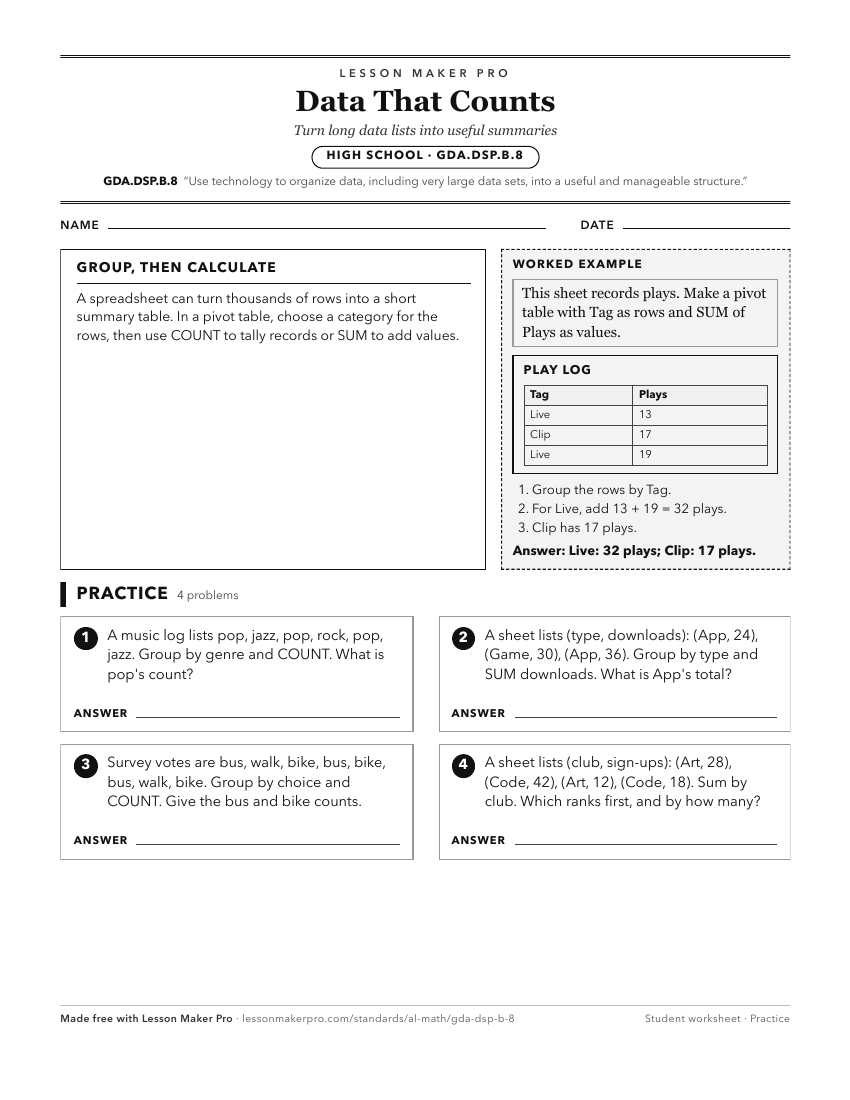
A ready-to-print activity worksheet aligned to GDA.DSP.B.8, with an answer key for the teacher on its own page. No account needed.
PDF, US Letter, prints cleanly in black and white.
Download the worksheetKeep exploring
Related Standards
- GDA.DSP.B
Data arise from a context and come in two types: quantitative (continuous or discrete) and categorical. Technology can be used to "clean" and organize data, inc...
- 8A.DSP.B
Data arise from a context and come in two types: quantitative (continuous or discrete) and categorical. Technology can be used to "clean" and organize data, inc...
- A1P.DSP.C
Data arise from a context and come in two types: quantitative (continuous or discrete) and categorical. Technology can be used to "clean" and organize data, inc...
- 1.DA.A.16
Organize, represent, and interpret data with up to three categories.
Turn this exact standard into a lesson
Grade, subject, topic, and the complete standard are prefilled. Create one free, no account needed.
Also for this standard:Make a WorksheetMake a QuizMake a Sub Lesson