Alabama Math A1P.DSP.C
Standard Cluster
Data arise from a context and come in two types: quantitative (continuous or discrete) and categorical. Technology can be used to “clean” and organize data, including very large data sets, into a useful and manageable structure—a first step in any analysis of data.
2019 Alabama Course of Study: Mathematics · Algebra I With Probability
Cluster contents
Standards in This Cluster
A1P.DSP.C is a cluster heading. These are the individual standards under it.
Teacher's field guide
What This Cluster Means
What Students Need to Do
- Students identify where a data set came from and what each column records. They distinguish labels, counts, and measurements. They use a spreadsheet to find inconsistent labels, duplicate rows, and missing values, then organize the data for analysis.
What Mastery Looks Like
- A student can explain why a zip code is a label, while number of siblings is a count and height is a measurement. They can clean a copy of a spreadsheet, flag missing entries, and sort rows without changing the original data.
Common Misconceptions
- Students may treat every column of numbers as quantitative, including zip codes. They may call all numerical data continuous, or delete blanks and unusual values without checking what they mean.
How to Assess It
- Exit ticket: Classify number of siblings, height, and bus route as a count, measurement, or label. Explain how you would handle 'Bus,' 'bus,' and a blank route entry in a spreadsheet.
Lesson moves
Ways to Teach It
Give pairs a 20-row cafeteria spreadsheet with duplicate rows, inconsistent lunch labels, and missing entries; have them clean a copy.
Ask: Why is a jersey number a label, not a count? Have students write one sentence defending their answer.
Run a card sort with zip code, number of pets, and height; teams place each under label, count, or measurement.
Use a local weather website's seven-day forecast; record high temperatures and weather descriptions, then decide which columns are measurements or labels.
Free download
Printable A1P.DSP.C Worksheet
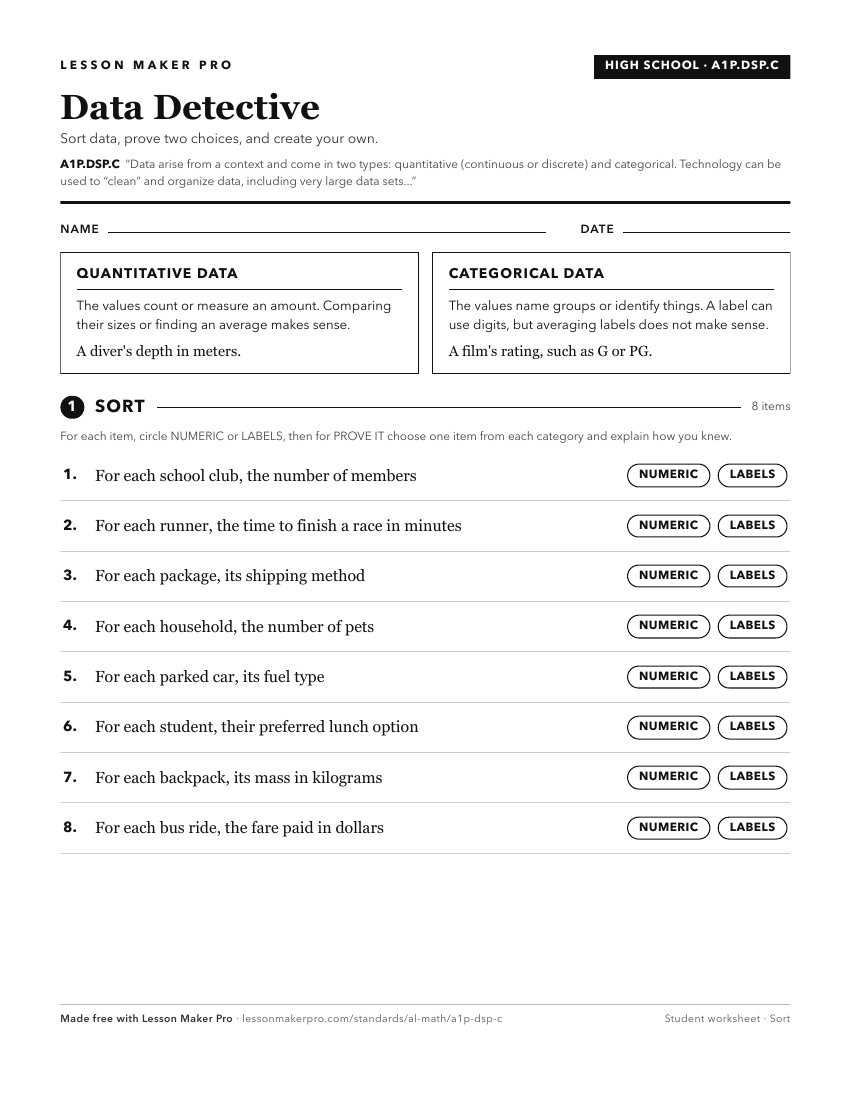
A ready-to-print activity worksheet aligned to A1P.DSP.C, with an answer key for the teacher on its own page. No account needed.
PDF, US Letter, prints cleanly in black and white.
Download the worksheetKeep exploring
Related Standards
- 8A.DSP.B
Data arise from a context and come in two types: quantitative (continuous or discrete) and categorical. Technology can be used to "clean" and organize data, inc...
- GDA.DSP.B
Data arise from a context and come in two types: quantitative (continuous or discrete) and categorical. Technology can be used to "clean" and organize data, inc...
- GDA.DSP.B.8
Use technology to organize data, including very large data sets, into a useful and manageable structure.
- 8A.DSP.B.38
Distinguish between quantitative and categorical data and between the techniques that may be used for analyzing data of these two types.
Turn this cluster into a lesson
Grade, subject, topic, and the complete cluster are prefilled. Create one free, no account needed.
Also for this cluster:Make a WorksheetMake a QuizMake a Sub Lesson