Alabama Math FM.N.A
Standard Cluster
Complex problems can be modeled using vertex and edge graphs and characteristics of the different structures are used to find solutions.
2019 Alabama Course of Study: Mathematics · Applications of Finite Mathematics
Cluster contents
Standards in This Cluster
FM.N.A is a cluster heading. These are the individual standards under it.
- FM.N.A.16
Use vertex and edge graphs to model mathematical situations involving networks.
- FM.N.A.16.a
Identify properties of simple graphs, complete graphs, bipartite graphs, complete bipartite graphs, and trees.
- FM.N.A.17
Solve problems involving networks through investigation and application of existence and nonexistence of Euler paths, Euler circuits, Hamilton paths, and Hamilt...
- FM.N.A.17.a
Develop optimal solutions of application-based problems using existing and student-created algorithms.
- FM.N.A.17.b
Give an argument for graph properties.
- FM.N.A.18
Apply algorithms relating to minimum weight spanning trees, networks, flows, and Steiner trees.
- FM.N.A.18.a
Use shortest path techniques to find optimal shipping routes.
- FM.N.A.18.b
Show that every connected graph has a minimal spanning tree.
- FM.N.A.18.c
Use Kruskal's Algorithm and Prim's Algorithm to determine the minimal spanning tree of a weighted graph.
- FM.N.A.19
Use vertex-coloring, edge-coloring, and matching techniques to solve application-based problems involving conflict.
- FM.N.A.20
Determine the minimum time to complete a project using algorithms to schedule tasks in order, including critical path analysis, the list-processing algorithm, a...
- FM.N.A.21
Use the adjacency matrix of a graph to determine the number of walks of length n in a graph.
Teacher's field guide
What This Cluster Means
What Students Need to Do
- Students turn places and connections into vertices and edges. They use paths and connections to solve route problems and explain what their graph leaves out.
What Mastery Looks Like
- A student can draw a graph from a road list without adding connections that are not there. They can find a route with the fewest roads and identify a road whose closure cuts off a location.
Common Misconceptions
- Students may swap vertices and edges, or treat two crossing lines as a junction. They may assume a line drawn longer on the page represents a longer road, even when no distances are given.
How to Assess It
- Exit ticket: Four sites A, B, C, and D have direct roads AB, BC, CA, and CD. Draw the graph, find the route from A to D using the fewest roads, and explain what happens if CD closes.
Lesson moves
Ways to Teach It
Give pairs four sticky-note locations and string roads AB, BC, CA, and CD; have them build the network and test which closure isolates a site.
Show two differently shaped graphs with the same labeled connections and ask students why their available routes are identical.
Run a route race: give pairs a road list and have them find the fewest-edge path before checking each other's graphs.
Use a school floor plan to mark rooms as vertices and hallways as edges, then find a hallway whose closure blocks access.
Free download
Printable FM.N.A Worksheet
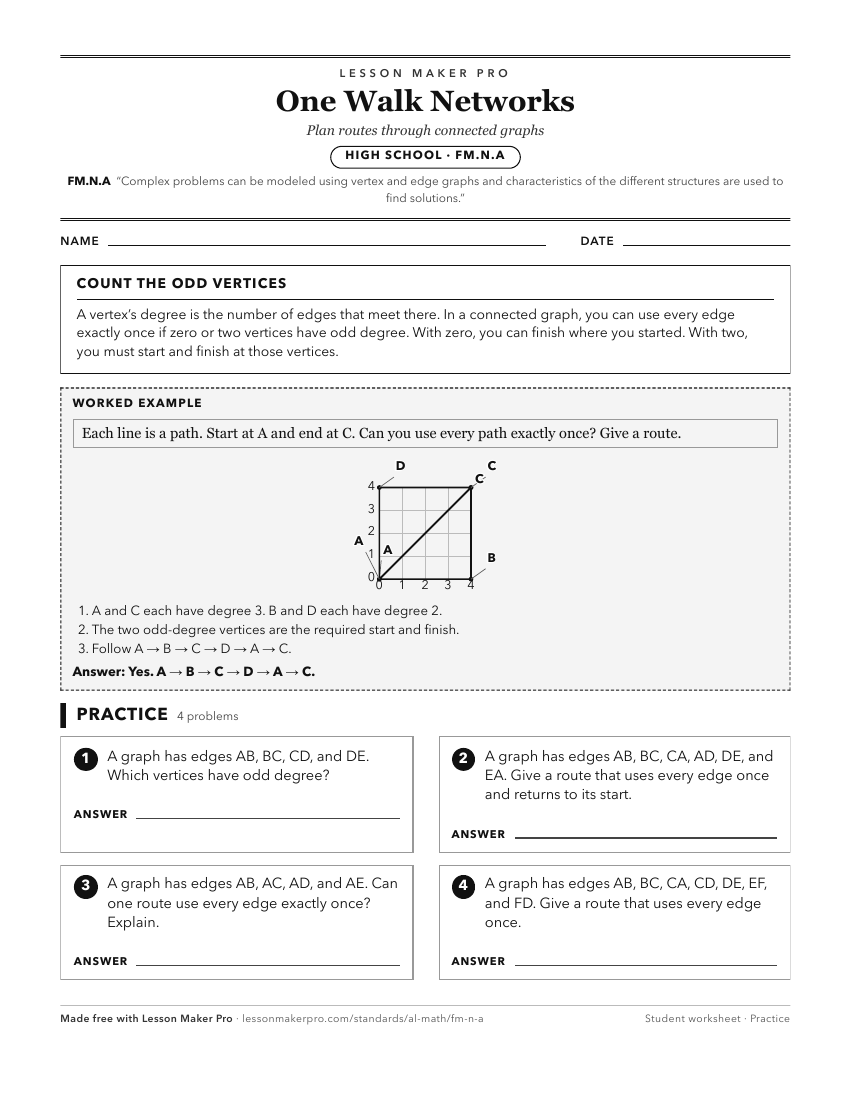
A ready-to-print activity worksheet aligned to FM.N.A, with an answer key for the teacher on its own page. No account needed.
PDF, US Letter, prints cleanly in black and white.
Download the worksheetKeep exploring
Related Standards
Turn this cluster into a lesson
Grade, subject, topic, and the complete cluster are prefilled. Create one free, no account needed.
Also for this cluster:Make a WorksheetMake a QuizMake a Sub Lesson