Alabama Math FM.N.A.16.a
The Standard
- FM.N.A
- Complex problems can be modeled using vertex and edge graphs and characteristics of the different structures are used to find solutions.
- FM.N.A.16
- Use vertex and edge graphs to model mathematical situations involving networks.
Identify properties of simple graphs, complete graphs, bipartite graphs, complete bipartite graphs, and trees.
2019 Alabama Course of Study: Mathematics · Complex problems can be modeled using vertex and edge graphs and characteristics of the different structures are used to find solutions.
Teacher's field guide
What This Standard Means
What Students Need to Do
- Students check diagrams for loops, repeated edges, and whether every pair of vertices is joined. They test whether vertices can split into two groups with edges only between groups, and whether every possible edge between groups is present. They check whether a connected graph has any cycles.
What Mastery Looks Like
- Given a graph, students name every type that fits and point to edges or missing edges as evidence. They can split a bipartite graph into two groups and identify a cycle that rules out a tree.
Common Misconceptions
- Students may call any graph without loops a tree, even if it has a cycle or disconnected pieces. They may call a bipartite graph complete bipartite when edges between the groups are missing. Some assume a graph can have only one label.
How to Assess It
- On an exit ticket, draw a square with edges only along its sides. Ask students which labels fit, simple, complete, bipartite, complete bipartite, or tree, and to explain each choice.
Lesson moves
Ways to Teach It
Give pairs four labeled index cards and string; have them build a tree, then add one string and identify the new cycle.
Show a square with both diagonals and ask, 'Can you split its vertices into two groups with no edges within either group? Why?'
Put a path, triangle, square, square with diagonal, two separate edges, and star on cards; pairs race to label each by type.
Sketch four bus stops connected without cycles; then draw a direct route between every pair and compare route counts.
Free download
Printable FM.N.A.16.a Worksheet
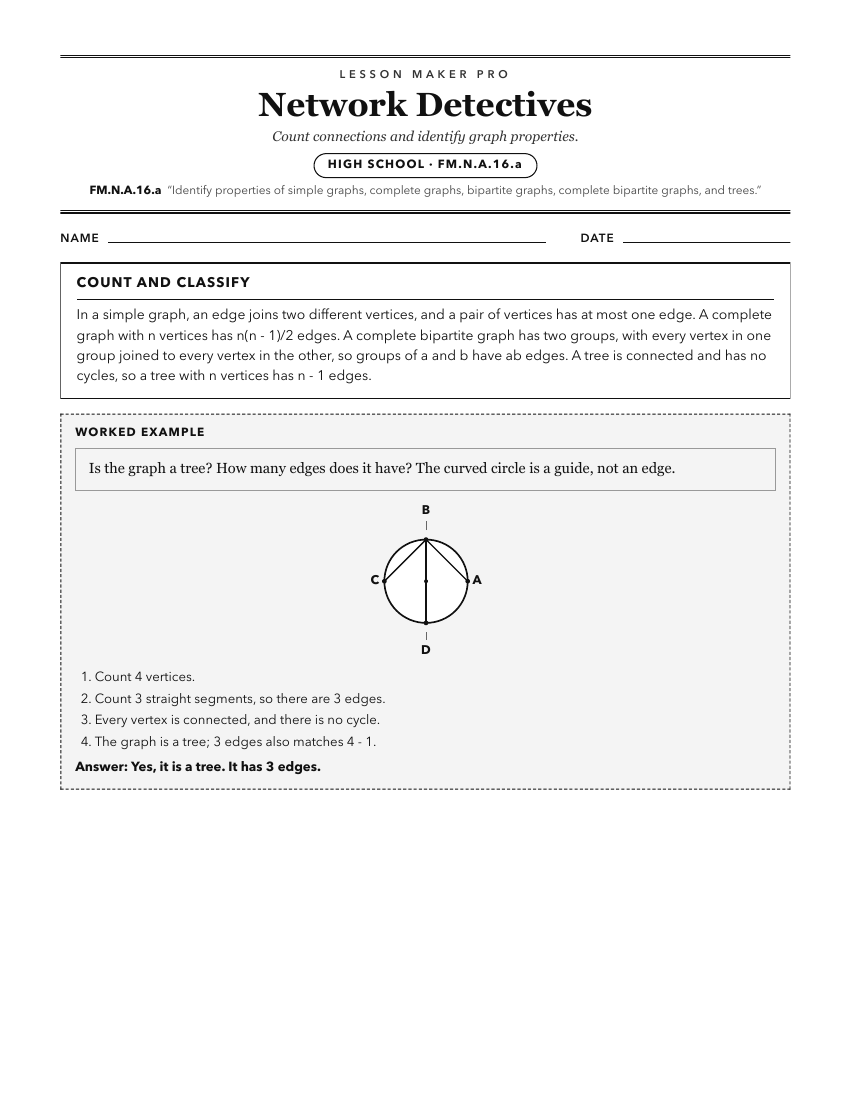
A ready-to-print activity worksheet aligned to FM.N.A.16.a, with an answer key for the teacher on its own page. No account needed.
PDF, US Letter, prints cleanly in black and white.
Download the worksheetKeep exploring
Related Standards
Turn this exact standard into a lesson
Grade, subject, topic, and the complete standard are prefilled. Create one free, no account needed.
Also for this standard:Make a WorksheetMake a QuizMake a Sub Lesson