Alabama Math FM.AC.A
Standard Cluster
Complex counting problems can be solved efficiently using a variety of techniques.
2019 Alabama Course of Study: Mathematics · Applications of Finite Mathematics
Cluster contents
Standards in This Cluster
FM.AC.A is a cluster heading. These are the individual standards under it.
- FM.AC.A.6
Use multiple representations and methods for counting objects and developing more efficient counting techniques. Note: Representations and methods may include t...
- FM.AC.A.7
Develop and use the Fundamental Counting Principle for counting independent and dependent events.
- FM.AC.A.7.a
Use various counting models (including tree diagrams and lists) to identify the distinguishing factors of a context in which the Fundamental Counting Principle ...
- FM.AC.A.8
Using application-based problems, develop formulas for permutations, combinations, and combinations with repetition and compare student-derived formulas to stan...
- FM.AC.A.8.a
Identify differences between applications of combinations and permutations.
- FM.AC.A.8.b
Using application-based problems, calculate the number of permutations of a set with n elements. Calculate the number of permutations of r elements taken from a...
- FM.AC.A.8.c
Using application-based problems, calculate the number of subsets of size r that can be chosen from a set of n elements, explaining this number as the number of...
- FM.AC.A.8.d
Using application-based problems, calculate the number of combinations with repetitions of r elements from a set of n elements as "(n + r – 1) choose r."
- FM.AC.A.9
Use various counting techniques to determine probabilities of events.
- FM.AC.A.10
Use the Pigeonhole Principle to solve counting problems.
Teacher's field guide
What This Cluster Means
What Students Need to Do
- Students count possible outcomes when choices happen in stages or some choices are restricted. They decide whether order matters, split outcomes into cases, or subtract outcomes that do not fit.
What Mastery Looks Like
- A student can count three-person committees that must include at least one named student without listing every committee. They can explain why their method counts each committee once.
Common Misconceptions
- Students may count the same team in different orders, even though the order does not matter. They may also add overlapping cases and count some outcomes twice.
How to Assess It
- A club has six students, including Ana and Ben. How many three-person committees include at least one of them? Show your count and explain how you avoided counting a committee twice.
Lesson moves
Ways to Teach It
Give pairs four name cards; have them list every two-person team and every two-person lineup, then compare the totals.
Ask students to write why choosing a captain and co-captain from six people differs from choosing a two-person team.
Teams race to solve three cards: choose two of five, award gold and silver to two of five, and choose two including Maya.
Use a cafeteria menu with three mains, four sides, and two drinks; count meals with one main, one side, and an optional drink.
Free download
Printable FM.AC.A Worksheet
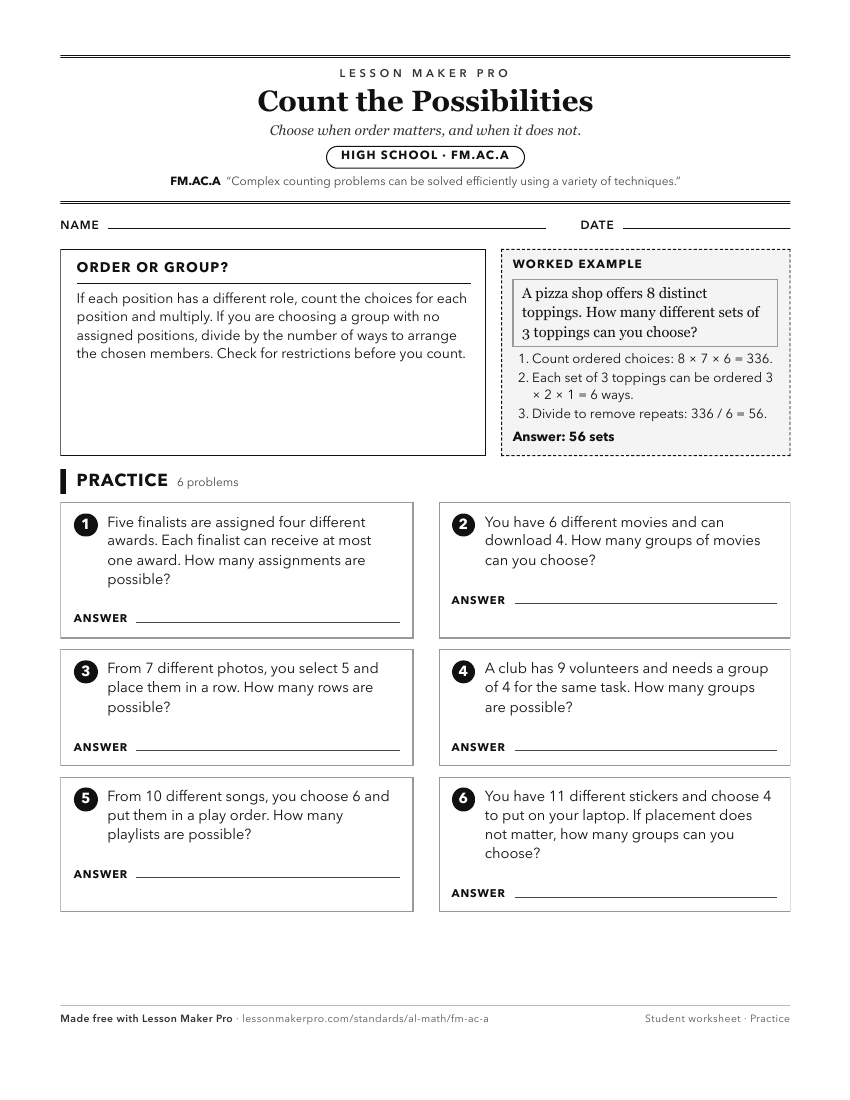
A ready-to-print activity worksheet aligned to FM.AC.A, with an answer key for the teacher on its own page. No account needed.
PDF, US Letter, prints cleanly in black and white.
Download the worksheetTurn this cluster into a lesson
Grade, subject, topic, and the complete cluster are prefilled. Create one free, no account needed.
Also for this cluster:Make a WorksheetMake a QuizMake a Sub Lesson