Alabama Math FM.AC.A.10
The Standard
- FM.AC.A
- Complex counting problems can be solved efficiently using a variety of techniques.
Use the Pigeonhole Principle to solve counting problems.
2019 Alabama Course of Study: Mathematics
Teacher's field guide
What This Standard Means
What Students Need to Do
- Students identify the items being counted and the groups those items can go into. They use the number of groups to show when a shared group is guaranteed.
What Mastery Looks Like
- A student can explain why 13 people guarantee that two share a birth month. They can also show why 25 people guarantee that three share a birth month, but 24 do not.
Common Misconceptions
- Students may treat a shared group as likely rather than certain. They may think 24 people guarantee three in one birth month, overlooking that each month could have exactly two.
How to Assess It
- Exit ticket: A rack has 7 bins. What is the fewest number of balls needed to guarantee that one bin holds 3? Explain your answer.
Lesson moves
Ways to Teach It
Give groups 13 counters and 12 cups; have them distribute the counters any way they want and find a cup holding two.
Ask students to draw how 24 people could be spread across birth months without putting three in any month.
Play a threshold game: name 5 bins and a target of 3; teams race to find the first guaranteed item count.
Sketch a parking lot with 10 rows and ask how many cars guarantee at least 4 cars in one row.
Free download
Printable FM.AC.A.10 Worksheet
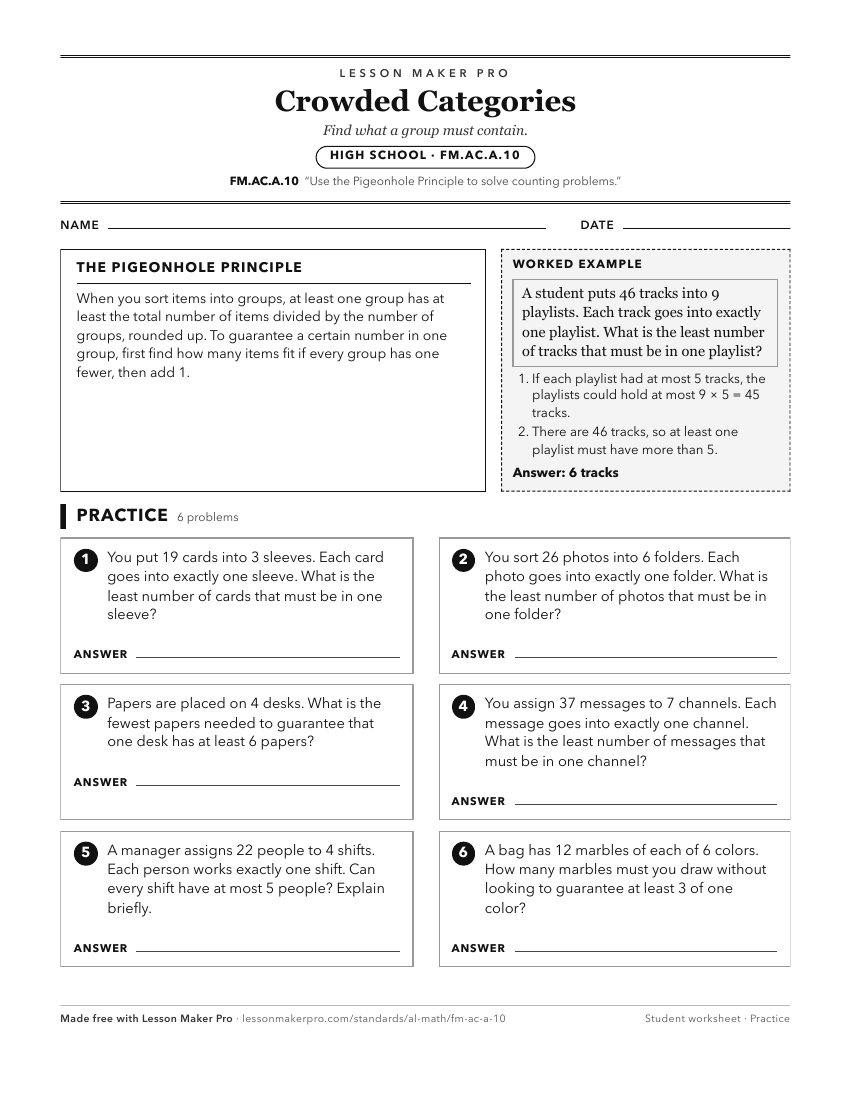
A ready-to-print activity worksheet aligned to FM.AC.A.10, with an answer key for the teacher on its own page. No account needed.
PDF, US Letter, prints cleanly in black and white.
Download the worksheetKeep exploring
Related Standards
- FM.AC.A
Complex counting problems can be solved efficiently using a variety of techniques.
- FM.AC.A.7
Develop and use the Fundamental Counting Principle for counting independent and dependent events.
- FM.AC.A.9
Use various counting techniques to determine probabilities of events.
- FM.AC.A.6
Use multiple representations and methods for counting objects and developing more efficient counting techniques. Note: Representations and methods may include t...
Turn this exact standard into a lesson
Grade, subject, topic, and the complete standard are prefilled. Create one free, no account needed.
Also for this standard:Make a WorksheetMake a QuizMake a Sub Lesson