Alabama Math 7.DSP.C.16
Standard Cluster
- 7.DSP.C
- Investigate probability models.
Find probabilities of simple and compound events through experimentation or simulation and by analyzing the sample space, representing the probabilities as percents, decimals, or fractions. a. Represent sample spaces for compound events using methods such as organized lists, tables, and tree diagrams, and determine the probability of an event by finding the fraction of outcomes in the sample space for which the compound event occurred. b. Design and use a simulation to generate frequencies for compound events. c. Represent events described in everyday language in terms of outcomes in the sample space which composed the event.
2019 Alabama Course of Study: Mathematics · Data Analysis, Statistics, and Probability
Cluster contents
Standards in This Cluster
7.DSP.C.16 is a cluster heading. These are the individual standards under it.
- 7.DSP.C.16.a
Represent sample spaces for compound events using methods such as organized lists, tables, and tree diagrams, and determine the probability of an event by findi...
- 7.DSP.C.16.c
Represent events described in everyday language in terms of outcomes in the sample space which composed the event.
Teacher's field guide
What This Cluster Means
What Students Need to Do
- Students list outcomes for one-step and two-step chance events using tables or tree diagrams. They identify which outcomes match a phrase like “at least one head” and write the probability as a fraction, decimal, or percent. They also use a simulation to estimate probability from trial counts.
What Mastery Looks Like
- For two coin flips, a student lists HH, HT, TH, and TT. They find that “at least one head” has a probability of 3/4, 0.75, or 75%. They know a short simulation may give a different result.
Common Misconceptions
- Students may count HT and TH as one outcome. They may assume every event they can name is equally likely. Some expect a short simulation to match the calculated probability exactly.
How to Assess It
- Exit ticket: Flip a coin and roll a die. List all possible outcomes, then find the probability of heads and an even number as a fraction, decimal, and percent.
Lesson moves
Ways to Teach It
Build two spinners labeled H/T and 1–6; run 30 trials and tally how often heads and an even number occur.
Ask students to write which two-coin outcomes fit “at least one head,” then explain why HT and TH count separately.
Make a six-by-six table for two dice, then play “sum of 7” versus “doubles” and predict which wins more often.
Use a café menu with two sandwiches and three drinks; list meal pairs and find the chance of getting water if each pair is equally likely.
Free download
Printable 7.DSP.C.16 Worksheet
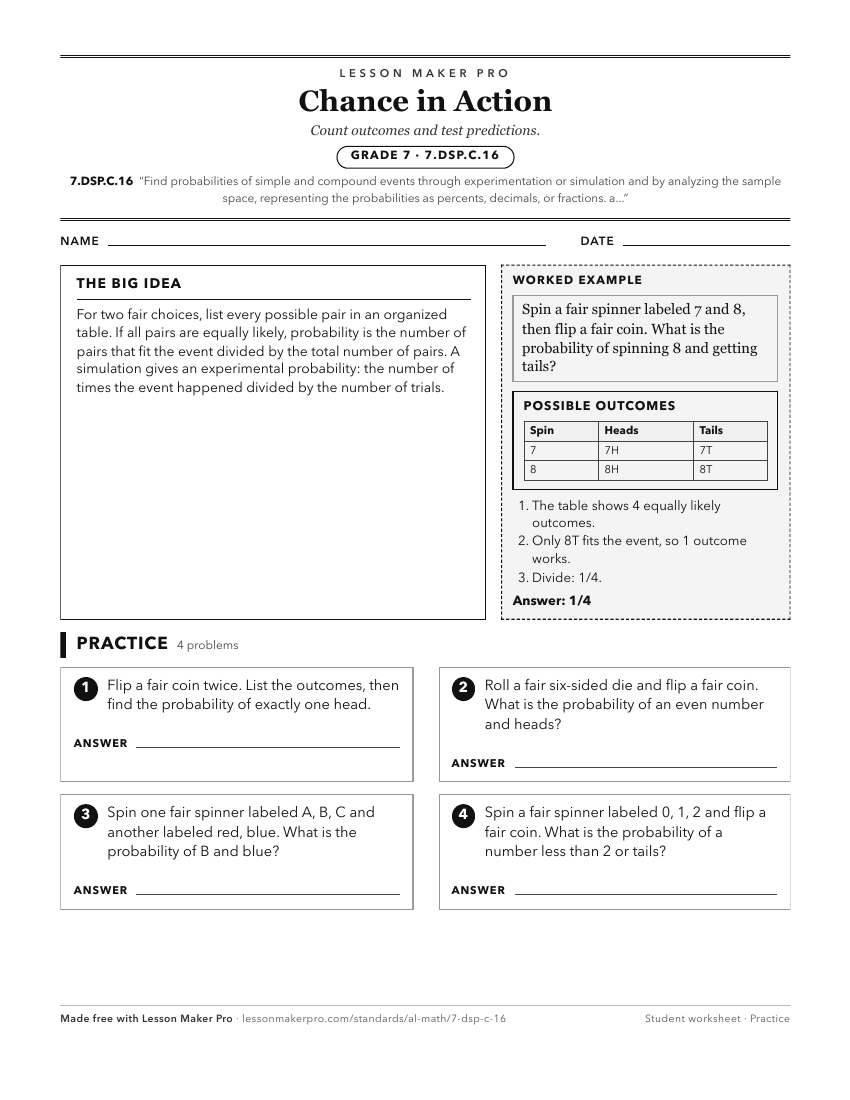
A ready-to-print activity worksheet aligned to 7.DSP.C.16, with an answer key for the teacher on its own page. No account needed.
PDF, US Letter, prints cleanly in black and white.
Download the worksheetKeep exploring
Related Standards
- 7A.DSP.C.32
Find probabilities of simple and compound events through experimentation or simulation and by analyzing the sample space, representing the probabilities as perc...
- 7A.DSP.C.32.a
Represent sample spaces for compound events using methods such as organized lists, tables, and tree diagrams, and determine the probability of an event by findi...
- FM.AC.A.9
Use various counting techniques to determine probabilities of events.
Turn this cluster into a lesson
Grade, subject, topic, and the complete cluster are prefilled. Create one free, no account needed.
Also for this cluster:Make a WorksheetMake a QuizMake a Sub Lesson