Alabama Math 7.DSP.C.16.c
The Standard
- 7.DSP.C
- Investigate probability models.
- 7.DSP.C.16
- Find probabilities of simple and compound events through experimentation or simulation and by analyzing the sample space, representing the probabilities as percents, decimals, or fractions.
Represent events described in everyday language in terms of outcomes in the sample space which composed the event.
2019 Alabama Course of Study: Mathematics
Teacher's field guide
What This Standard Means
What Students Need to Do
- Students list all possible outcomes for a chance situation. Then they name which outcomes match a phrase such as “at least one head” or “a number greater than 4.”
What Mastery Looks Like
- For two coin flips, a student lists HH, HT, TH, and TT. They identify HH, HT, and TH as the outcomes with at least one head and explain why TT is left out.
Common Misconceptions
- Students may read “at least one” as “exactly one” and leave out HH. They may also treat HT and TH as the same outcome when the order of the flips matters.
How to Assess It
- Exit ticket: Flip a coin twice. List every possible outcome, then circle the outcomes that have at least one tail.
Lesson moves
Ways to Teach It
Use two H/T paper disks labeled first and second to make all outcomes, then circle those with at least one head.
Have students write why HT and TH count for exactly one head, but HH does not.
Give pairs die event cards, such as “greater than 4,” and have them race to list the matching faces.
Put tickets numbered 1 to 10 in a bag and ask which tickets win if an even number is drawn.
Free download
Printable 7.DSP.C.16.c Worksheet
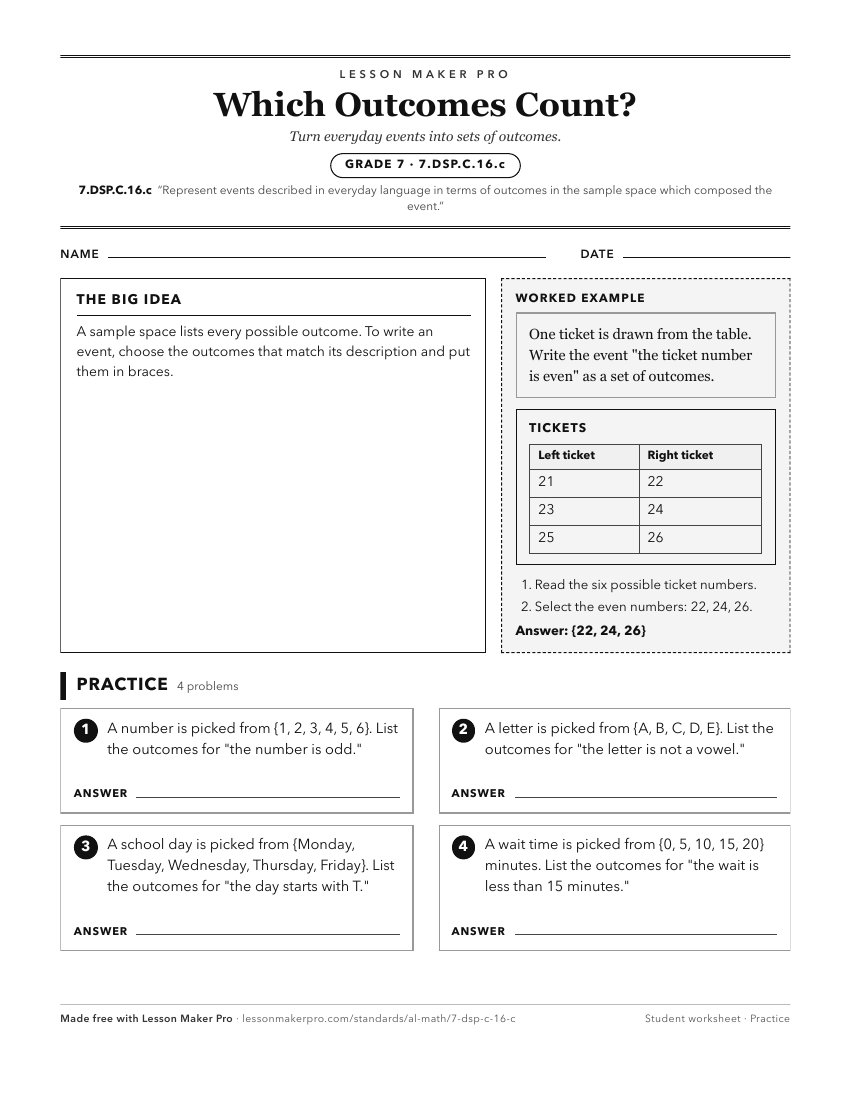
A ready-to-print activity worksheet aligned to 7.DSP.C.16.c, with an answer key for the teacher on its own page. No account needed.
PDF, US Letter, prints cleanly in black and white.
Download the worksheetKeep exploring
Related Standards
- 7A.DSP.C.32.c
Represent events described in everyday language in terms of outcomes in the sample space which composed the event.
- 7A.DSP.C.32.a
Represent sample spaces for compound events using methods such as organized lists, tables, and tree diagrams, and determine the probability of an event by findi...
Turn this exact standard into a lesson
Grade, subject, topic, and the complete standard are prefilled. Create one free, no account needed.
Also for this standard:Make a WorksheetMake a QuizMake a Sub Lesson