Alabama Math 7A.DSP.C.32
Standard Cluster
- 7A.DSP.C
- Investigate probability models.
Find probabilities of simple and compound events through experimentation or simulation and by analyzing the sample space, representing the probabilities as percents, decimals, or fractions. a. Represent sample spaces for compound events using methods such as organized lists, tables, and tree diagrams, and determine the probability of an event by finding the fraction of outcomes in the sample space for which the compound event occurred. b. Design and use a simulation to generate frequencies for compound events. c. Represent events described in everyday language in terms of outcomes in the sample space which composed the event.
2019 Alabama Course of Study: Mathematics
Cluster contents
Standards in This Cluster
7A.DSP.C.32 is a cluster heading. These are the individual standards under it.
- 7A.DSP.C.32.a
Represent sample spaces for compound events using methods such as organized lists, tables, and tree diagrams, and determine the probability of an event by findi...
- 7A.DSP.C.32.c
Represent events described in everyday language in terms of outcomes in the sample space which composed the event.
Teacher's field guide
What This Cluster Means
What Students Need to Do
- Students list possible results of single and combined chance events using lists, tables, or tree diagrams. They match phrases such as “heads and even” to specific outcomes. They find probabilities from the outcomes or from trial results and write them as fractions, decimals, and percents.
What Mastery Looks Like
- A student lists all 12 coin-and-die outcomes and marks the three with heads and an even number. They find 3/12 = 1/4 = 0.25 = 25% and explain why 40 trials might give a different percentage.
Common Misconceptions
- Students may count the outcomes they want but forget to count every possible outcome. They may treat “or” as “and,” or expect a short simulation to match the calculated probability exactly.
How to Assess It
- Draw a coin-and-die outcome table. Circle outcomes with tails or an even roll, then give their probability as a fraction, decimal, and percent.
Lesson moves
Ways to Teach It
In pairs, flip a coin and roll a die 40 times, tally heads with an even roll, and compare the tally to 3/12.
Write which coin-and-die outcomes fit “heads or a roll above 4,” then explain whether an outcome can fit both parts.
Give pairs coin-and-die event cards to solve using a 12-outcome table, then check each fraction, decimal, and percent.
List lunches made from turkey or cheese sandwiches and apple, carrots, or chips; find the chance of turkey with apple if all lunches are equally likely.
Free download
Printable 7A.DSP.C.32 Worksheet
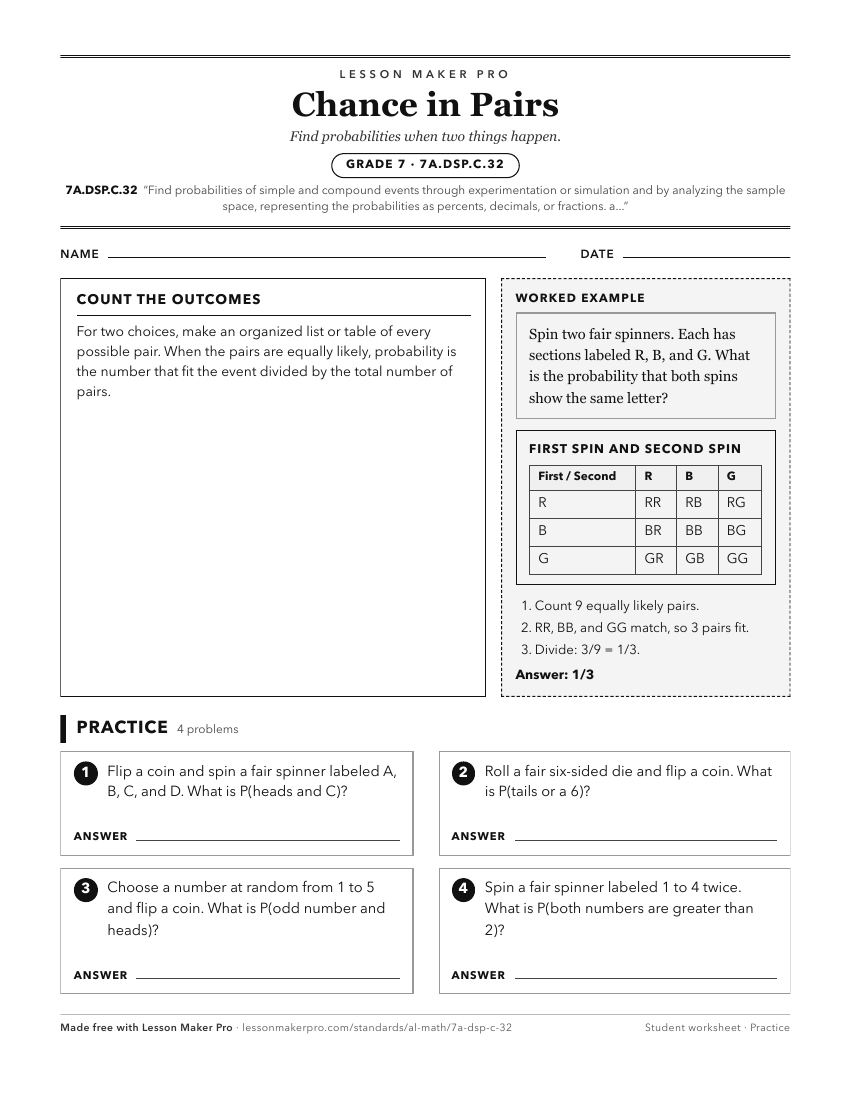
A ready-to-print activity worksheet aligned to 7A.DSP.C.32, with an answer key for the teacher on its own page. No account needed.
PDF, US Letter, prints cleanly in black and white.
Download the worksheetKeep exploring
Related Standards
- 7.DSP.C.16
Find probabilities of simple and compound events through experimentation or simulation and by analyzing the sample space, representing the probabilities as perc...
- 7.DSP.C.16.a
Represent sample spaces for compound events using methods such as organized lists, tables, and tree diagrams, and determine the probability of an event by findi...
- FM.AC.A.9
Use various counting techniques to determine probabilities of events.
Turn this cluster into a lesson
Grade, subject, topic, and the complete cluster are prefilled. Create one free, no account needed.
Also for this cluster:Make a WorksheetMake a QuizMake a Sub Lesson