Alabama Math 7.DSP.C.13
The Standard
- 7.DSP.C
- Investigate probability models.
Use a number from 0 to 1 to represent the probability of a chance event occurring, explaining that larger numbers indicate greater likelihood of the event occurring, while a number near zero indicates an unlikely event.
2019 Alabama Course of Study: Mathematics · Data Analysis, Statistics, and Probability
Teacher's field guide
What This Standard Means
What Students Need to Do
- Students use numbers from 0 to 1 to describe how likely an event is. They compare those numbers and explain which event is more likely.
What Mastery Looks Like
- A student can label an impossible event 0 and a certain event 1. They can explain why a chance of 0.8 is greater than a chance of 0.2.
Common Misconceptions
- Students may think 0 means very unlikely rather than impossible, or 1 means very likely rather than certain. Some compare the digits in 0.8 and 0.25 instead of comparing the values.
How to Assess It
- A bag holds one red marble and three blue marbles. Ask students to write the chance of drawing each color as a number from 0 to 1 and explain which is more likely.
Lesson moves
Ways to Teach It
Put one red and three blue counters in a cup; students draw, replace, and label each color's chance with a fraction.
Ask students to explain whether a chance of 0.1 is closer to impossible or certain.
Pairs match rolling a 7, rolling an even number, and rolling 1 through 6 on one die to 0, 0.5, and 1.
Show forecasts of 20% and 80% rain; students write each chance as a decimal and choose which day needs an umbrella.
Free download
Printable 7.DSP.C.13 Worksheet
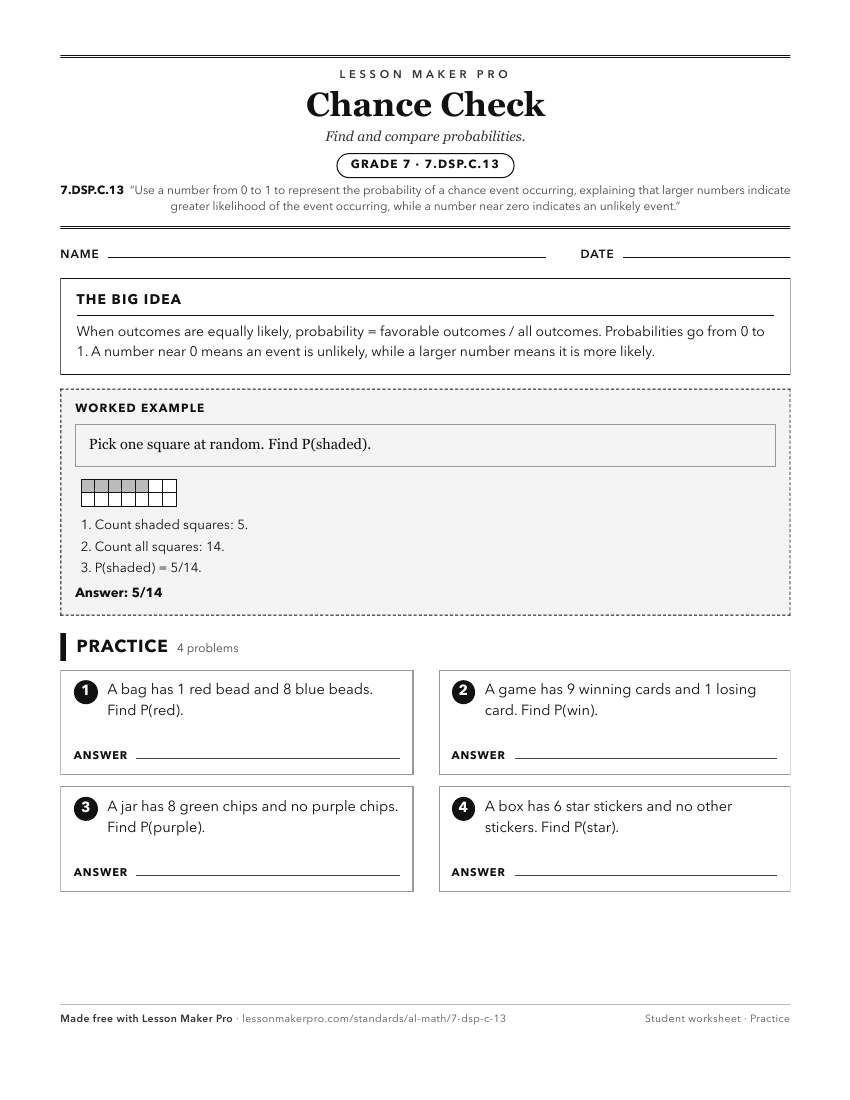
A ready-to-print activity worksheet aligned to 7.DSP.C.13, with an answer key for the teacher on its own page. No account needed.
PDF, US Letter, prints cleanly in black and white.
Download the worksheetKeep exploring
Related Standards
- 7A.DSP.C.29
Use a number between 0 and 1 to represent the probability of a chance event occurring, explaining that larger numbers indicate greater likelihood of the event o...
- 7.DSP.C.16
Find probabilities of simple and compound events through experimentation or simulation and by analyzing the sample space, representing the probabilities as perc...
- 7A.DSP.C.32
Find probabilities of simple and compound events through experimentation or simulation and by analyzing the sample space, representing the probabilities as perc...
- FM.AC.A.9
Use various counting techniques to determine probabilities of events.
Turn this exact standard into a lesson
Grade, subject, topic, and the complete standard are prefilled. Create one free, no account needed.
Also for this standard:Make a WorksheetMake a QuizMake a Sub Lesson