Alabama ELA 8.CL.1
The Standard
Analyze how informational and graphic text elements, including allusions, point of view, purpose, comparisons, categories, and figurative, connotative, and technical word meanings, develop central and supporting ideas.
2021 Alabama Course of Study: English Language Arts
Teacher's field guide
What This Standard Means
What Students Need to Do
- Students find the main idea of an article or infographic and the details that support it. They explain how graphics, comparisons, categories, allusions, and word choices shape those ideas. They also consider the writer's viewpoint and purpose.
What Mastery Looks Like
- A student can point to a graph or heading and explain what it adds to a claim. They can explain how a comparison, allusion, or figurative or technical term affects the reader's understanding, using evidence from the text.
Common Misconceptions
- Students may treat a chart as decoration instead of evidence. They may confuse the writer's viewpoint with the topic, or read an allusion or figurative phrase literally. They may give a technical word its everyday meaning.
How to Assess It
- Write on the board: 'Our cafeteria should cut food waste.' Draw bars labeled 'Apples: 30' and 'Milk cartons: 5,' then ask students how the graph supports the claim.
Lesson moves
Ways to Teach It
Give pairs an article on cafeteria waste and a bar graph; have them tape a graph detail beside the claim it supports.
Compare 'students squander food' with 'students discard lunches'; ask which headline sounds more critical and what purpose that wording serves.
Give teams cafeteria data cards to sort under 'food,' 'cost,' and 'waste'; ask which category best supports a plan to reduce waste.
Bring a grocery flyer with category headings and price comparisons; have students explain which products the layout makes seem like bargains.
Free download
Printable 8.CL.1 Worksheet
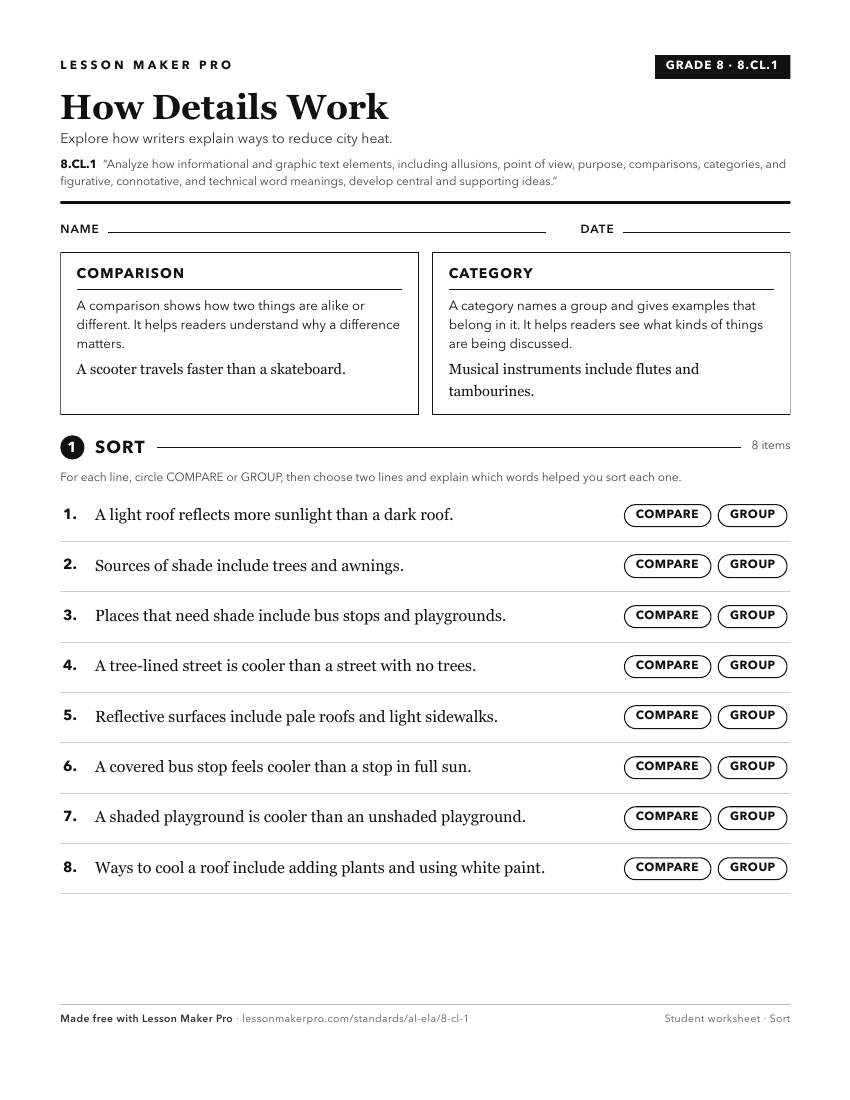
A ready-to-print activity worksheet aligned to 8.CL.1, with an answer key for the teacher on its own page. No account needed.
PDF, US Letter, prints cleanly in black and white.
Download the worksheetKeep exploring
Related Standards
- 7.CL.1
Evaluate the contributions of informational text elements, including categories, point of view, purpose, and figurative, connotative, and technical word meaning...
- 6.CL.1
Identify and explain an author's rhetorical choices, including point of view, purpose, anecdotes, and figurative, connotative, and technical word meanings, to d...
- 9.CL.4
Analyze how authors use characterization, connotation, denotation, figurative language, literary elements, and point of view to create and convey meaning in a v...
- 4.LF.23
Evaluate how text features and structures contribute to the meaning of an informational text.
Turn this exact standard into a lesson
Grade, subject, topic, and the complete standard are prefilled. Create one free, no account needed.
Also for this standard:Make a WorksheetMake a QuizMake a Sub Lesson