Alabama ELA 4.LF.25
The Standard
Explain how the form of a poem contributes to its meaning.
2021 Alabama Course of Study: English Language Arts · Literacy Foundations 4-5
Teacher's field guide
What This Standard Means
What Students Need to Do
- Students notice line breaks, stanzas, and repeated words or sounds. They explain how one of those choices affects what a reader feels or notices.
What Mastery Looks Like
- A student points to a short line or repeated phrase and explains its effect. They use words from the poem to back up their answer.
Common Misconceptions
- Students may count rhymes without explaining what the rhymes do. They may treat every line break as the end of a sentence, even when the thought continues.
How to Assess It
- Write 'Rain taps / rain taps / rain taps / stop' on the board. Ask: How does repeating one line change the way the last line feels?
Lesson moves
Ways to Teach It
Give pairs word cards for 'Rain taps rain taps rain taps stop'; have them arrange two line layouts and read each aloud.
Read a poem with 'wait' alone on a line, then ask: Why might the poet leave that word by itself?
Display 'Go / go / go / STOP'; have teams point to one break and explain what it makes them notice.
Put 'The bus is late / I wait / and wait' on a pretend bus stop sign; ask how the lines stretch the wait.
Free download
Printable 4.LF.25 Worksheet
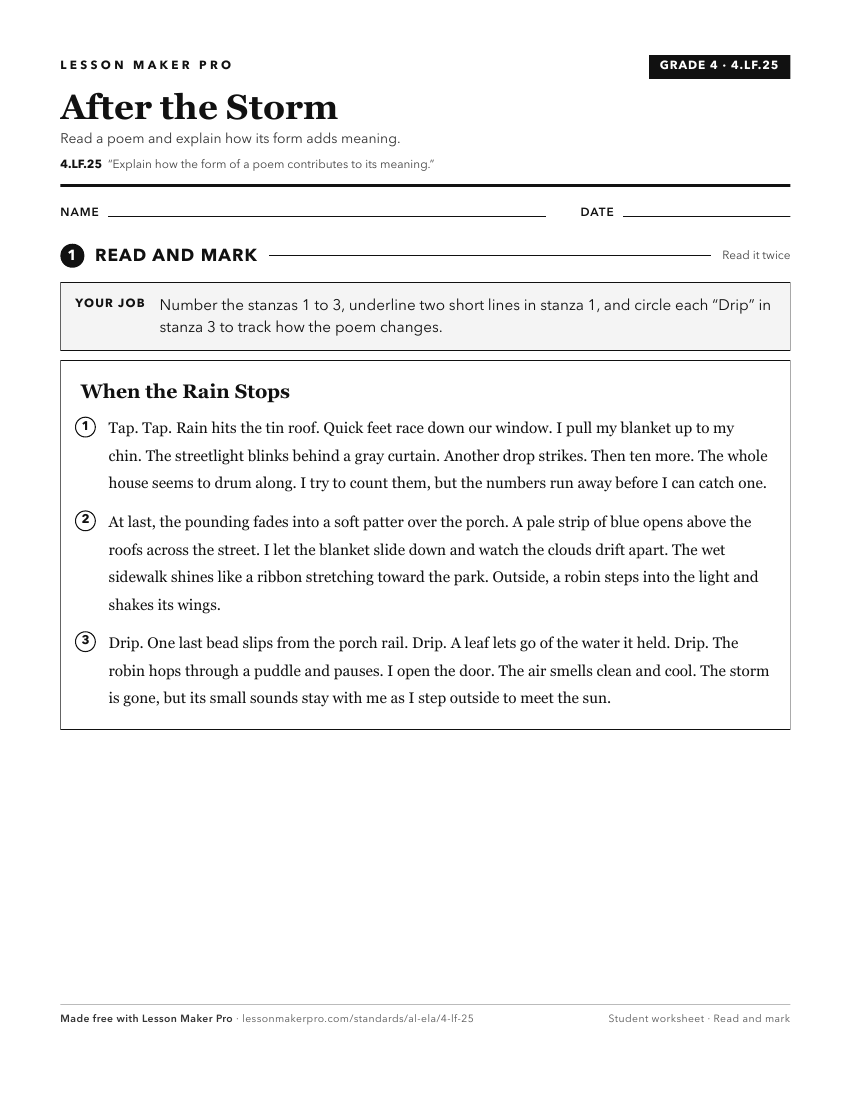
A ready-to-print activity worksheet aligned to 4.LF.25, with an answer key for the teacher on its own page. No account needed.
PDF, US Letter, prints cleanly in black and white.
Download the worksheetKeep exploring
Related Standards
- 4.LF.26
Analyze how rhythm and rhyme in poetry contribute to meaning.
- 4.LF.10.a
Explain how specific word choices shape meaning or tone.
- 7.CL.3
Explain how the author's choice of setting, plot, characters, theme, conflict, dialogue, and point of view contribute to and/or enhance the meaning and purpose ...
- 4.LF.10.b
Explain how figurative language contributes to the meaning of text, including simile, metaphor, alliteration, personification, hyperbole, and idioms.
Turn this exact standard into a lesson
Grade, subject, topic, and the complete standard are prefilled. Create one free, no account needed.
Also for this standard:Make a WorksheetMake a QuizMake a Sub Lesson