Alabama ELA 4.LF.26
The Standard
Analyze how rhythm and rhyme in poetry contribute to meaning.
2021 Alabama Course of Study: English Language Arts · Literacy Foundations 4-5
Teacher's field guide
What This Standard Means
What Students Need to Do
- Students find rhyming words and listen for the beat in a poem. They explain how those sounds affect the poem's mood or help show what is happening.
What Mastery Looks Like
- A student can circle rhyming words and tap a line's beat. They can explain why a quick beat makes raindrops seem lively or a slow beat makes a scene feel calm.
Common Misconceptions
- Students may think words rhyme because they have the same last letters, even when they sound different. They may notice a rhyme but not explain what it adds to the poem.
How to Assess It
- Give students these lines: “Drip, drop, raindrops hop. / Plip, plop, puddles pop.” Ask them to circle the rhyme, tap the beat, and explain how both make the rain feel.
Lesson moves
Ways to Teach It
Give pairs the rain lines from the exit ticket; have them tap the beat with pencils, circle hop and pop, and describe the rain.
Ask: How would the rain feel different if the poet replaced “hop” and “pop” with “creep” and “sleep”?
Play rhyme swap: teams write two new rhyming verbs for the rain lines, then read their version aloud and explain its mood.
Have students write a two-line crosswalk chant with a steady beat and end rhyme, then explain how its sound helps others remember the rule.
Free download
Printable 4.LF.26 Worksheet
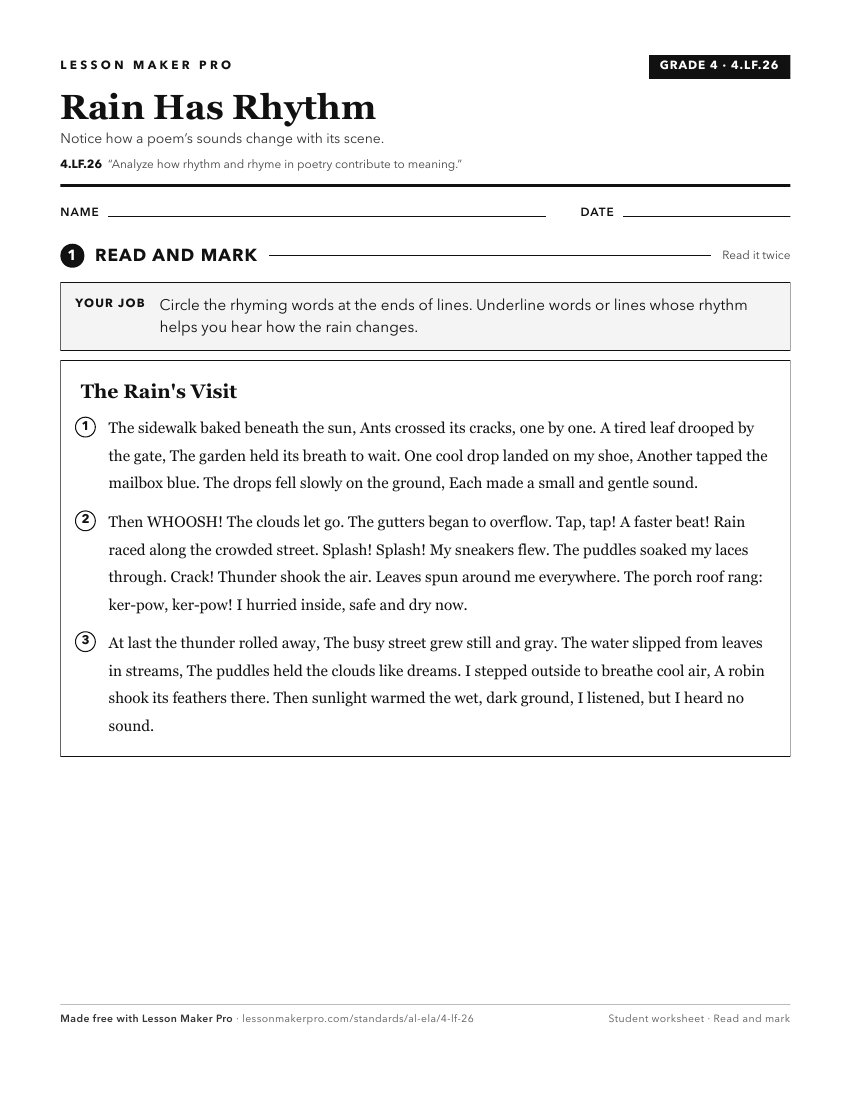
A ready-to-print activity worksheet aligned to 4.LF.26, with an answer key for the teacher on its own page. No account needed.
PDF, US Letter, prints cleanly in black and white.
Download the worksheetKeep exploring
Related Standards
- 4.LF.25
Explain how the form of a poem contributes to its meaning.
- 1.LF.9.c
Participate in poetry reading, noticing phrasing, rhythm, and rhyme.
- 11.CL.4
Analyze how an author uses characterization, figurative language, literary elements, and point of view to create and convey meaning.
- 2.LF.32
Identify rhyme schemes in poems or songs.
Turn this exact standard into a lesson
Grade, subject, topic, and the complete standard are prefilled. Create one free, no account needed.
Also for this standard:Make a WorksheetMake a QuizMake a Sub Lesson