Alabama ELA 3.LF.8
Standard Cluster
Apply knowledge of phoneme-grapheme correspondences, multisyllabic word construction, and syllable division principles to decode and encode (spell) words accurately in isolation and in context. a. Decode multisyllabic words with common syllable patterns, including open/closed, vowel-r, vowel-consonant-e, vowel teams, consonant-le, and odd or schwa syllables. b. Apply knowledge of multisyllabic word construction and syllable division principles to decode grade-appropriate multisyllabic words. c. Decode and encode words with three-consonant blends, digraphs, trigraphs, quadrigraph eigh, combinations, diphthongs, and silent letter combinations. d. Decode and encode words with graphemes that represent multiple sound-symbol correspondences by applying knowledge of most common to least common frequency. e. Decode and encode multisyllabic words using knowledge of stress or accent to pronounce a word correctly, including the schwa sound when appropriate. f. Decode and encode words using knowledge of the morphological structure of a word, including prefixes, suffixes, and roots. g. Decode and encode contractions with am, is, has, not, have, would, and will. h. Decode and encode frequently confused homophones accurately using knowledge of English and meaning to facilitate learning. i. Decode and encode words with hard and soft c and g. j. Decode and encode grade-appropriate high frequency words that follow regular and irregular phoneme-grapheme correspondences, using knowledge of the specific sound-symbol correspondences that are irregular.
2021 Alabama Course of Study: English Language Arts · Literacy Foundations K-3
Cluster contents
Standards in This Cluster
3.LF.8 is a cluster heading. These are the individual standards under it.
- 3.LF.8.a
Decode multisyllabic words with common syllable patterns, including open/closed, vowel-r, vowel-consonant-e, vowel teams, consonant-le, and odd or schwa syllabl...
- 3.LF.8.b
Apply knowledge of multisyllabic word construction and syllable division principles to decode grade-appropriate multisyllabic words.
- 3.LF.8.c
Decode and encode words with three-consonant blends, digraphs, trigraphs, quadrigraph eigh, combinations, diphthongs, and silent letter combinations.
- 3.LF.8.d
Decode and encode words with graphemes that represent multiple sound-symbol correspondences by applying knowledge of most common to least common frequency.
- 3.LF.8.e
Decode and encode multisyllabic words using knowledge of stress or accent to pronounce a word correctly, including the schwa sound when appropriate.
- 3.LF.8.f
Decode and encode words using knowledge of the morphological structure of a word, including prefixes, suffixes, and roots.
- 3.LF.8.g
Decode and encode contractions with am, is, has, not, have, would, and will.
- 3.LF.8.h
Decode and encode frequently confused homophones accurately using knowledge of English and meaning to facilitate learning.
- 3.LF.8.i
Decode and encode words with hard and soft c and g.
- 3.LF.8.j
Decode and encode grade-appropriate high frequency words that follow regular and irregular phoneme-grapheme correspondences, using knowledge of the specific sou...
Teacher's field guide
What This Cluster Means
What Students Need to Do
- Students break longer words into syllables and use spelling patterns, word parts, and stress to read them. They spell words in sentences, including contractions, homophones, and common words with unexpected spellings.
What Mastery Looks Like
- A student can mark the parts in replay, candle, and about, then read and spell each word. They choose there, their, or they're by meaning and explain why g sounds different in gentle and goat.
Common Misconceptions
- Students may split candle as can-dle and pronounce the final e. They may stress the first syllable of about or use a hard g in gentle. They may spell said as sed or write their when they mean there.
How to Assess It
- Dictate, “The gentle giant can't carry eight boxes.” Have students write it, read it aloud, and mark the syllable break in gentle.
Lesson moves
Ways to Teach It
Use letter tiles to build replay, basket, candle, and about; mark syllable breaks, underline the stressed syllable, then read and spell each.
Ask why c sounds different in city and cap. Have pairs point to the next letter and write the rule they notice.
Play a sentence-card relay: choose their, there, or they're for each blank, then expand can't, she's, and we'll on the back.
Write a grocery list for eight apples, six bananas, and two potatoes; mark syllable breaks, then check spelling against a store flyer.
Free download
Printable 3.LF.8 Worksheet
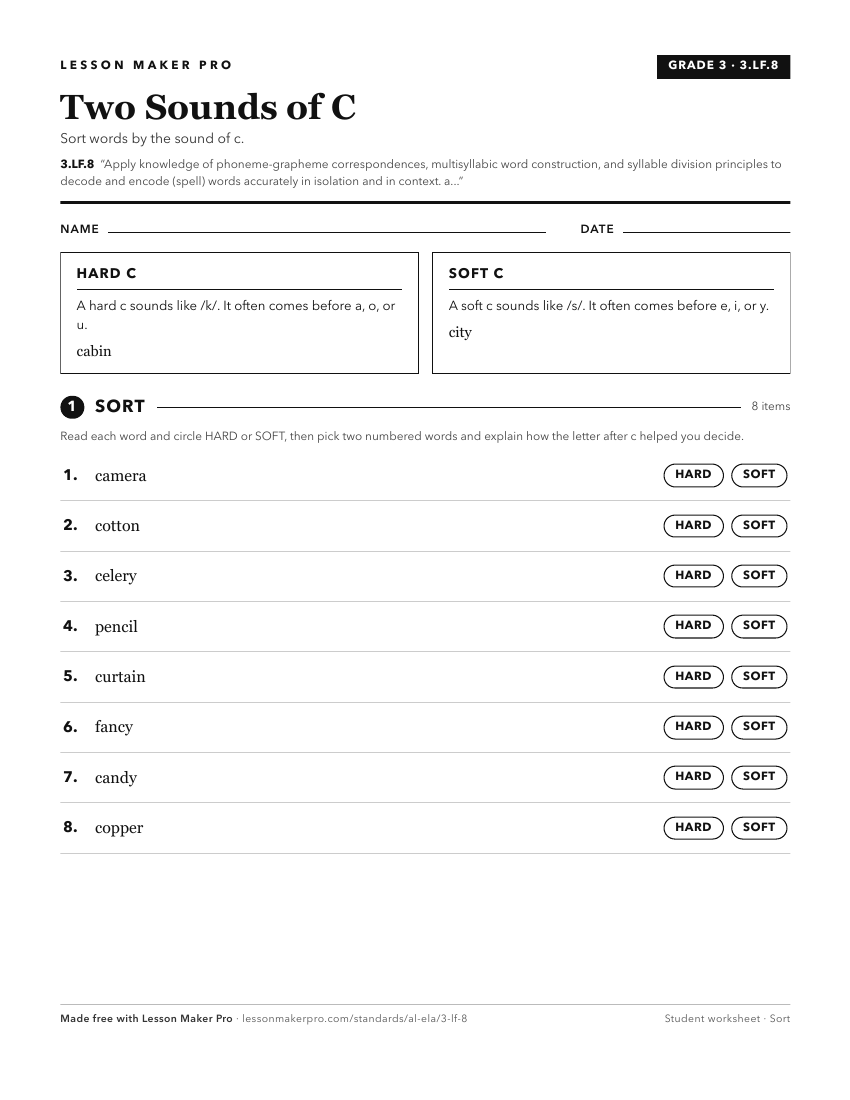
A ready-to-print activity worksheet aligned to 3.LF.8, with an answer key for the teacher on its own page. No account needed.
PDF, US Letter, prints cleanly in black and white.
Download the worksheetKeep exploring
Related Standards
- 2.LF.10
Apply knowledge of phoneme-grapheme correspondences, multisyllabic word construction, and syllable division principles to decode and encode (spell) words accura...
- 2.LF.38
Apply knowledge of grade-appropriate phoneme-grapheme correspondences, multisyllabic word construction, syllable division principles, and spelling rules (or gen...
- 3.LF.32
Apply knowledge of grade-appropriate phoneme-grapheme correspondences, multisyllabic word construction, syllable division rules, and spelling rules (or generali...
- K.LF.10
Apply knowledge of phoneme-grapheme correspondences and word-analysis skills to decode and encode (spell) words accurately in both isolation and in decodable, g...
Turn this cluster into a lesson
Grade, subject, topic, and the complete cluster are prefilled. Create one free, no account needed.
Also for this cluster:Make a WorksheetMake a QuizMake a Sub Lesson