Alabama ELA 3.LF.8.h
The Standard
- 3.LF.8
- Apply knowledge of phoneme-grapheme correspondences, multisyllabic word construction, and syllable division principles to decode and encode (spell) words accurately in isolation and in context.
Decode and encode frequently confused homophones accurately using knowledge of English and meaning to facilitate learning.
2021 Alabama Course of Study: English Language Arts
Teacher's field guide
What This Standard Means
What Students Need to Do
- Students read words that sound alike but have different spellings, such as to, too, and two. They use the sentence meaning to choose the right spelling when they write.
What Mastery Looks Like
- A student reads a sentence with a homophone and explains what the word means there. When writing, they spell the word that fits the meaning without guessing from its sound.
Common Misconceptions
- Students may write two whenever they hear the sound, even when they mean too. They may think there and their are interchangeable because the words sound alike.
How to Assess It
- Ask students to fill in the blanks with to, too, or two: 'I have ___ pencils. I want to draw, ___. Give one ___ Mia.' Have them explain one choice.
Lesson moves
Ways to Teach It
Give pairs word cards for to, too, and two and sentence strips with blanks, then have students place and read each match.
Write 'Their dog ran over there' on the board and ask, 'Why does each spelling fit its place?'
Play homophone bingo with here, hear, one, and won; read sentence clues aloud while students cover the matching written word.
Show a lunch menu with 'two tacos' and 'too spicy'; have students circle each word and explain its meaning.
Free download
Printable 3.LF.8.h Worksheet
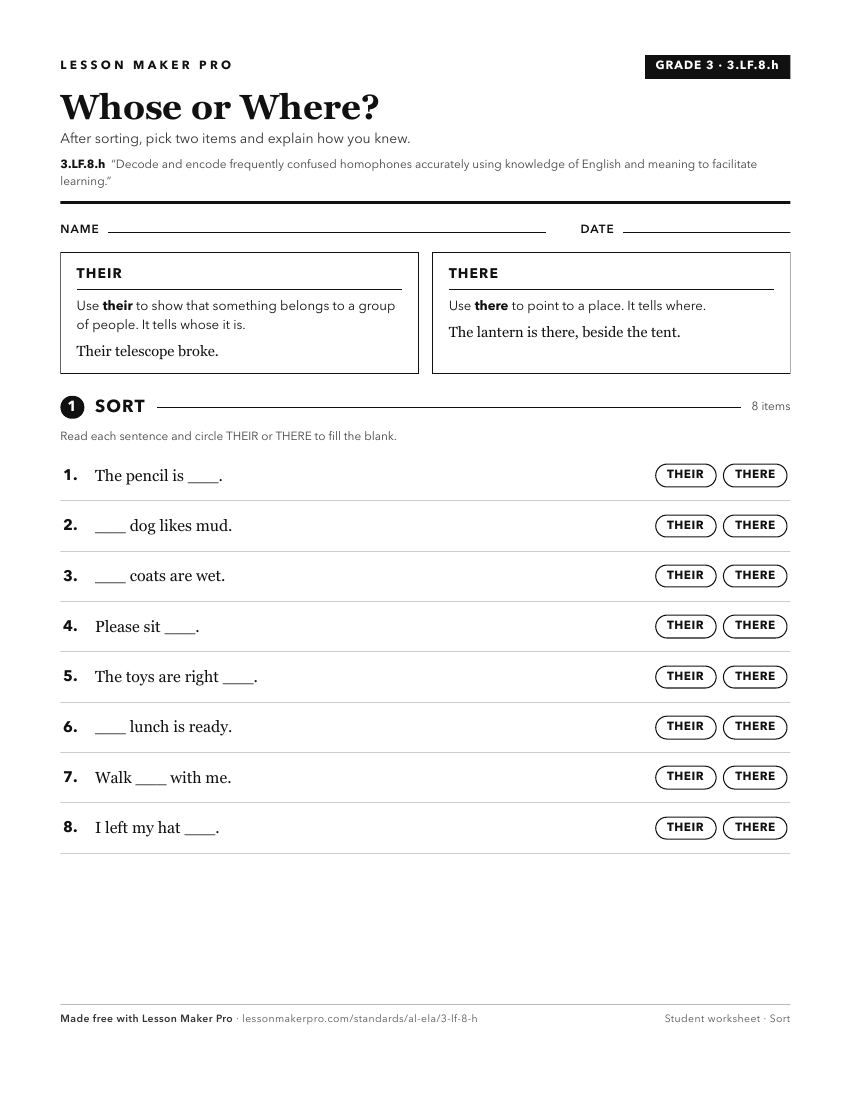
A ready-to-print activity worksheet aligned to 3.LF.8.h, with an answer key for the teacher on its own page. No account needed.
PDF, US Letter, prints cleanly in black and white.
Download the worksheetKeep exploring
Related Standards
- 1.LF.31.o
With prompting and support, encode frequently confused homophones, using knowledge of English and meaning to facilitate learning.
- 2.LF.38.q
Encode frequently confused homophones accurately, using knowledge of English orthography and meaning to facilitate learning.
- 3.LF.32.e
Encode frequently confused homophones accurately, using context to determine correct spelling.
- K-3.R2
Use knowledge of phoneme-grapheme correspondences and word analysis skills to decode and encode words accurately.
Turn this exact standard into a lesson
Grade, subject, topic, and the complete standard are prefilled. Create one free, no account needed.
Also for this standard:Make a WorksheetMake a QuizMake a Sub Lesson