Alabama ELA 2.LF.10
Standard Cluster
Apply knowledge of phoneme-grapheme correspondences, multisyllabic word construction, and syllable division principles to decode and encode (spell) words accurately in isolation and in context. a. Decode multisyllabic words with common syllable patterns, including open/closed, vowel-r, vowel-consonant-e, vowel teams, consonant-le, and schwa syllables. b. Apply knowledge of multisyllabic word construction and syllable division principles to decode grade-appropriate multisyllabic words. c. Decode and encode words with three-consonant blends and blends containing digraphs. d. Decode and encode words with consonant digraphs, trigraphs, and combinations. e. Decode and encode words with variable vowel teams and vowel diphthongs. f. Decode and encode words with vowel-r combinations. g. Decode and encode words that follow the -ild, -ost, -old, -olt, and -ind patterns. h. Decode and encode words with a after w read /ä/ and a before l read /â/. i. Decode and encode words with or after w read /er/. j. Decode and encode words with the hard and soft sounds of c and g, in context and in isolation. k. Decode and encode words with vowel y in the final position of one and two syllable words, distinguishing the difference between the long /ī/ sound in one-syllable words and the long /ē/ sound in two-syllable words, and words with vowel y in medial position, producing the short /ĭ/ sound for these words. l. Decode words with silent letter combinations. m. Decode and encode words with prefixes and suffixes, including words with dropped e and y-to-i changes for suffix addition. n. Decode and encode grade-appropriate high frequency words that are spelled using predictable, decodable phoneme-grapheme correspondences, including those that contain only one irregularity. o. Decode and encode contractions with am, is, has, not, have, would, and will.
2021 Alabama Course of Study: English Language Arts · Literacy Foundations K-3
Cluster contents
Standards in This Cluster
2.LF.10 is a cluster heading. These are the individual standards under it.
- 2.LF.10.a
Decode multisyllabic words with common syllable patterns, including open/closed, vowel-r, vowel-consonant-e, vowel teams, consonant-le, and schwa syllables.
- 2.LF.10.b
Apply knowledge of multisyllabic word construction and syllable division principles to decode grade-appropriate multisyllabic words.
- 2.LF.10.c
Decode and encode words with three-consonant blends and blends containing digraphs.
- 2.LF.10.d
Decode and encode words with consonant digraphs, trigraphs, and combinations.
- 2.LF.10.e
Decode and encode words with variable vowel teams and vowel diphthongs.
- 2.LF.10.f
Decode and encode words with vowel-r combinations.
- 2.LF.10.g
Decode and encode words that follow the -ild, -ost, -old, -olt, and -ind patterns.
- 2.LF.10.h
Decode and encode words with a after w read /ä/ and a before l read /â/.
- 2.LF.10.i
Decode and encode words with or after w read /er/.
- 2.LF.10.j
Decode and encode words with the hard and soft sounds of c and g, in context and in isolation.
- 2.LF.10.k
Decode and encode words with vowel y in the final position of one and two syllable words, distinguishing the difference between the long /ī/ sound in one-syllab...
- 2.LF.10.l
Decode words with silent letter combinations.
- 2.LF.10.m
Decode and encode words with prefixes and suffixes, including words with dropped e and y-to-i changes for suffix addition.
- 2.LF.10.n
Decode and encode grade-appropriate high frequency words that are spelled using predictable, decodable phoneme-grapheme correspondences, including those that co...
- 2.LF.10.o
Decode and encode contractions with am, is, has, not, have, would, and will.
Teacher's field guide
What This Cluster Means
What Students Need to Do
- Students break longer words into syllables to read and spell them. They use consonant blends, vowel patterns, word parts, and contractions when reading words alone and in sentences.
What Mastery Looks Like
- A student can divide candle into can/dle, read it, and spell it from dictation. They spell hoping and happiness by changing the base words, read knee without sounding the k, and write I'll with an apostrophe.
Common Misconceptions
- Students may pronounce the silent k in knee or read the y in happy like the y in my. They may spell hoping as hopeing or leave the apostrophe out of I'll.
How to Assess It
- Dictate, “The child splashed in a puddle.” Have students write it, circle spl, divide puddle into syllables, and read their sentence aloud.
Lesson moves
Ways to Teach It
Give pairs letter tiles to build scrape and scrap, then have them mark the scr blend and name each vowel pattern.
Write my, happy, and gym on the board; ask students why the y sounds different in each word.
Play syllable match with cards labeled can, dle, ta, ble, pur, ple; students build words, read them, then spell them without cards.
Give students a sample lunch menu listing peach slices and wheat bread; have them circle vowel teams and write an order using both foods.
Free download
Printable 2.LF.10 Worksheet
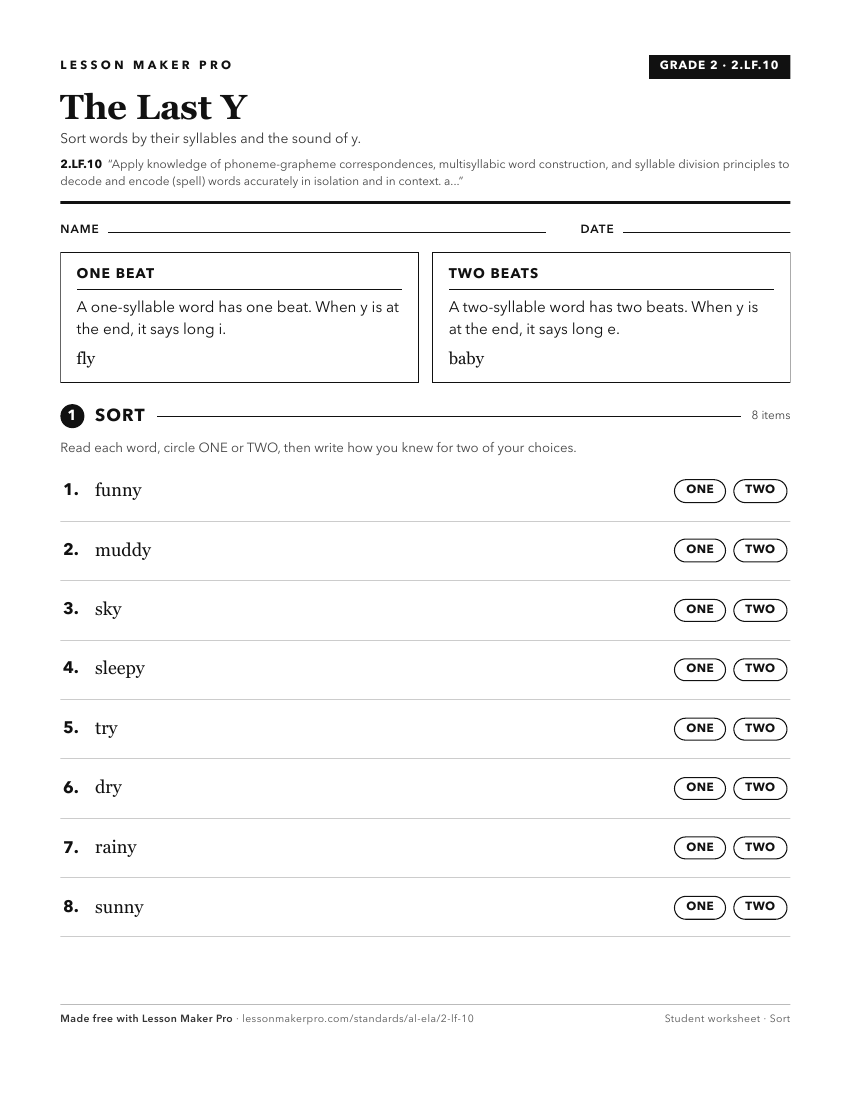
A ready-to-print activity worksheet aligned to 2.LF.10, with an answer key for the teacher on its own page. No account needed.
PDF, US Letter, prints cleanly in black and white.
Download the worksheetKeep exploring
Related Standards
- 3.LF.8
Apply knowledge of phoneme-grapheme correspondences, multisyllabic word construction, and syllable division principles to decode and encode (spell) words accura...
- 2.LF.38
Apply knowledge of grade-appropriate phoneme-grapheme correspondences, multisyllabic word construction, syllable division principles, and spelling rules (or gen...
- 3.LF.32
Apply knowledge of grade-appropriate phoneme-grapheme correspondences, multisyllabic word construction, syllable division rules, and spelling rules (or generali...
- K.LF.10
Apply knowledge of phoneme-grapheme correspondences and word-analysis skills to decode and encode (spell) words accurately in both isolation and in decodable, g...
Turn this cluster into a lesson
Grade, subject, topic, and the complete cluster are prefilled. Create one free, no account needed.
Also for this cluster:Make a WorksheetMake a QuizMake a Sub Lesson