Alabama ELA 2.LF.16.d
The Standard
- 2.LF.16
- Describe word relationships and nuances in word meanings, including relating them to their opposites and distinguishing shades of meaning in similar or related words.
With prompting and support, interpret figurative language.
2021 Alabama Course of Study: English Language Arts
Teacher's field guide
What This Standard Means
What Students Need to Do
- Students hear a phrase that means more than its exact words. With a question or picture cue, they use the sentence around it to explain what the speaker means.
What Mastery Looks Like
- When Maya says, “My legs are jelly” after a race, a student explains that her legs feel weak or wobbly. They point to the race as a clue.
Common Misconceptions
- Students may think Maya’s legs really turned into jelly. They may guess a meaning from one word without checking the rest of the sentence.
How to Assess It
- Ask: “After the race, Maya said, ‘My legs are jelly.’ What does she mean? What clue helped you?”
Lesson moves
Ways to Teach It
Give pairs drawings of heavy rain and falling cats; have them match “raining cats and dogs” to the right picture and explain why.
Ask: “Ben has butterflies in his stomach before the play. How might he feel? What in the sentence helps you decide?”
Play phrase charades: one student acts out “moving like a snail,” and classmates explain what the phrase means.
Show a local weather forecast and ask students to replace “heavy rain” with “raining cats and dogs,” then explain the match.
Free download
Printable 2.LF.16.d Worksheet
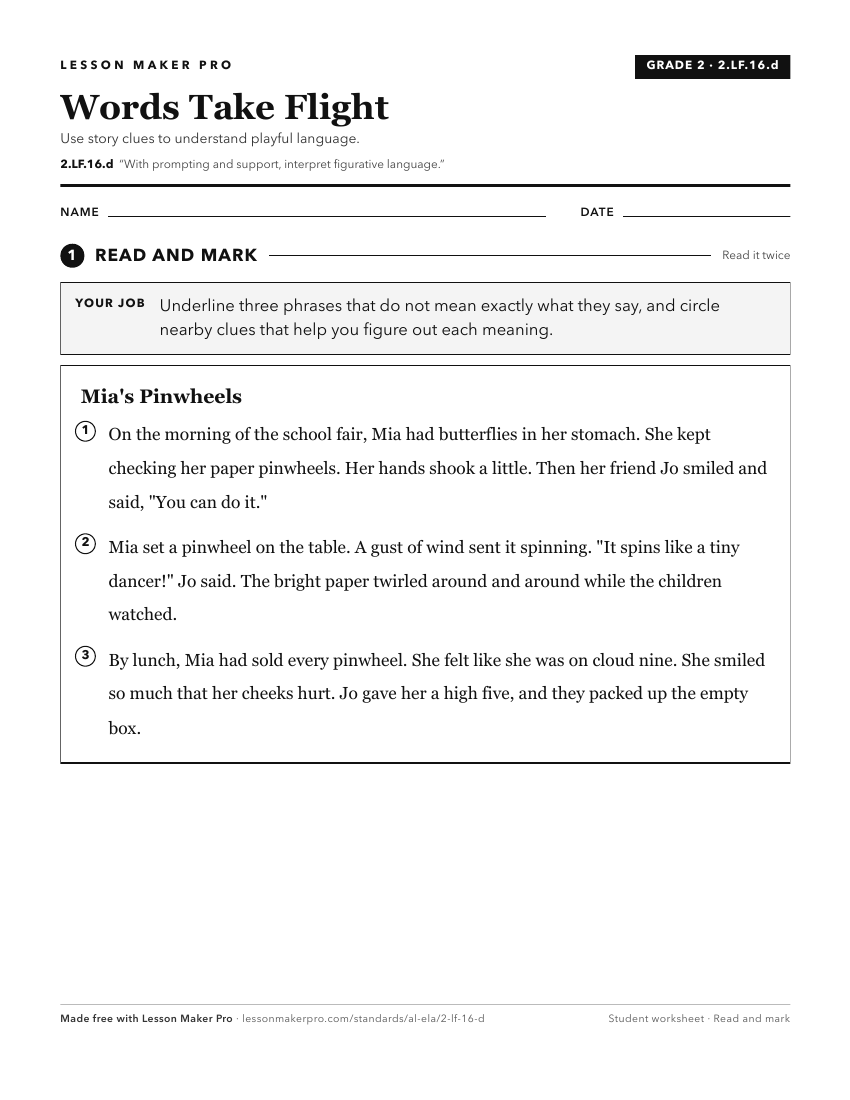
A ready-to-print activity worksheet aligned to 2.LF.16.d, with an answer key for the teacher on its own page. No account needed.
PDF, US Letter, prints cleanly in black and white.
Download the worksheetKeep exploring
Related Standards
- 3.LF.14.e
Interpret figurative language.
- 4.LF.10.b
Explain how figurative language contributes to the meaning of text, including simile, metaphor, alliteration, personification, hyperbole, and idioms.
- 5.LF.12.a
Locate similes, metaphors, personification, hyperbole, imagery, alliteration, onomatopoeia, and idioms and interpret their meanings in context.
Turn this exact standard into a lesson
Grade, subject, topic, and the complete standard are prefilled. Create one free, no account needed.
Also for this standard:Make a WorksheetMake a QuizMake a Sub Lesson