Alabama ELA 3.LF.14.e
The Standard
- 3.LF.14
- Describe word relationships and nuances in word meanings, including relating them to their opposites and distinguishing shades of meaning in similar or related words, including nouns, verbs, and adjectives.
Interpret figurative language.
2021 Alabama Course of Study: English Language Arts
Teacher's field guide
What This Standard Means
What Students Need to Do
- Students recognize when a phrase means something other than its exact words. They use clues in the sentence to explain what the speaker means.
What Mastery Looks Like
- A student knows that 'My backpack weighs a ton' means it feels very heavy. They can explain why the speaker does not mean an actual ton.
Common Misconceptions
- Some students picture cats and dogs falling from the sky when they hear 'raining cats and dogs.' Others think 'as fast as a cheetah' means someone runs at exactly the animal's speed.
How to Assess It
- Exit ticket: Read 'The classroom was a zoo, with children shouting and running around.' Write what 'zoo' means here and underline the words that helped you.
Lesson moves
Ways to Teach It
Give pairs cards with figurative phrases and cards with plain meanings, then have them match 'raining cats and dogs' to 'raining hard.'
Read 'My backpack weighs a ton.' Ask partners what the speaker means and why the words cannot be literally true.
Play phrase charades with slips reading 'butterflies in my stomach' and 'on cloud nine'; classmates guess each meaning.
Ask students to write down a phrase they hear at home, such as 'hold your horses,' and explain what the speaker meant.
Free download
Printable 3.LF.14.e Worksheet
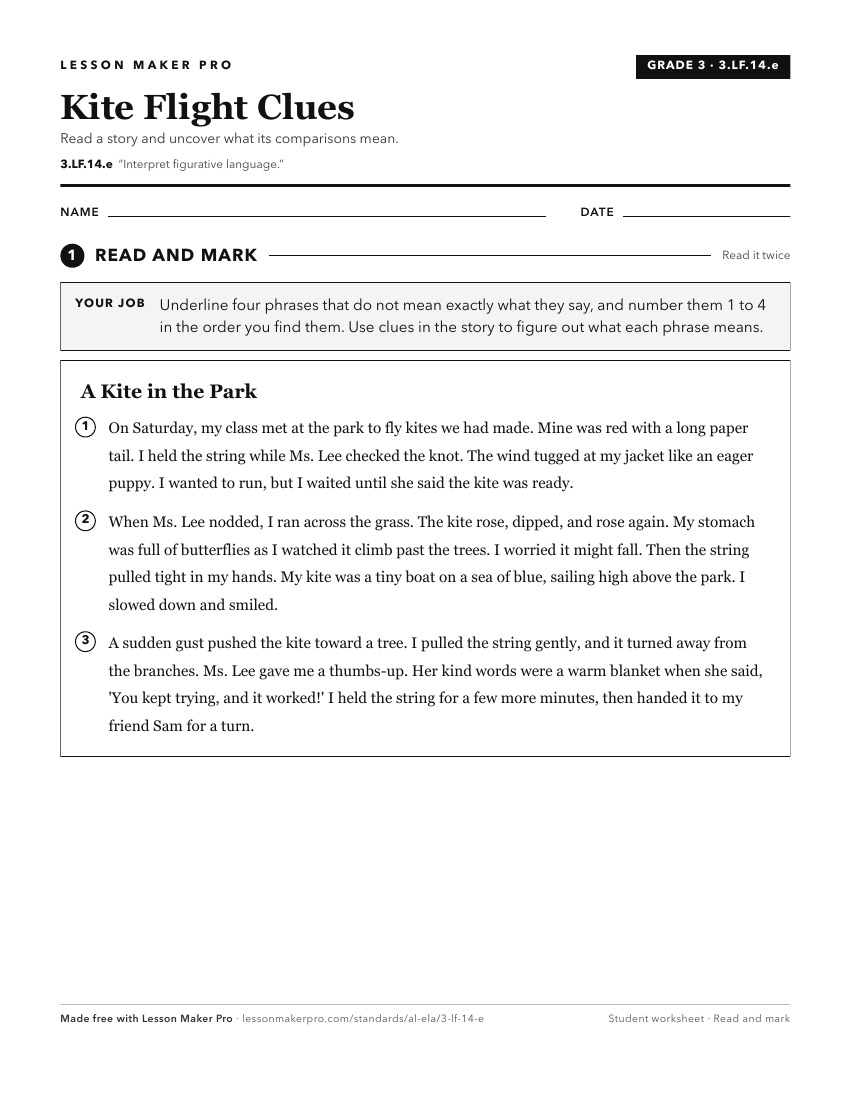
A ready-to-print activity worksheet aligned to 3.LF.14.e, with an answer key for the teacher on its own page. No account needed.
PDF, US Letter, prints cleanly in black and white.
Download the worksheetKeep exploring
Related Standards
- 2.LF.16.d
With prompting and support, interpret figurative language.
- 4.LF.10.b
Explain how figurative language contributes to the meaning of text, including simile, metaphor, alliteration, personification, hyperbole, and idioms.
- 10.CL.4
Interpret an author's use of characterization, connotation, denotation, figurative language, literary elements, and point of view to create and convey meaning i...
Turn this exact standard into a lesson
Grade, subject, topic, and the complete standard are prefilled. Create one free, no account needed.
Also for this standard:Make a WorksheetMake a QuizMake a Sub Lesson