Alabama ELA 1.LF.31
Standard Cluster
Apply knowledge of grade-appropriate phoneme-grapheme correspondences and spelling rules (or generalizations) to encode words accurately. a. Encode vowel-consonant (VC) and consonant-vowel-consonant (CVC) words, while using some knowledge of basic position-based rules for spelling English words in closed syllables. b. Encode consonant-vowel (CV) words using knowledge of open syllable patterns. c. Encode words with two-consonant blends in beginning position, including blends that are commonly confused with other spellings, by distinguishing the placement and action of the lips, teeth, and tongue during articulation. d. Encode words with consonant digraphs using knowledge that one sound may be spelled with two letters. e. Encode words with vowel-consonant-e syllable patterns. f. With prompting and support, encode words with the common vowel teams and diphthongs. g. With prompting and support, encode words with vowel-r combinations ar, or, er, ir, and ur. h. With prompting and support, encode words with final /ch/ sound spelled -ch and -tch. i. With prompting and support, encode words with final /f/, /l/, and /s/ sounds in one-syllable base words by doubling the final consonant when it follows a short vowel sound. j. Encode words with final /v/ sound, using knowledge that no English word ends with a v. k. Encode grade-appropriate high frequency words that follow regular phoneme-grapheme correspondences. l. Encode grade-appropriate high frequency words that follow regular phoneme-grapheme correspondences and patterns in all but one position, pointing out the part of the word that does not follow the regular pattern. m. Encode words with suffixes -s, -es, -ing, -ed, -er, and -est. n. With prompting and support, encode words with common prefixes re-, un-, and mis-. o. With prompting and support, encode frequently confused homophones, using knowledge of English and meaning to facilitate learning.
2021 Alabama Course of Study: English Language Arts · Literacy Foundations K-3
Cluster contents
Standards in This Cluster
1.LF.31 is a cluster heading. These are the individual standards under it.
- 1.LF.31.a
Encode vowel-consonant (VC) and consonant-vowel-consonant (CVC) words, while using some knowledge of basic position-based rules for spelling English words in cl...
- 1.LF.31.b
Encode consonant-vowel (CV) words using knowledge of open syllable patterns.
- 1.LF.31.c
Encode words with two-consonant blends in beginning position, including blends that are commonly confused with other spellings, by distinguishing the placement ...
- 1.LF.31.d
Encode words with consonant digraphs using knowledge that one sound may be spelled with two letters.
- 1.LF.31.e
Encode words with vowel-consonant-e syllable patterns.
- 1.LF.31.f
With prompting and support, encode words with the common vowel teams and diphthongs.
- 1.LF.31.g
With prompting and support, encode words with vowel-r combinations ar, or, er, ir, and ur.
- 1.LF.31.h
With prompting and support, encode words with final /ch/ sound spelled -ch and -tch.
- 1.LF.31.i
With prompting and support, encode words with final /f/, /l/, and /s/ sounds in one-syllable base words by doubling the final consonant when it follows a short ...
- 1.LF.31.j
Encode words with final /v/ sound, using knowledge that no English word ends with a v.
- 1.LF.31.k
Encode grade-appropriate high frequency words that follow regular phoneme-grapheme correspondences.
- 1.LF.31.l
Encode grade-appropriate high frequency words that follow regular phoneme-grapheme correspondences and patterns in all but one position, pointing out the part o...
- 1.LF.31.m
Encode words with suffixes -s, -es, -ing, -ed, -er, and -est.
- 1.LF.31.n
With prompting and support, encode words with common prefixes re-, un-, and mis-.
- 1.LF.31.o
With prompting and support, encode frequently confused homophones, using knowledge of English and meaning to facilitate learning.
Teacher's field guide
What This Cluster Means
What Students Need to Do
- Students say the sounds in a word and write the letters for each sound. They spell short words with closed, open, and silent-e syllables, blends, digraphs, vowel teams, and r-controlled vowels. They use spelling patterns, word parts, and meaning to spell endings, common words, and homophones.
What Mastery Looks Like
- A student writes cat, go, stop, ship, cake, boat, cow, and bird from dictation. With help, they spell watch, bell, have, and unkind, then add -ing to jump. They spot the unexpected letters in said and choose two when counting objects.
Common Misconceptions
- Students may write sop for stop because they miss one sound in the blend, or sip for ship because they expect one letter per sound. They may write hav, bel, or wach, missing the final e, doubled l, or -tch. They may write sed for said or use too when they mean two.
How to Assess It
- Dictate stop, ship, go, cake, boat, watch, have, and said. Ask students to circle the unexpected letters in said.
Lesson moves
Ways to Teach It
Give pairs letter tiles to build cap, then change it to cape; have them read both words and explain the vowel change.
Say slip and sip slowly; ask partners which sound is missing from sip and where their tongue moves to make it.
Play a spelling relay: say ship, stop, boat, bird, and cake; teams write each word, compare spellings, and fix errors.
Give students a pretend lunch order for two sandwiches; have them write the order and explain why two fits.
Free download
Printable 1.LF.31 Worksheet
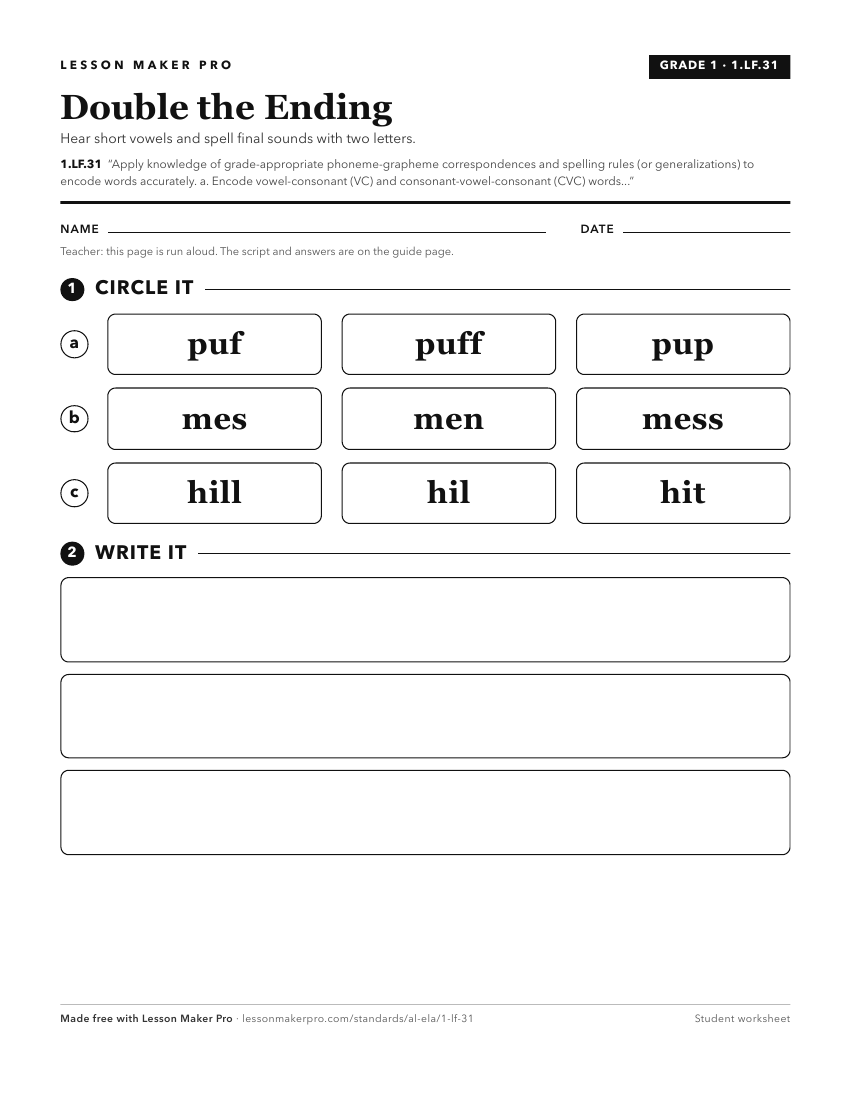
A ready-to-print activity worksheet aligned to 1.LF.31, with an answer key for the teacher on its own page. No account needed.
PDF, US Letter, prints cleanly in black and white.
Download the worksheetKeep exploring
Related Standards
- K.LF.35
Apply knowledge of grade-appropriate phoneme-grapheme correspondences and spelling rules (or generalizations) to encode words accurately.
- 3.LF.32
Apply knowledge of grade-appropriate phoneme-grapheme correspondences, multisyllabic word construction, syllable division rules, and spelling rules (or generali...
- 2.LF.38
Apply knowledge of grade-appropriate phoneme-grapheme correspondences, multisyllabic word construction, syllable division principles, and spelling rules (or gen...
- K.LF.10
Apply knowledge of phoneme-grapheme correspondences and word-analysis skills to decode and encode (spell) words accurately in both isolation and in decodable, g...
Turn this cluster into a lesson
Grade, subject, topic, and the complete cluster are prefilled. Create one free, no account needed.
Also for this cluster:Make a WorksheetMake a QuizMake a Sub Lesson