Alabama ELA 1.LF.31.e
The Standard
- 1.LF.31
- Apply knowledge of grade-appropriate phoneme-grapheme correspondences and spelling rules (or generalizations) to encode words accurately.
Encode words with vowel-consonant-e syllable patterns.
2021 Alabama Course of Study: English Language Arts
Teacher's field guide
What This Standard Means
What Students Need to Do
- Students hear a word with a long vowel, then spell it with a consonant followed by a silent e. They compare pairs like tap and tape to decide when the final e is needed.
What Mastery Looks Like
- A student hears “tape” and writes t-a-p-e, not t-a-p. They can explain that the final e changes the vowel sound but is not spoken.
Common Misconceptions
- Students may write tap for tape because they do not hear the e. Some put the e right after the vowel, writing taep instead of tape.
How to Assess It
- Say “kit” and “kite.” Have students write both words and circle the letter that changes the vowel sound in kite.
Lesson moves
Ways to Teach It
Give pairs letter tiles t, a, p, e; have them build tap, add e to make tape, and read both aloud.
Write tap and tape on the board; ask, “Why does tape need an e when tap does not?”
Call out kit, kite, hop, and hope; have partners write each word, then check each other's final e.
Give students a roll of tape and a blank label; ask them to write tape on the label and attach it.
Free download
Printable 1.LF.31.e Worksheet
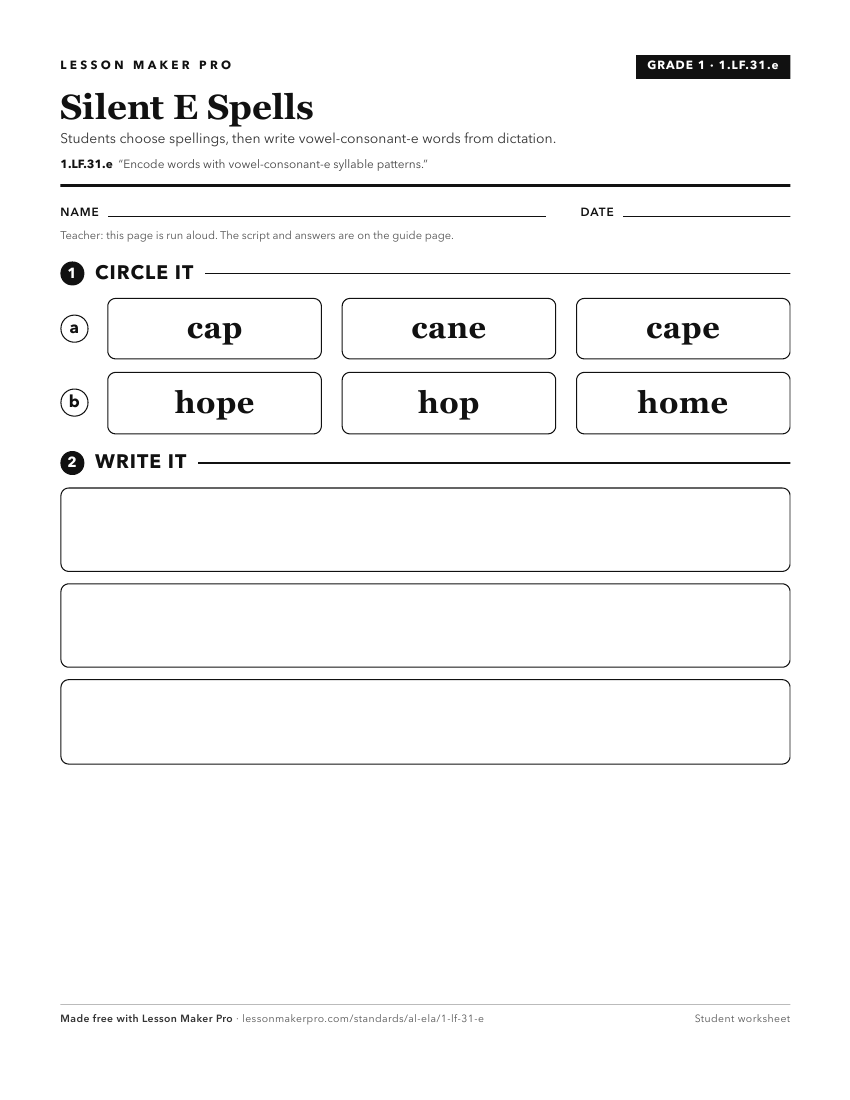
A ready-to-print activity worksheet aligned to 1.LF.31.e, with an answer key for the teacher on its own page. No account needed.
PDF, US Letter, prints cleanly in black and white.
Download the worksheetKeep exploring
Related Standards
Turn this exact standard into a lesson
Grade, subject, topic, and the complete standard are prefilled. Create one free, no account needed.
Also for this standard:Make a WorksheetMake a QuizMake a Sub Lesson