Alabama ELA K.LF.35
Standard Cluster
Apply knowledge of grade-appropriate phoneme-grapheme correspondences and spelling rules (or generalizations) to encode words accurately. a. Encode at the phoneme level, using the most common grapheme/spelling(s), for a spoken phoneme (sound). b. With prompting and support, encode vowel-consonant (VC) and consonant-vowel-consonant (CVC) words, while using some knowledge of basic position-based rules for spelling English words. c. With prompting and support, encode grade-appropriate high frequency words that follow regular phoneme-grapheme correspondences. d. With prompting and support, encode grade-appropriate high frequency words that follow regular phoneme-grapheme correspondences and patterns in all but one position, pointing out the part of the word that does not follow the regular pattern.
2021 Alabama Course of Study: English Language Arts · Literacy Foundations K-3
Cluster contents
Standards in This Cluster
K.LF.35 is a cluster heading. These are the individual standards under it.
- K.LF.35.a
Encode at the phoneme level, using the most common grapheme/spelling(s), for a spoken phoneme (sound).
- K.LF.35.b
With prompting and support, encode vowel-consonant (VC) and consonant-vowel-consonant (CVC) words, while using some knowledge of basic position-based rules for ...
- K.LF.35.c
With prompting and support, encode grade-appropriate high frequency words that follow regular phoneme-grapheme correspondences.
- K.LF.35.d
With prompting and support, encode grade-appropriate high frequency words that follow regular phoneme-grapheme correspondences and patterns in all but one posit...
Teacher's field guide
What This Cluster Means
What Students Need to Do
- Students hear a sound and write its usual letter or letters. With help, they stretch and spell short words like at and cat. They write common words like can and is, and notice that the s in is says /z/.
What Mastery Looks Like
- A student writes m when they hear /m/. With sound boxes and a prompt, they spell at and cat, write can and is, and point to the unexpected s in is.
Common Misconceptions
- Some children leave out the middle vowel and write ct for cat. Others write iz for is because they hear /z/. Some use k in cat because they know k can spell /k/.
How to Assess It
- Give children sound boxes and say /m/, at, cat, kit, can, and is. Have them write each, then circle the letter in is that says /z/ and explain why cat starts with c but kit starts with k.
Lesson moves
Ways to Teach It
Give children three counters and letter tiles; say map, then have them push one counter per sound, build the word, and write it.
Write cat and kit; ask partners, 'Why is /k/ spelled c before a but k before i?'
Play word-change: write mat, then have children swap one tile at a time to make sat, sit, and sip.
After washing a classroom table, have children make an 'It is wet' sign and circle the s in is that says /z/.
Free download
Printable K.LF.35 Worksheet
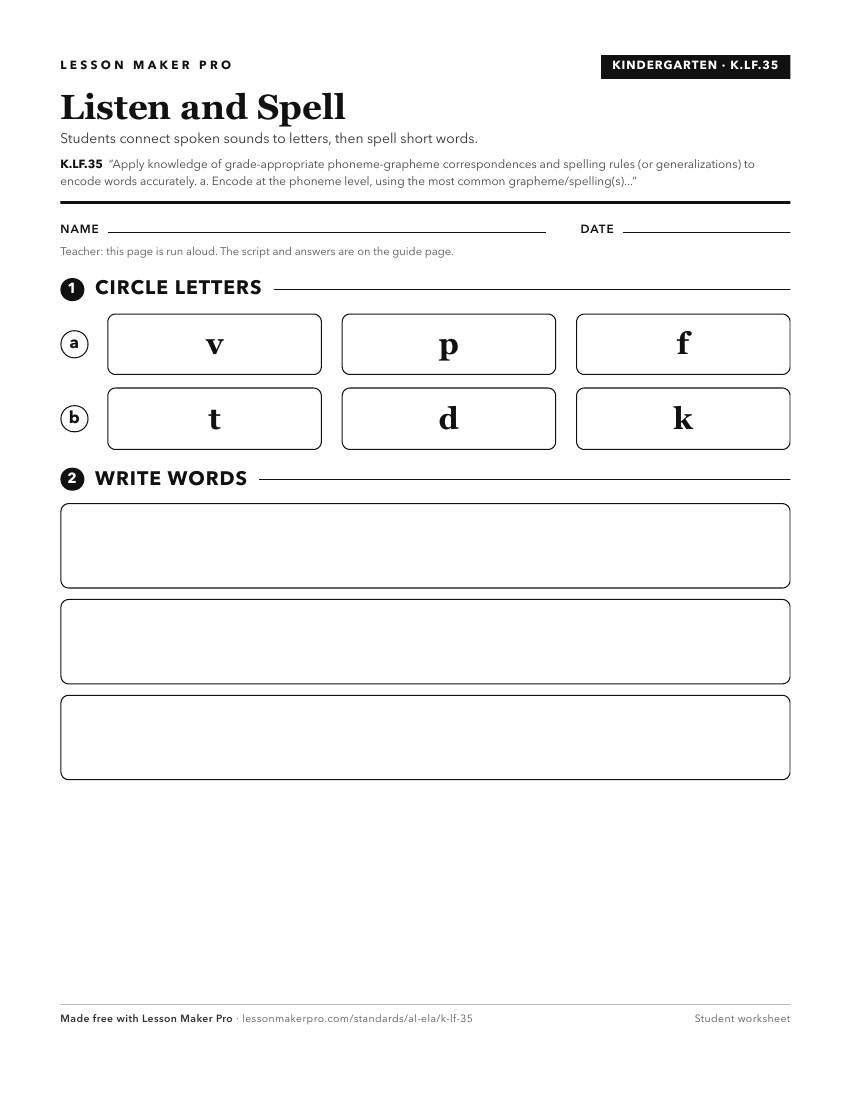
A ready-to-print activity worksheet aligned to K.LF.35, with an answer key for the teacher on its own page. No account needed.
PDF, US Letter, prints cleanly in black and white.
Download the worksheetKeep exploring
Related Standards
- 1.LF.31
Apply knowledge of grade-appropriate phoneme-grapheme correspondences and spelling rules (or generalizations) to encode words accurately.
- 3.LF.32
Apply knowledge of grade-appropriate phoneme-grapheme correspondences, multisyllabic word construction, syllable division rules, and spelling rules (or generali...
- 2.LF.38
Apply knowledge of grade-appropriate phoneme-grapheme correspondences, multisyllabic word construction, syllable division principles, and spelling rules (or gen...
- K.LF.10
Apply knowledge of phoneme-grapheme correspondences and word-analysis skills to decode and encode (spell) words accurately in both isolation and in decodable, g...
Turn this cluster into a lesson
Grade, subject, topic, and the complete cluster are prefilled. Create one free, no account needed.
Also for this cluster:Make a WorksheetMake a QuizMake a Sub Lesson