Wyoming Math 8.NS.1
Standard Cluster
Know that numbers that are not rational are called irrational. Understand informally that every number has a decimal expansion; for rational numbers show that the decimal expansion repeats eventually, and convert a decimal expansion which repeats eventually into a rational number. Explore the real number system and its appropriate usage in real-world situations. Make comparisons between rational and irrational numbers. Understand that all real numbers have a decimal expansion. Model the hierarchy of the real number system, including natural, whole, integer, rational, and irrational numbers. Convert repeating decimals to fractions.
2023 Wyoming Mathematics Content and Performance Standards · Know that there are numbers that are not rational, and approximate them by rational numbers.
Cluster contents
Standards in This Cluster
8.NS.1 is a cluster heading. These are the individual standards under it.
Teacher's field guide
What This Cluster Means
What Students Need to Do
- Students sort numbers into natural, whole, integer, rational, and irrational groups. They recognize that every real number has a decimal expansion, and that rational decimals terminate or eventually repeat. They turn repeating decimals into fractions and use rational estimates to compare irrational numbers.
What Mastery Looks Like
- A student can place 4 in the natural, whole, integer, and rational groups, and √2 in the irrational group. They can write 0.1666... as 1/6, even though the repeating digits do not start right away. They can use 1.4² and 1.5² to show that √2 lies between 1.4 and 1.5.
Common Misconceptions
- Students may call a negative number irrational just because it is negative. They may think 0.1666... is irrational because it does not repeat right away. They may mistake a calculator's short display of √2 for a terminating decimal.
How to Assess It
- Exit ticket: Place -3, 4, 0.1666..., and √2 in all groups that apply: natural, whole, integer, rational, or irrational. Convert 0.1666... to a fraction, then use squares to show whether √2 lies between 1.4 and 1.5.
Lesson moves
Ways to Teach It
Give pairs nested circles labeled real, rational, integer, whole, and natural; have them place cards showing 4, 0, -3, 1/6, and √2.
Ask: Why is 0.1666... rational even though it never ends? Have students write its fraction and explain the repeating 6.
Play a matching game with cards showing 1/3, 1/6, 2/9, 0.333..., 0.1666..., and 0.222...
Sketch a square garden with area 2 square meters; compare 1.4 and 1.5 meters as estimates of its side.
Free download
Printable 8.NS.1 Worksheet
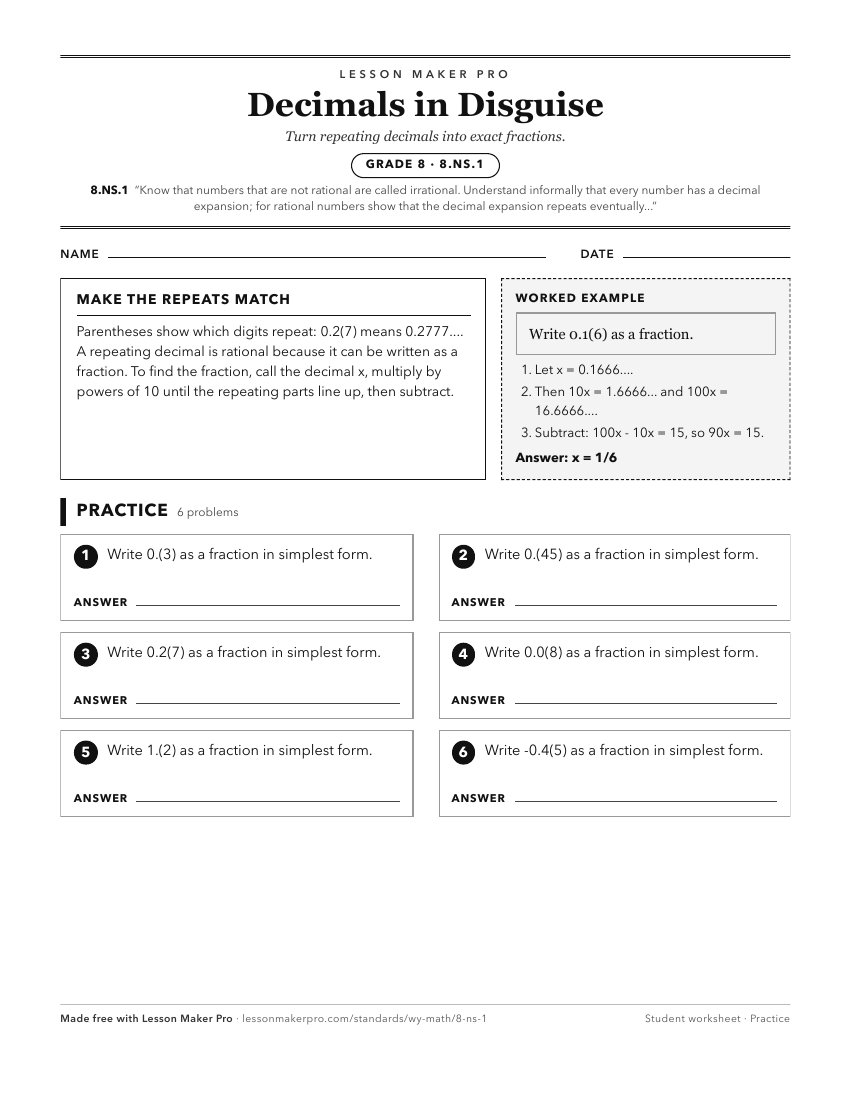
A ready-to-print activity worksheet aligned to 8.NS.1, with an answer key for the teacher on its own page. No account needed.
PDF, US Letter, prints cleanly in black and white.
Download the worksheetTurn this cluster into a lesson
Grade, subject, topic, and the complete cluster are prefilled. Create one free, no account needed.
Also for this cluster:Make a WorksheetMake a QuizMake a Sub Lesson