Virginia SOL 5.4.a
The Standard
- 5.4
- The student will investigate and understand that electricity is transmitted and used in daily life. Key ideas include
electricity flows easily through conductors but not insulators
Virginia Standards of Learning for Science
Teacher's field guide
What This Standard Means
What Students Need to Do
- Students test everyday materials in a simple circuit and use the results to classify each material. They explain how the test provides evidence for each classification.
What Mastery Looks Like
- A student can build a closed test circuit and change one material at a time. They classify materials from bulb or buzzer evidence and recognize common patterns, such as metals conducting.
Common Misconceptions
- Students may think an unlit bulb always proves the tested material is an insulator, even when the circuit is open. They may also assume every part of a metal-coated object behaves the same way.
How to Assess It
- Give students a circuit diagram and three test results: foil lights the bulb, rubber does not, and a paper clip lights it. Ask them to classify each material and explain their evidence.
Lesson moves
Ways to Teach It
Use a battery, bulb, and wires to test foil, paper clips, craft sticks, rubber bands, coins, and plastic spoons.
Ask students to write why electrical cords have metal inside and plastic outside, using evidence from circuit tests.
Play a prediction game with material cards, then award points for correct classifications after each material is tested.
Inspect a flashlight or unplugged extension cord and identify where conducting and insulating materials are used for function and safety.
Free download
Printable 5.4.a Worksheet
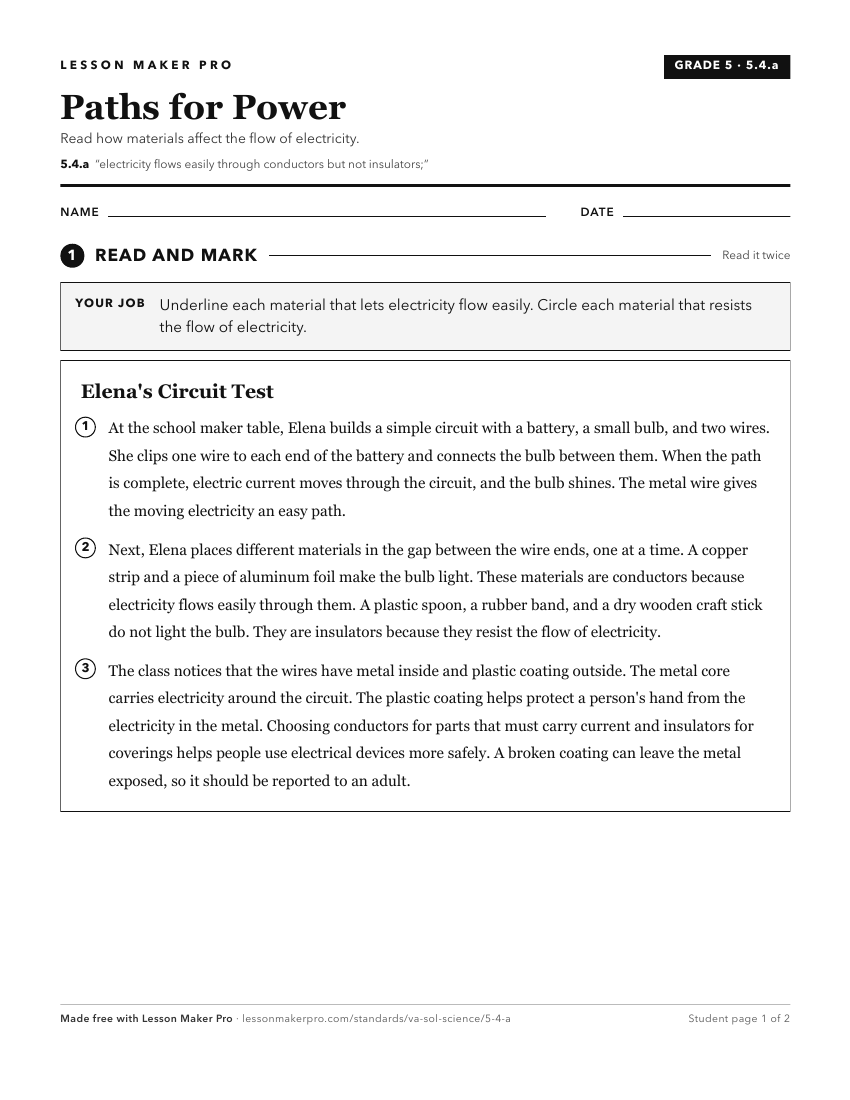
A ready-to-print activity worksheet aligned to 5.4.a, with an answer key for the teacher on its own page. No account needed.
PDF, US Letter, prints cleanly in black and white.
Download the worksheetKeep exploring
Related Standards
Turn this exact standard into a lesson
Grade, subject, topic, and the complete standard are prefilled. Create one free, no account needed.
Also for this standard:Make a WorksheetMake a QuizMake a Sub Lesson