Virginia SOL 4.7.b
The Standard
- 4.7
- The student will investigate and understand that the ocean environment has characteristics. Key characteristics include
physical properties and movement of ocean water
Virginia Standards of Learning for Science
Teacher's field guide
What This Standard Means
What Students Need to Do
- Students describe ocean water using traits such as salt content, temperature, and density. They distinguish waves, tides, and currents by how the water moves and what causes the motion.
What Mastery Looks Like
- Students can identify waves, tides, and currents in diagrams or short examples. They can explain that ocean conditions vary by location and depth.
Common Misconceptions
- Students may call every ocean movement a wave or think tides are caused by wind. They may also think ocean temperature and salt content are the same everywhere.
How to Assess It
- Give students three labeled sketches showing a wave, a tide, and a current. Ask them to describe each movement and name one cause.
Lesson moves
Ways to Teach It
Use a tray of water, a fan, and floating paper dots to model how wind moves surface water.
Ask students to write how a wave, tide, and current would affect a floating beach ball differently.
Have pairs sort scenario cards into waves, tides, or currents, then explain one choice to the class.
Read a local beach forecast and identify how water temperature, tides, waves, and currents could affect swimmers or boaters.
Free download
Printable 4.7.b Worksheet
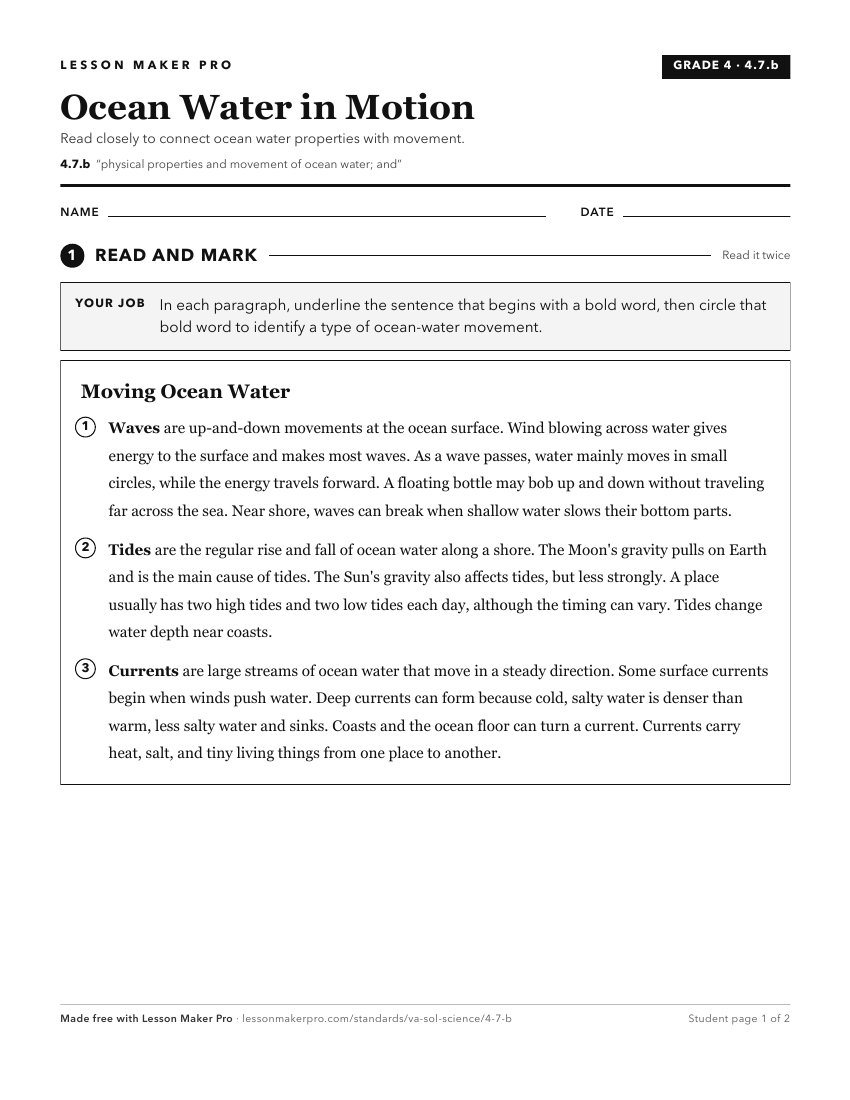
A ready-to-print activity worksheet aligned to 4.7.b, with an answer key for the teacher on its own page. No account needed.
PDF, US Letter, prints cleanly in black and white.
Download the worksheetKeep exploring
Related Standards
- 6.6
The student will investigate and understand that water has unique physical properties and has a role in the natural and human-made environment. Key ideas includ...
- 3.3
The student will investigate and understand how materials interact with water. Key ideas include
- 6.6.b
water has specific properties
- 4.7
The student will investigate and understand that the ocean environment has characteristics. Key characteristics include
Turn this exact standard into a lesson
Grade, subject, topic, and the complete standard are prefilled. Create one free, no account needed.
Also for this standard:Make a WorksheetMake a QuizMake a Sub Lesson