Virginia SOL 7.MG.3
SOL Standard (Knowledge and Skills Cluster)
The student will compare and contrast quadrilaterals based on their properties and determine unknown side lengths and angle measures of quadrilaterals.
Virginia Standards of Learning for Mathematics
Cluster contents
Knowledge and Skills in This Standard
7.MG.3 is a Standards of Learning standard. These are the knowledge and skills expectations under it.
- 7.MG.3.a.i
Compare and contrast properties of the following quadrilaterals: parallelogram, rectangle, square, rhombus, and trapezoid: parallel/perpendicular sides and diag...
- 7.MG.3.a.ii
Compare and contrast properties of the following quadrilaterals: parallelogram, rectangle, square, rhombus, and trapezoid: congruence of angle measures, side, a...
- 7.MG.3.a.iii
Compare and contrast properties of the following quadrilaterals: parallelogram, rectangle, square, rhombus, and trapezoid: lines of symmetry.
- 7.MG.3.b.i
Sort and classify quadrilaterals as parallelograms, rectangles, trapezoids, rhombi, and/or squares based on their properties: parallel/perpendicular sides and d...
- 7.MG.3.b.ii
Sort and classify quadrilaterals as parallelograms, rectangles, trapezoids, rhombi, and/or squares based on their properties: congruence of angle measures, side...
- 7.MG.3.b.iii
Sort and classify quadrilaterals as parallelograms, rectangles, trapezoids, rhombi, and/or squares based on their properties: lines of symmetry
- 7.MG.3.c
Given a diagram, determine an unknown angle measure in a quadrilateral, using properties of quadrilaterals.
- 7.MG.3.d
Given a diagram, determine an unknown side length in a quadrilateral using properties of quadrilaterals.
Teacher's field guide
What This Cluster Means
What Students Need to Do
- Students identify parallel and perpendicular segments, congruent sides and angles, diagonal relationships, and lines of symmetry. They sort quadrilaterals under every name that fits. They use those properties to calculate missing side lengths and angle measures.
What Mastery Looks Like
- Students classify a quadrilateral under every name that applies and support each choice with measured or marked properties. They find missing sides using congruent segments and missing angles using angle relationships or the 360 degree sum.
Common Misconceptions
- Students often think a rectangle is not a parallelogram or that every rhombus is a square. They may assume all quadrilateral diagonals are congruent, perpendicular, or angle bisectors. Some use 180 degrees instead of 360 degrees for the interior angle sum.
How to Assess It
- Give this exit ticket: ABCD is a parallelogram, AB = 3x + 2, CD = 20, and angle A = 68 degrees. Find x, find angle B, and list every valid classification.
Lesson moves
Ways to Teach It
Give students straws, rulers, protractors, and tracing paper to build five quadrilaterals, measure their parts, and test each line of symmetry.
Ask, "Is every square a rectangle, and is every rectangle a square?" Require two reasons using sides, angles, or diagonals.
Run a card sort with shape diagrams and property cards; students place each shape under every name that applies and defend one choice.
Have students photograph a window, floor tile, sign, or table, then label its quadrilateral type and mark measurable properties.
Free download
Printable 7.MG.3 Worksheet
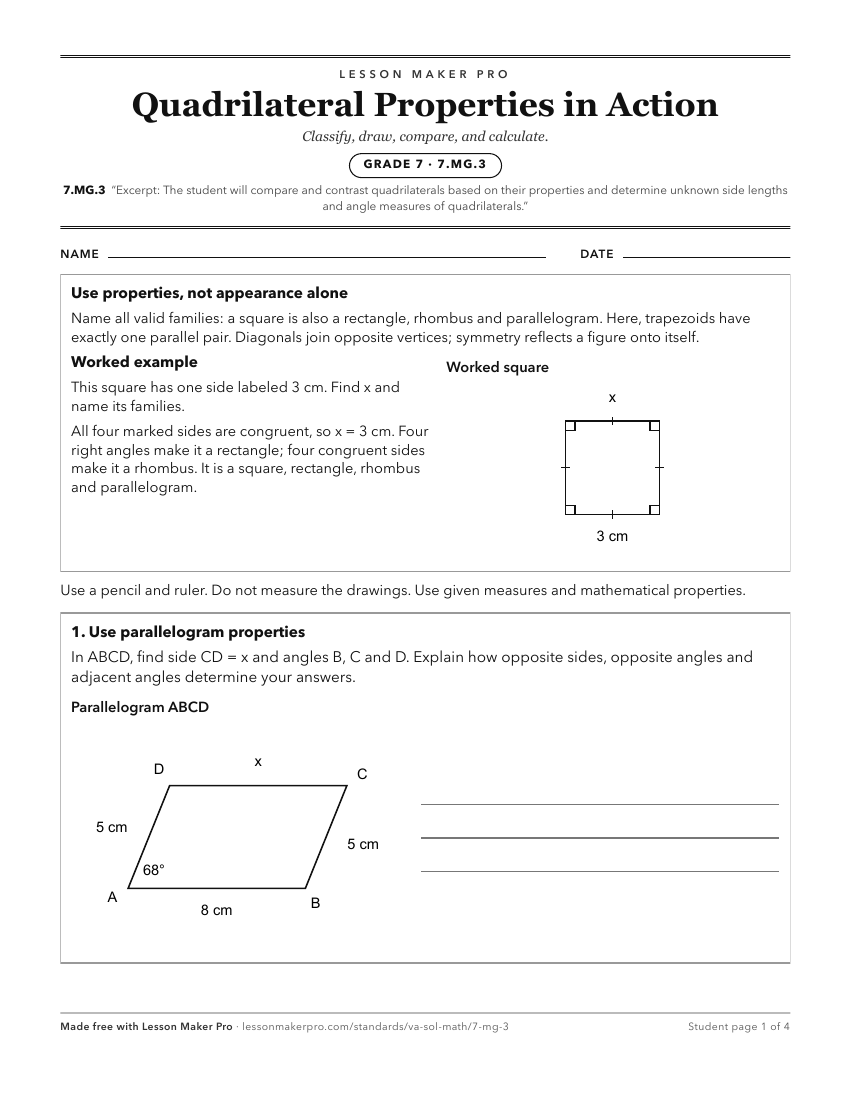
A ready-to-print activity worksheet aligned to 7.MG.3, with an answer key for the teacher on its own page. No account needed.
PDF, US Letter, prints cleanly in black and white.
Download the worksheetKeep exploring
Related Standards
Turn this cluster into a lesson
Grade, subject, topic, and the complete cluster are prefilled. Create one free, no account needed.
Also for this cluster:Make a WorksheetMake a QuizMake a Sub Lesson