Virginia SOL 7.MG.3.a.iii
The Standard
Compare and contrast properties of the following quadrilaterals: parallelogram, rectangle, square, rhombus, and trapezoid: lines of symmetry.
Virginia Standards of Learning for Mathematics · The student will compare and contrast quadrilaterals based on their properties and determine unknown side lengths and angle measures of quadrilaterals.
Teacher's field guide
What This Standard Means
What Students Need to Do
- Students identify and count lines of symmetry in parallelograms, rectangles, squares, rhombuses, and trapezoids. They compare which shapes share the same symmetry features and which differ.
What Mastery Looks Like
- Students correctly draw and count all lines of symmetry on each figure. They explain how equal side lengths, equal angles, and shape orientation affect symmetry.
Common Misconceptions
- Students may assume every diagonal is a line of symmetry. They may miss that rectangles have two lines, squares have four, rhombuses have two, and only isosceles trapezoids have one.
How to Assess It
- Give diagrams of the five quadrilateral types, including a non-isosceles trapezoid. Ask students to draw every line of symmetry and label the number for each shape.
Lesson moves
Ways to Teach It
Give students paper quadrilateral cutouts and have them test possible symmetry lines by folding each shape so its halves match.
Ask students to explain why a rectangle's diagonals are not symmetry lines while a rhombus's diagonals are.
Play a card sort where students match quadrilateral diagrams to cards showing zero, one, two, or four lines of symmetry.
Have students inspect floor tiles, signs, windows, and logos, then sketch one quadrilateral example and mark its symmetry lines.
Free download
Printable 7.MG.3.a.iii Worksheet
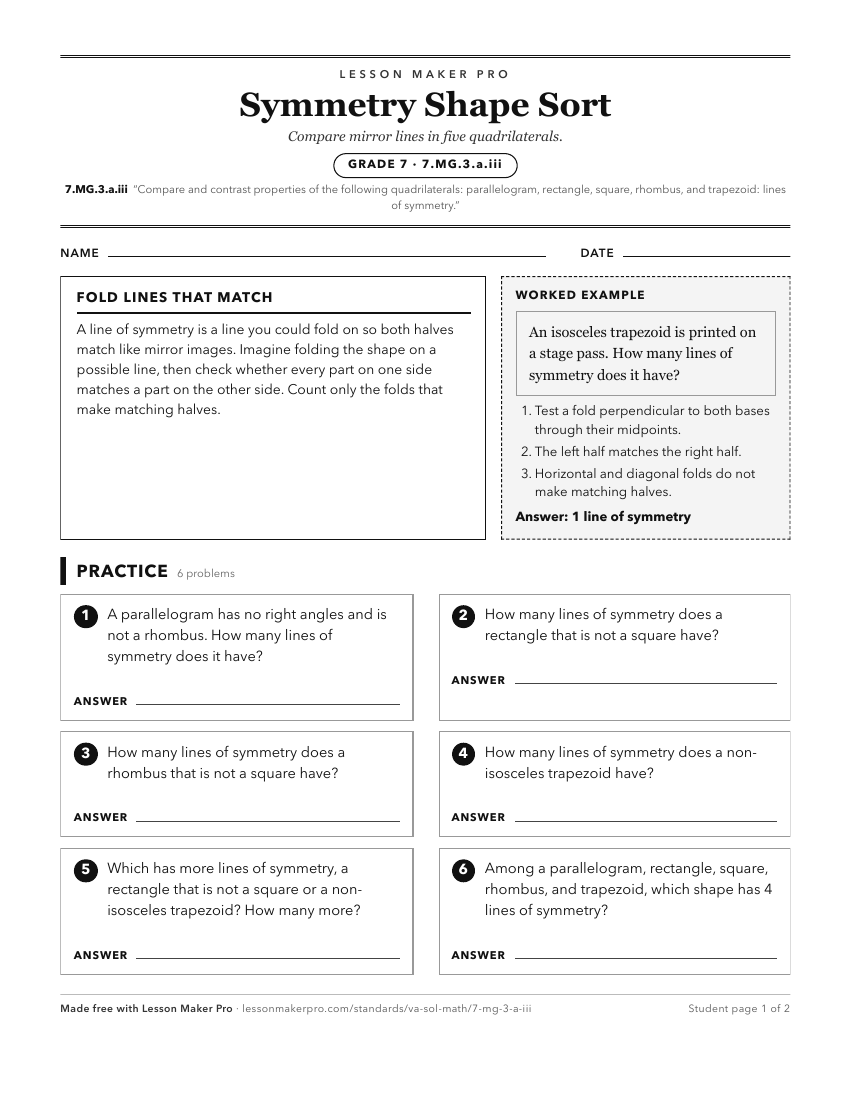
A ready-to-print activity worksheet aligned to 7.MG.3.a.iii, with an answer key for the teacher on its own page. No account needed.
PDF, US Letter, prints cleanly in black and white.
Download the worksheetKeep exploring
Related Standards
- 7.MG.3.b.iii
Sort and classify quadrilaterals as parallelograms, rectangles, trapezoids, rhombi, and/or squares based on their properties: lines of symmetry
- 7.MG.3.a.i
Compare and contrast properties of the following quadrilaterals: parallelogram, rectangle, square, rhombus, and trapezoid: parallel/perpendicular sides and diag...
- 4.MG.5.a
Develop definitions for parallelograms, rectangles, squares, rhombi, and trapezoids through the exploration of properties and attributes.
- 7.MG.3.a.ii
Compare and contrast properties of the following quadrilaterals: parallelogram, rectangle, square, rhombus, and trapezoid: congruence of angle measures, side, a...
Turn this exact standard into a lesson
Grade, subject, topic, and the complete standard are prefilled. Create one free, no account needed.
Also for this standard:Make a WorksheetMake a QuizMake a Sub Lesson