Virginia SOL 6.NS.3.b
The Standard
Recognize and represent patterns of perfect squares not to exceed 202 , by using concrete and pictorial models.
Virginia Standards of Learning for Mathematics · The student will recognize and represent patterns with whole number exponents and perfect squares.
Teacher's field guide
What This Standard Means
What Students Need to Do
- Students build or draw square arrays with equal rows and columns. They connect each side length to repeated multiplication, exponent notation, and the resulting square number.
What Mastery Looks Like
- A student can match a side length, square array, multiplication expression, exponent form, and value. They can identify perfect squares through 400 and continue the pattern.
Common Misconceptions
- Students may read 8² as 8 × 2 instead of 8 × 8. They may call any number made by multiplying two factors a perfect square. Some miss that the model must have equal rows and columns.
How to Assess It
- Give an exit ticket: “Draw and label a square model for 12². Then decide whether 225 is a perfect square and explain.”
Lesson moves
Ways to Teach It
Give pairs square tiles to build arrays from 1 by 1 through 10 by 10, then record each side length and total.
Ask students to compare 6² and 6 × 2 using words, equations, and labeled square models.
Use card sets showing side lengths, arrays, exponent forms, and values for students to match against a timer.
Plan square garden beds with side lengths from 5 to 20 feet, then calculate and compare the planting areas.
Free download
Printable 6.NS.3.b Worksheet
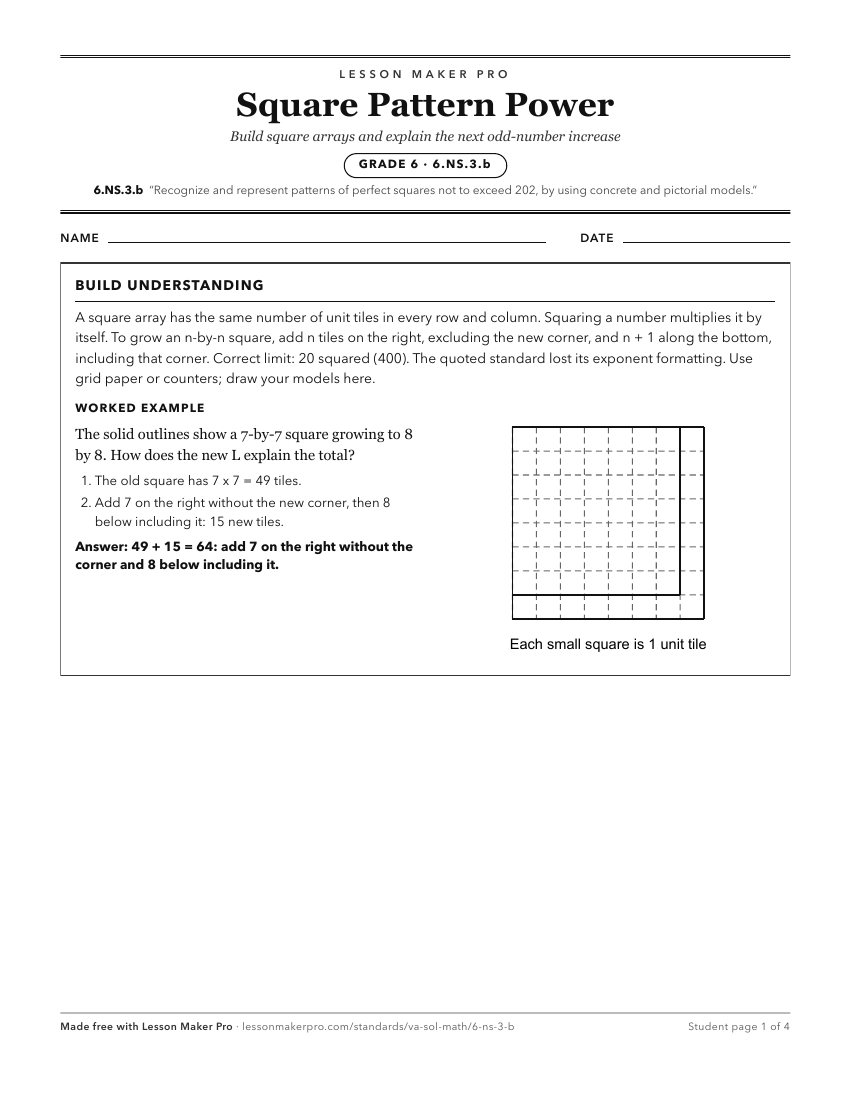
A ready-to-print activity worksheet aligned to 6.NS.3.b, with an answer key for the teacher on its own page. No account needed.
PDF, US Letter, prints cleanly in black and white.
Download the worksheetKeep exploring
Related Standards
- 6.NS.3.c
Justify if a number between 0 and 400 is a perfect square through modeling or mathematical reasoning.
- 6.NS.3
The student will recognize and represent patterns with whole number exponents and perfect squares.
- K.MG.2.a
Identify and name concrete and pictorial representations of circles, triangles, squares, and rectangles regardless of their orientation in space.
- 6.NS.3.a
Recognize and represent patterns with bases and exponents that are whole numbers.
Turn this exact standard into a lesson
Grade, subject, topic, and the complete standard are prefilled. Create one free, no account needed.
Also for this standard:Make a WorksheetMake a QuizMake a Sub Lesson