Virginia SOL 5.MG.3
SOL Standard (Knowledge and Skills Cluster)
The student will classify and measure angles and triangles, and solve problems, including those in context.
Virginia Standards of Learning for Mathematics
Cluster contents
Knowledge and Skills in This Standard
5.MG.3 is a Standards of Learning standard. These are the knowledge and skills expectations under it.
- 5.MG.3.a
Classify angles as right, acute, obtuse, or straight and justify reasoning.
- 5.MG.3.b
Classify triangles as right, acute, or obtuse and equilateral, scalene, or isosceles and justify reasoning.
- 5.MG.3.c
Identify congruent sides and right angles using geometric markings to denote properties of triangles.
- 5.MG.3.d
Compare and contrast the properties of triangles.
- 5.MG.3.e
Identify the appropriate tools (e.g., protractor, straightedge, angle ruler, available technology) to measure and draw angles.
- 5.MG.3.f
Measure right, acute, obtuse, and straight angles, using appropriate tools, and identify measures in degrees.
- 5.MG.3.g
Use models to prove that the sum of the interior angles of a triangle is 180 degrees and use the relationship to determine an unknown angle measure in a triangl...
- 5.MG.3.h
Solve addition and subtraction contextual problems to determine unknown angle measures on a diagram.
Teacher's field guide
What This Cluster Means
What Students Need to Do
- Students measure, draw, and classify angles using suitable tools and degree measures. They classify triangles by angles and side lengths, using markings to identify equal sides and right angles. They use angle relationships and the 180° triangle sum to solve for unknown measures.
What Mastery Looks Like
- Students select a suitable tool, measure or draw angles accurately, and name each angle type. They classify triangles by both angles and sides, using measures and markings as evidence. They find missing angle measures by using 180° or combining adjacent angles correctly.
Common Misconceptions
- Students often choose angle labels from appearance instead of degree measure, or read the wrong protractor scale. They may think longer rays make larger angles or miss the meaning of square and tick markings. Some use side and angle classifications as competing labels rather than two descriptions of the same triangle.
How to Assess It
- Exit ticket: A triangle has angles of 38° and 71°, with matching tick marks opposite the two 71° angles. Find the third angle, classify the triangle two ways, and justify both labels.
Lesson moves
Ways to Teach It
Cut the three corners from paper triangles, align them on a straight line, then measure and add the angles.
Ask, “Can a triangle be both right and isosceles?” Draw an example and justify each label with measures or markings.
Sort triangle cards into an angle-type and side-type grid, then check each disputed card with a protractor and ruler.
Give students a roof-truss diagram with two angle measures; have them calculate the missing angle and explain its effect on the design.
Free download
Printable 5.MG.3 Worksheet
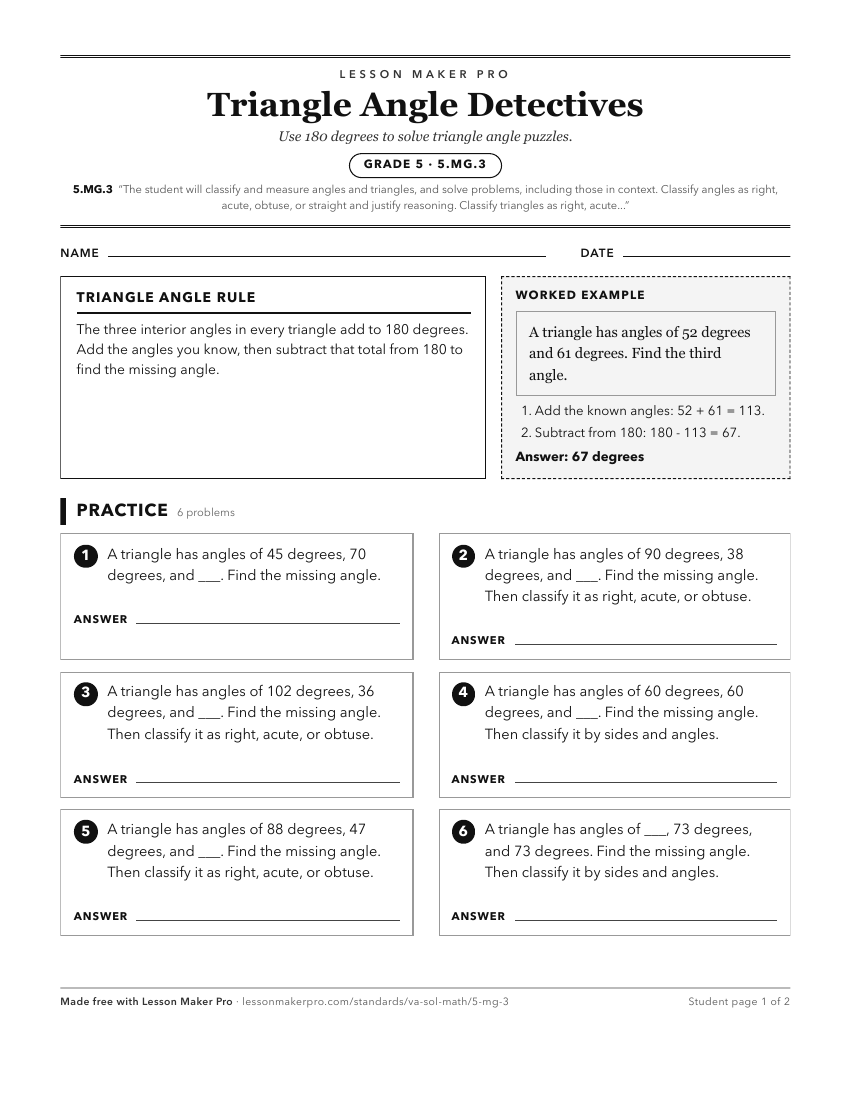
A ready-to-print activity worksheet aligned to 5.MG.3, with an answer key for the teacher on its own page. No account needed.
PDF, US Letter, prints cleanly in black and white.
Download the worksheetKeep exploring
Related Standards
- 6.MG.2
The student will reason mathematically to solve problems, including those in context, that involve the area and perimeter of triangles and parallelograms.
- 7.CE.1
The student will estimate, solve, and justify solutions to multistep contextual problems involving operations with rational numbers.
- 8.MG.4
The student will apply the Pythagorean Theorem to solve problems involving right triangles, including those in context.
- 7.CE.2
The student will solve problems, including those in context, involving proportional relationships.
Turn this cluster into a lesson
Grade, subject, topic, and the complete cluster are prefilled. Create one free, no account needed.
Also for this cluster:Make a WorksheetMake a QuizMake a Sub Lesson