Virginia SOL 1.CE.1.k
The Standard
Use concrete materials to model an equation that represents the relationship of two expressions of equal value.
Virginia Standards of Learning for Mathematics · The student will recall with automaticity addition and subtraction facts within 10 and represent, solve, and justify solutions to single-step problems, including those in context, using addition and subtraction with whole numbers within 20.
Teacher's field guide
What This Standard Means
What Students Need to Do
- Students build each side of an equation with counters, cubes, or ten-frames. They compare the totals and explain why different expressions can name the same amount.
What Mastery Looks Like
- Given 6 + 2 = 5 + 3, a student builds both sides accurately and shows that each has 8. The student explains that the equal sign means both expressions have the same value.
Common Misconceptions
- Students may treat the equal sign as a signal to calculate only what comes before it. They may think both expressions must look alike, or miscount objects when comparing totals.
How to Assess It
- Give each student cubes and the equation 7 + 1 = 10 - 2. Ask them to build both sides and complete, “They are equal because ___.”
Lesson moves
Ways to Teach It
Use linking cubes to build 7 + 2 and 10 - 1, then place the trains side by side to compare their lengths.
Ask, “How can 6 + 3 and 10 - 1 have the same value?” Partners draw models and explain.
Play Equality Match by pairing expression cards with equal values, then checking each pair with counters.
Compare two snack plates, such as 4 crackers plus 2 crackers and 8 crackers minus 2, and decide whether the amounts match.
Free download
Printable 1.CE.1.k Worksheet
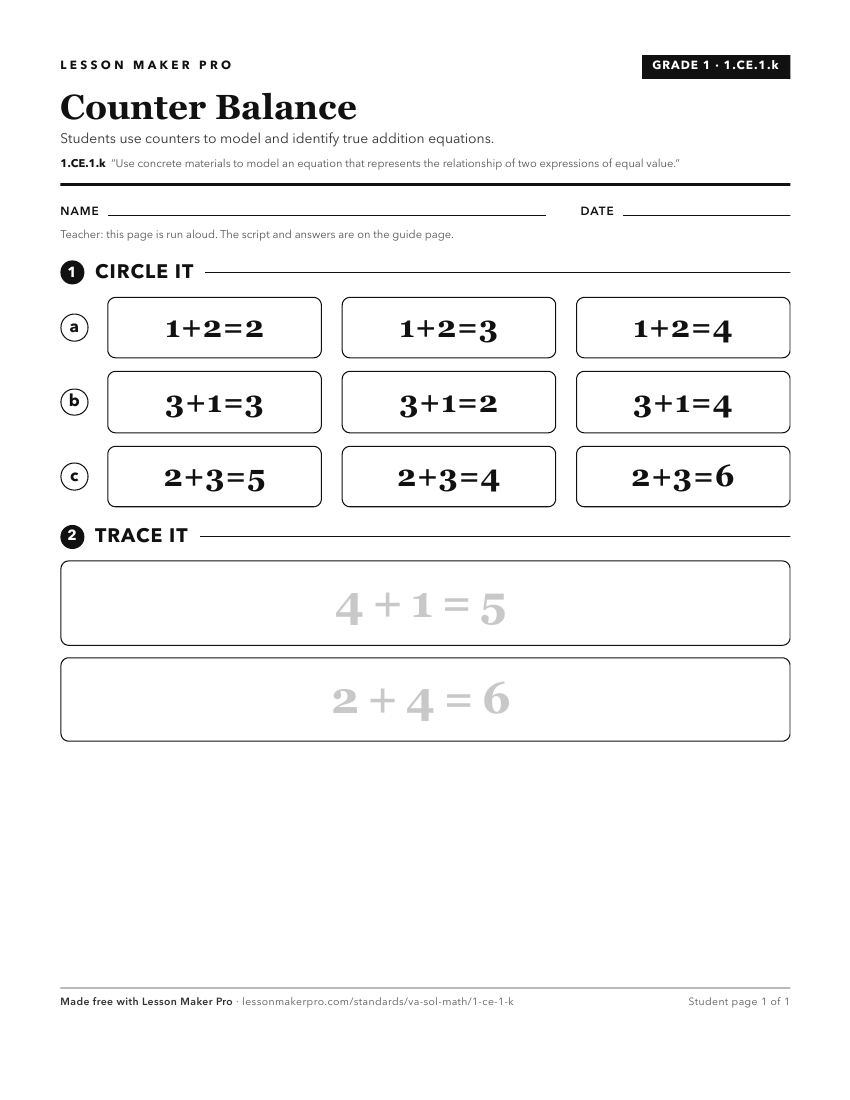
A ready-to-print activity worksheet aligned to 1.CE.1.k, with an answer key for the teacher on its own page. No account needed.
PDF, US Letter, prints cleanly in black and white.
Download the worksheetKeep exploring
Related Standards
- 2.CE.1.j
Represent and justify the relationship between values and expressions as equal or not equal using appropriate models and/or symbols (e.g., 9 + 24 = 10 + 23; 45 ...
- 4.CE.2.c
Create an equation using addition, subtraction, multiplication, and division to represent the relationship between equivalent mathematical expressions (e.g., 4 ...
- 1.CE.1.j
Use concrete materials to model, identify, and justify when two expressions are not equal (e.g., 10 - 3 is not equal to 3 + 5).
- 3.CE.2.g
Create an equation to represent the mathematical relationship between equivalent expressions using multiplication and/or division facts through 10 × 10 (e.g., 4...
Turn this exact standard into a lesson
Grade, subject, topic, and the complete standard are prefilled. Create one free, no account needed.
Also for this standard:Make a WorksheetMake a QuizMake a Sub Lesson