Virginia SOL K.LU.2.B
The Standard
With guidance and support, identify statements and questions and use ending punctuation (e.g., period and question mark)
Virginia Standards of Learning for English · Mechanics
Teacher's field guide
What This Standard Means
What Students Need to Do
- Students sort spoken and written sentences into telling sentences and asking sentences. With teacher support, they place a period after a statement and a question mark after a question.
What Mastery Looks Like
- Given a short sentence, students can tell whether it gives information or asks for information. They add a period or question mark at the end and explain their choice.
Common Misconceptions
- Students may choose punctuation by sentence length or voice volume instead of meaning. They may confuse the period and question mark or place the mark before the final word.
How to Assess It
- Read aloud, “The dog is wet” and “Is the dog wet.” Have students label each as telling or asking, then add the correct ending mark.
Lesson moves
Ways to Teach It
Give pairs sentence cards and punctuation cards, then have them match each sentence with a period or question mark.
Ask, “How can you tell if someone is asking or telling?” Record examples students create for each type.
Play Punctuation Corners by reading sentences aloud while students move to the period corner or question mark corner.
Examine classroom signs, menus, or notes and circle periods and question marks, then discuss what each sentence does.
Free download
Printable K.LU.2.B Worksheet
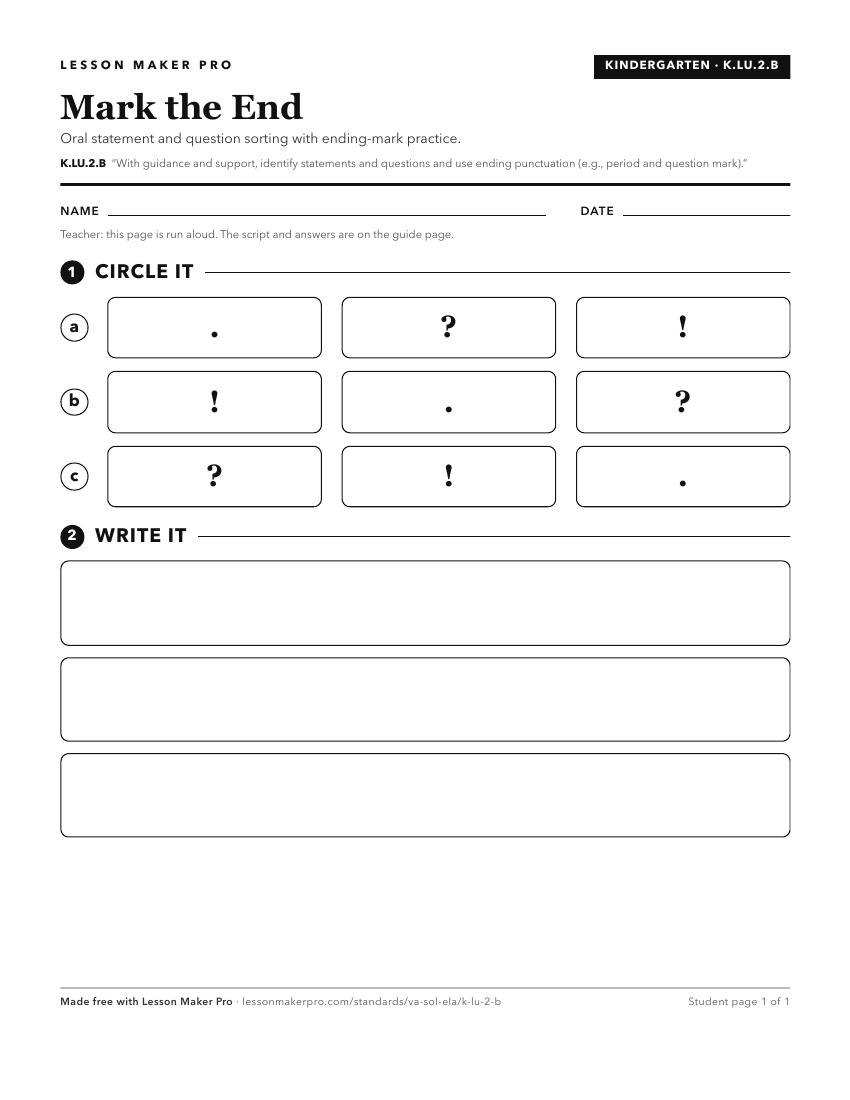
A ready-to-print activity worksheet aligned to K.LU.2.B, with an answer key for the teacher on its own page. No account needed.
PDF, US Letter, prints cleanly in black and white.
Download the worksheetKeep exploring
Related Standards
- K.FFR.1.F
Recognize the distinguishing features of a sentence (e.g., first word, capitalization, ending punctuation)
- 1.LU.2.B
Identify statements and questions and, use correct ending punctuation (e.g., period, questions mark, and exclamation points).
- 3.W.3.B
With guidance and support from peers and adults, edit writing for format and conventions such as capitalization, usage, punctuation, and spelling. (See Language...
- 2.LU.2.A
Identify statements, questions, and commands and use correct ending punctuation (e.g., period, question mark, and exclamation points).
Turn this exact standard into a lesson
Grade, subject, topic, and the complete standard are prefilled. Create one free, no account needed.
Also for this standard:Make a WorksheetMake a QuizMake a Sub Lesson