Virginia SOL 8.RI.2.C
The Standard
Analyze how an author establishes and conveys a perspective or purpose in a text and acknowledges and responds to conflicting evidence or viewpoints.
Virginia Standards of Learning for English · Craft and Style
Teacher's field guide
What This Standard Means
What Students Need to Do
- Students identify what the writer wants readers to believe, understand, or do. They examine word choice, evidence, and organization for clues. They also track how the writer treats opposing claims or evidence.
What Mastery Looks Like
- Students state the author’s viewpoint or goal precisely and support it with relevant phrases from the text. They explain how word choice, selected evidence, and responses to opposition shape the reader’s reaction.
Common Misconceptions
- Students may confuse the author’s perspective with the topic or main idea. They may label any different opinion as conflicting evidence without checking whether the author addresses it. Some assume that mentioning another view makes a text unbiased.
How to Assess It
- Give students a short editorial that includes one opposing view. Ask: “What does the author want readers to think, and how does the author answer the opposing view? Cite two phrases.”
Lesson moves
Ways to Teach It
Cut apart an editorial, then have pairs sort sentences into claim, supporting evidence, opposing view, and response.
Ask students to write: Which words reveal the author’s stance, and how does the reply to one opposing view strengthen or weaken it?
Play Evidence Match: teams pair author choices with purpose cards, then defend each match using a quoted phrase.
Compare two news reports on the same school policy and mark how each source frames disagreement and guides readers.
Free download
Printable 8.RI.2.C Worksheet
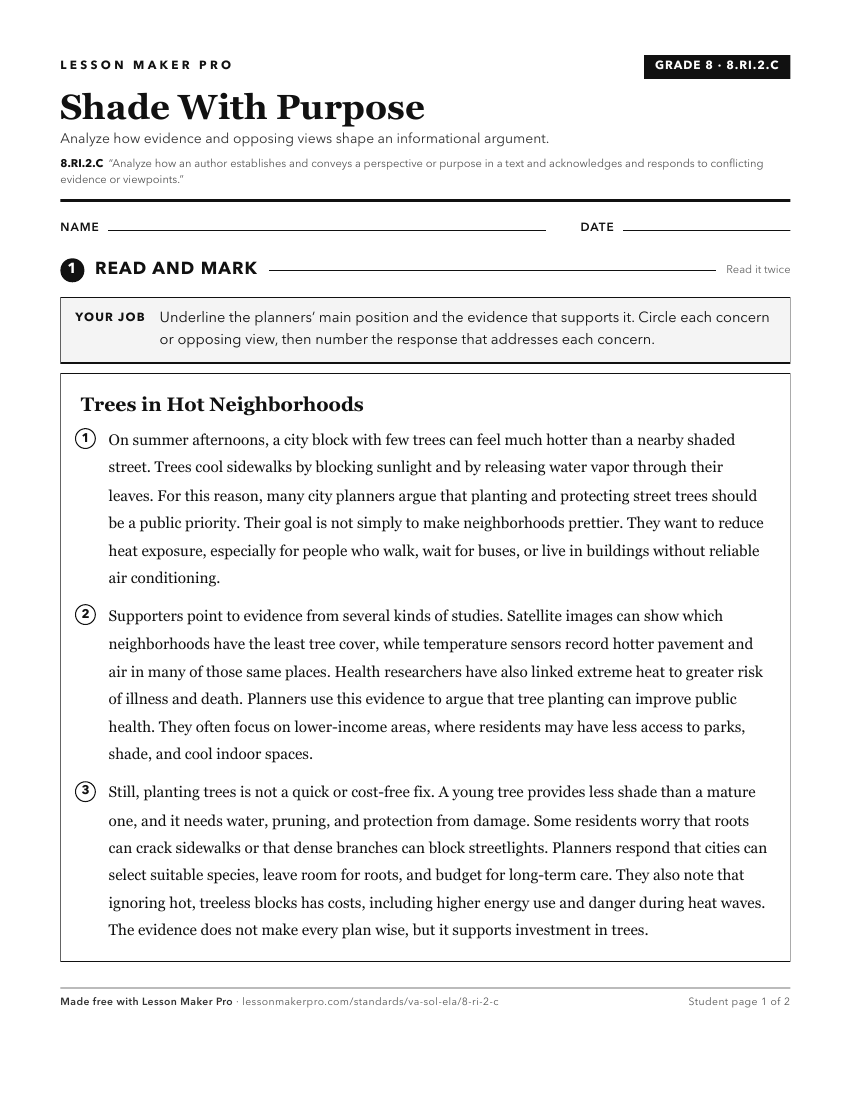
A ready-to-print activity worksheet aligned to 8.RI.2.C, with an answer key for the teacher on its own page. No account needed.
PDF, US Letter, prints cleanly in black and white.
Download the worksheetKeep exploring
Related Standards
- 5.RI.2.C
Determine the author’s purpose(s) and describe how the author’s perspective (e.g., beliefs, assumptions, biases) influences the meaning of the text.
- 7.RI.2.C
Analyze how an author’s purpose(s) reflects the author’s perspective (e.g., beliefs, assumptions, biases) and influences the meaning of an informational text.
- 8.RI.3.B
Compare and contrast how two or more authors present conflicting information on the same topic by assessing where the texts disagree in reasoning and evidence.
- 8.RL.2.C
Analyze how an author develops and contrasts the points of view of different characters or narrators in a text.
Turn this exact standard into a lesson
Grade, subject, topic, and the complete standard are prefilled. Create one free, no account needed.
Also for this standard:Make a WorksheetMake a QuizMake a Sub Lesson