Virginia SOL 7.RV.1.E
The Standard
Analyze the construction and meaning of figurative language, including simile, hyperbole, metaphor, and personification.
Virginia Standards of Learning for English · Vocabulary Development and Word Analysis
Teacher's field guide
What This Standard Means
What Students Need to Do
- Students identify comparisons, exaggerations, and human actions given to nonhuman things. They name each type and explain how the wording creates an image, mood, or meaning beyond the literal words.
What Mastery Looks Like
- Given a passage, students label each example accurately and point to the words that create it. They paraphrase the literal meaning and explain the intended effect. They distinguish direct comparisons from comparisons using “like” or “as.”
Common Misconceptions
- Students often label any sentence with “like” or “as” as a simile, even when no comparison is made. They may confuse metaphor with personification or call every dramatic description hyperbole. Some explain only the literal meaning and miss the image, tone, or emphasis.
How to Assess It
- Exit ticket: Label each example and underline the clue: “Her voice was like velvet,” “The cafeteria was a zoo,” “The moon watched us,” and “I waited a century.” Choose one and explain its literal meaning and effect.
Lesson moves
Ways to Teach It
Give pairs sentence strips and four label cards; students match each strip to a label and underline the clue words.
Ask, “How does ‘The rain punched the windows’ differ from ‘The rain hit the windows’?” Students discuss mood and word choice.
Play Figurative Language Four Corners: read a sentence, students move to a labeled corner, then justify their choice to a partner.
Have students find figurative wording in two product ads, then explain what image each phrase creates for the buyer.
Free download
Printable 7.RV.1.E Worksheet
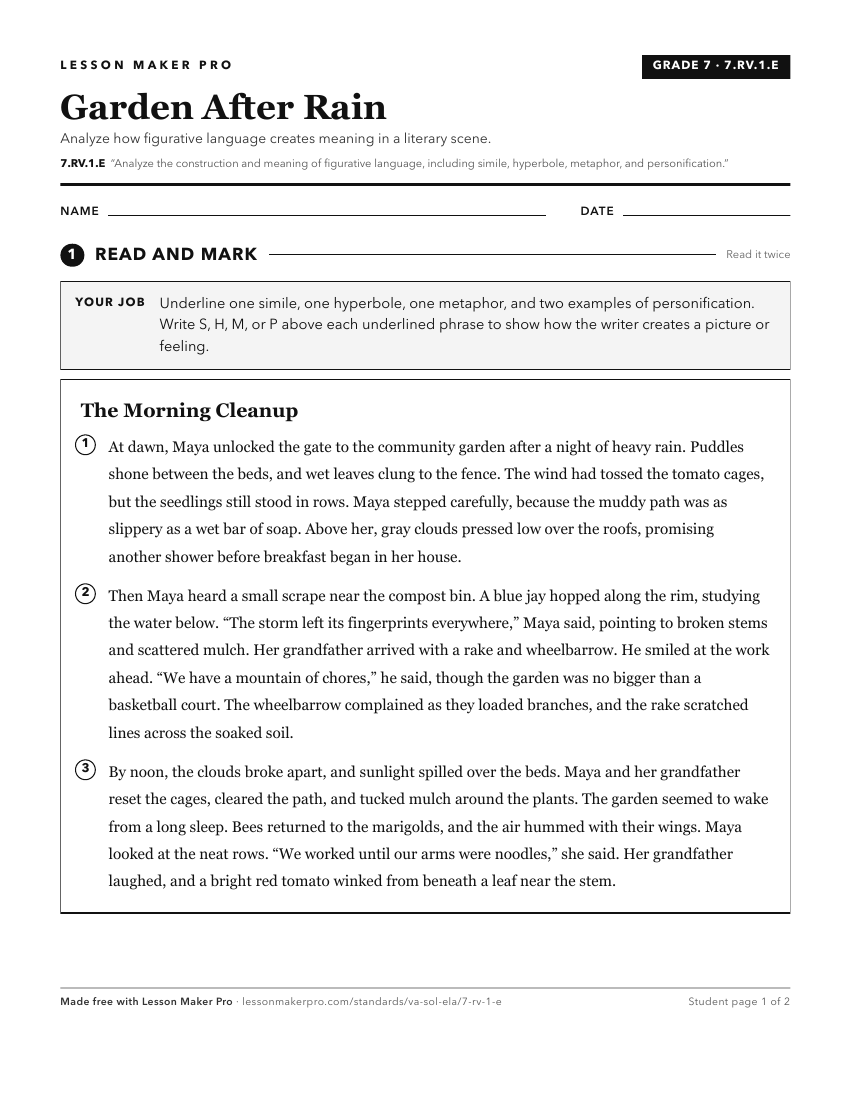
A ready-to-print activity worksheet aligned to 7.RV.1.E, with an answer key for the teacher on its own page. No account needed.
PDF, US Letter, prints cleanly in black and white.
Download the worksheetKeep exploring
Related Standards
- 10.RL.2.B
Analyze how authors use literary devices and figurative language, including allusion, allegory, and paradox to impact the meaning of the text.
- 12.RV.1.F
Interpret the meaning of figurative language and literary and classical allusions and analyze their role in texts.
- 6.RV.1.E
Explain the construction and meaning of figurative language, including simile, hyperbole, metaphor, and personification.
- 8.RV.1.E
Analyze the construction and meaning of an author’s use of symbols, analogy, and figurative language such as simile, metaphor, personification, hyperbole, and i...
Turn this exact standard into a lesson
Grade, subject, topic, and the complete standard are prefilled. Create one free, no account needed.
Also for this standard:Make a WorksheetMake a QuizMake a Sub Lesson