Virginia SOL 7.RV.1.C
The Standard
Apply knowledge of Greek and Latin roots and affixes to predict the meaning of unfamiliar words.
Virginia Standards of Learning for English · Vocabulary Development and Word Analysis
Teacher's field guide
What This Standard Means
What Students Need to Do
- Students spot familiar roots, prefixes, and suffixes inside unfamiliar words. They combine those clues with the sentence context to predict and check a reasonable meaning.
What Mastery Looks Like
- A student can explain that “subterranean” relates to being under the earth because “sub” means under and “terr” means earth. The student checks that prediction against the sentence and revises it if needed.
Common Misconceptions
- Students may assume a familiar-looking letter group is always the same root or combine word-part meanings mechanically. They may ignore context, confuse prefixes with suffixes, or think one word part gives the full definition.
How to Assess It
- Give this exit ticket: “The sailors planned to circumnavigate the island rather than cross it.” Ask students to mark word parts, predict the meaning, and cite a context clue.
Lesson moves
Ways to Teach It
Give pairs cards labeled “pre,” “dict,” “ion,” “bio,” “graph,” and “able,” then have them build words and explain each part.
Post “antibiotic” in a short paragraph, then ask: Which word parts guide your prediction, and where does context confirm it?
Play Root Relay: teams match 12 unfamiliar words to root meanings, then earn a point only after explaining one match.
Collect five words from medicine labels, menus, or news headlines, highlight Greek or Latin parts, and write a plain-language meaning for each.
Free download
Printable 7.RV.1.C Worksheet
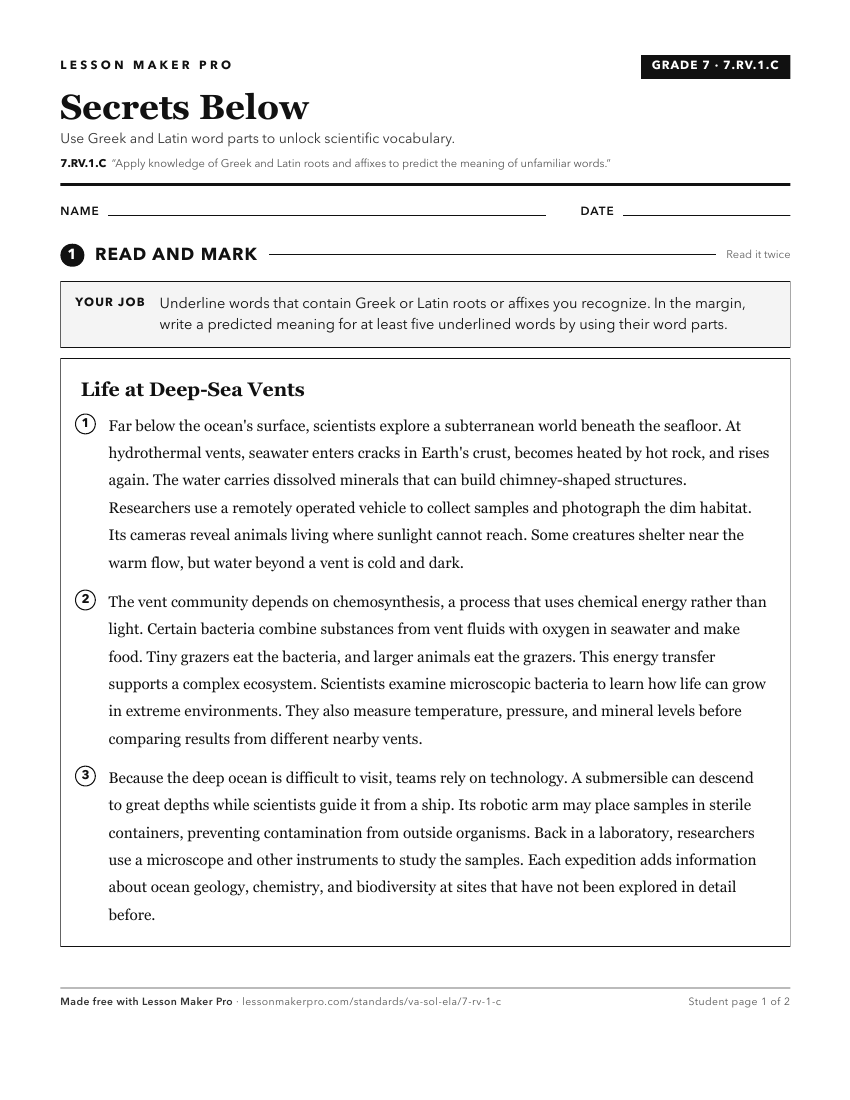
A ready-to-print activity worksheet aligned to 7.RV.1.C, with an answer key for the teacher on its own page. No account needed.
PDF, US Letter, prints cleanly in black and white.
Download the worksheetKeep exploring
Related Standards
- 5.RV.1.F
Analyze the morphological relationships between words, including how Greek and Latin affixes and roots impact the meaning.
- 6.RV.1.C
The 6th Grade version of this standard.
- 8.RV.1.C
Apply knowledge of Greek and Latin roots and affixes to determine the meaning of unfamiliar words.
- 12.RV.1.C
Use structural analysis of roots, affixes, and etymology to understand the meanings of unfamiliar and complex words.
Turn this exact standard into a lesson
Grade, subject, topic, and the complete standard are prefilled. Create one free, no account needed.
Also for this standard:Make a WorksheetMake a QuizMake a Sub Lesson