Virginia SOL 6.RV.1.C
The Standard
Apply knowledge of Greek and Latin roots and affixes to predict the meaning of unfamiliar words.
Virginia Standards of Learning for English · Vocabulary Development and Word Analysis
Teacher's field guide
What This Standard Means
What Students Need to Do
- Students break an unfamiliar word into a root, prefix, and suffix when present. They combine those meanings and use sentence clues to predict a clear definition.
What Mastery Looks Like
- Given audible, students identify aud as “hear” and -ible as “able to be.” They infer “able to be heard,” then check that meaning against the sentence.
Common Misconceptions
- Students may split words at the wrong place or treat any familiar-looking letters as a root. They may combine meanings too literally or ignore how the word is used in the sentence.
How to Assess It
- Give this prompt: “The speaker’s voice was barely audible from the back row. Underline the root, circle the suffix, and explain what audible means.”
Lesson moves
Ways to Teach It
Give pairs cards labeled tele, graph, bio, logy, pre, and dict; students build possible words and explain their predicted meanings.
Have students answer, “If two witnesses contradict each other, what does contradict mean, and how do contra and dict help?” then share responses.
Play a root relay where teams match telephone, telescope, and television to tele, then write the shared meaning.
Students scan menus, labels, or school notices for unfamiliar words, mark known roots and affixes, and propose definitions before checking a dictionary.
Free download
Printable 6.RV.1.C Worksheet
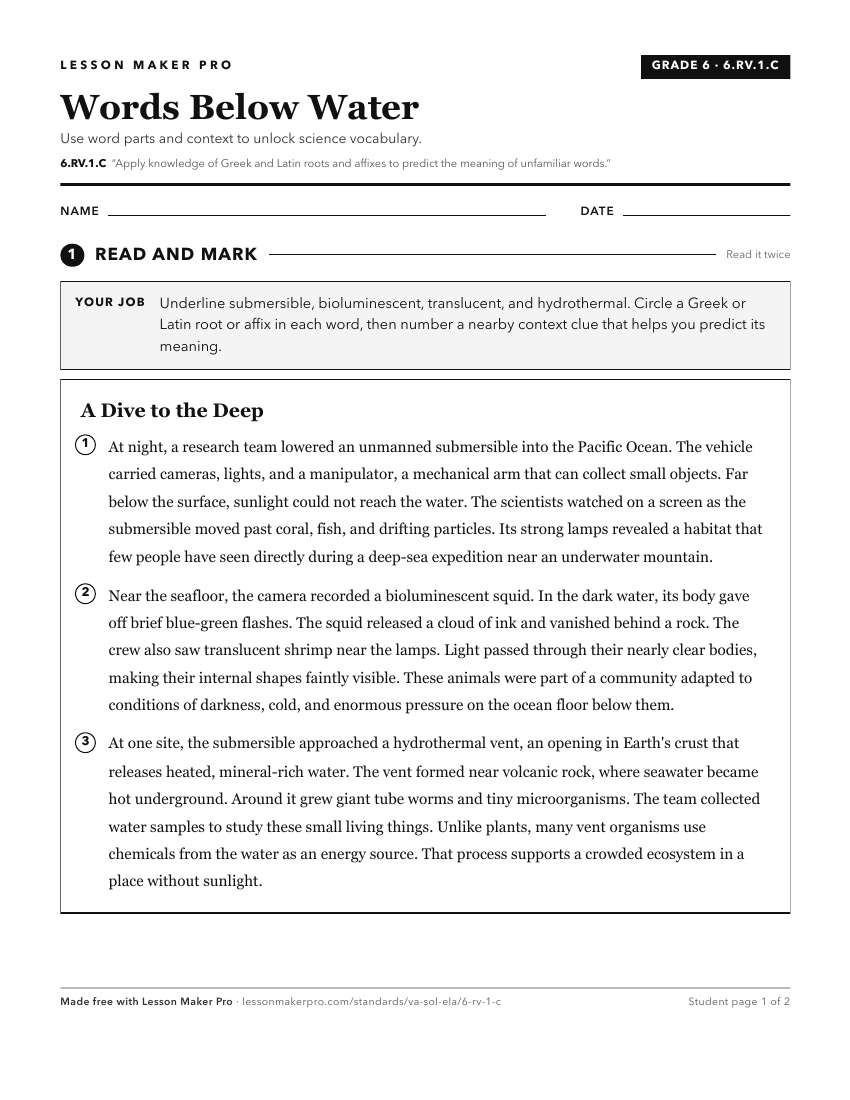
A ready-to-print activity worksheet aligned to 6.RV.1.C, with an answer key for the teacher on its own page. No account needed.
PDF, US Letter, prints cleanly in black and white.
Download the worksheetKeep exploring
Related Standards
- 5.RV.1.F
Analyze the morphological relationships between words, including how Greek and Latin affixes and roots impact the meaning.
- 7.RV.1.C
The 7th Grade version of this standard.
- 11.RV.1.C
Use structural analysis of roots, affixes, and etymology to understand the meanings of unfamiliar and complex words.
- 8.RV.1.C
Apply knowledge of Greek and Latin roots and affixes to determine the meaning of unfamiliar words.
Turn this exact standard into a lesson
Grade, subject, topic, and the complete standard are prefilled. Create one free, no account needed.
Also for this standard:Make a WorksheetMake a QuizMake a Sub Lesson