Virginia SOL 3.LU.1.B
The Standard
Distinguish between complete and incomplete sentences.
Virginia Standards of Learning for English · Grammar
Teacher's field guide
What This Standard Means
What Students Need to Do
- Students decide whether a group of words names who or what and tells what happens or is true. They revise fragments by adding missing information.
What Mastery Looks Like
- Students correctly sort sentences and fragments, then explain which part is missing. They can revise a fragment by adding a subject, a predicate, or enough words to finish the thought.
Common Misconceptions
- Students may think capitalization and end punctuation make any word group a sentence. They may mistake long fragments for sentences or reject commands because the subject “you” is not written.
How to Assess It
- Give students four examples: “The puppy under the table.” “The puppy slept.” “Close the door.” and “Because rain fell.” Ask them to label each and repair the fragments.
Lesson moves
Ways to Teach It
Give pairs subject and predicate cards; students match them, read each sentence aloud, then identify leftover cards that form fragments.
Display “After the bell rang.” and ask students to explain what is missing, then rewrite it as a full thought.
Play Sentence or Fragment corners: read a word group, then students move to a labeled corner and justify their choice.
Have students inspect classroom signs and announcements, recording two sentences and revising one fragment into a sentence.
Free download
Printable 3.LU.1.B Worksheet
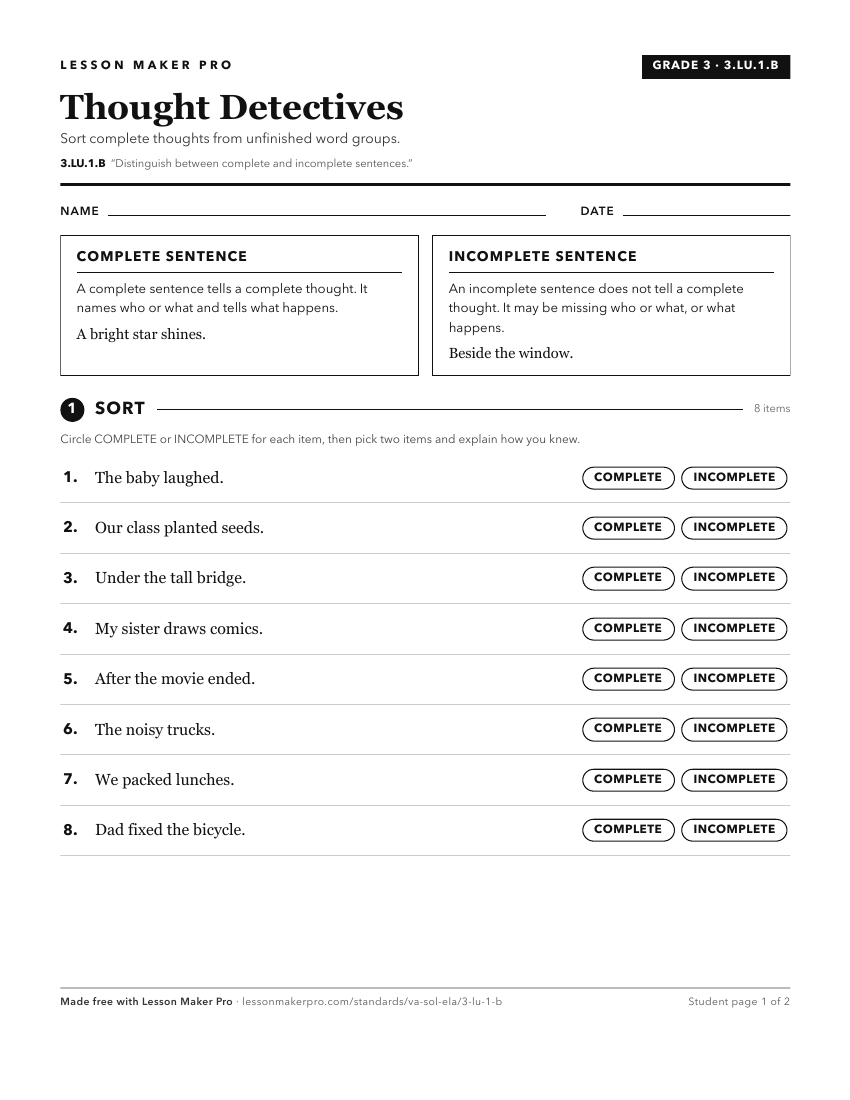
A ready-to-print activity worksheet aligned to 3.LU.1.B, with an answer key for the teacher on its own page. No account needed.
PDF, US Letter, prints cleanly in black and white.
Download the worksheetKeep exploring
Related Standards
- K.FFR.1.F
Recognize the distinguishing features of a sentence (e.g., first word, capitalization, ending punctuation)
- 2.LU.1.A
Produce and expand complete sentences, both simple and compound.
- 8.LU.2.A
Construct complete sentences with appropriate punctuation, avoiding comma splices and run-ons in writing.
- 6.LU.2.A
Construct complete sentences with appropriate punctuation, avoiding comma splices and run-ons in writing.
Turn this exact standard into a lesson
Grade, subject, topic, and the complete standard are prefilled. Create one free, no account needed.
Also for this standard:Make a WorksheetMake a QuizMake a Sub Lesson