Virginia SOL 10.LU
SOL Standard (Knowledge and Skills Cluster)
The student will use the conventions of Standard English when speaking and writing, differentiating between contexts that call for formal English and situations where informal discourse is more appropriate.
Virginia Standards of Learning for English
Cluster contents
Knowledge and Skills in This Standard
10.LU is a Standards of Learning standard. These are the knowledge and skills expectations under it.
- 10.LU.1.A
Use, edit, and revise parallel structure across complex sentences and paragraphs in writing.
- 10.LU.1.B
Use complex sentence structure (made up of main and subordinate clauses and subordinating conjunctions) to infuse sentence variety in writing.
- 10.LU.1.C
Recognize and use active and passive voice to convey a desired effect in speaking and writing.
- 10.LU.1.D
Use subordination, coordination, apposition, and other devices to indicate the relationship between ideas clearly.
- 10.LU.1.E
Maintain consistent verb tense when speaking and writing.
- 10.LU.2.A
Know and apply the rules for the use of a colon (e.g., joining independent clauses, introducing a list, introducing a quotation) when writing.
- 10.LU.2.B
Apply a style manual, such as that of the Modern Language Association (MLA) or the American Psychological Association (APA), to apply rules for punctuation and ...
- 10.LU.2.C
Spell correctly, consulting reference materials to check as needed.
Teacher's field guide
What This Cluster Means
What Students Need to Do
- Students choose formal or informal English to fit the audience and purpose. They revise sentences for parallel structure, varied clauses, clear idea relationships, consistent tense, and purposeful voice. They use colons, quotation formats, spelling tools, and an assigned style guide correctly.
What Mastery Looks Like
- A student can revise a paragraph so its verbs, lists, clauses, and tense are consistent and its sentence patterns are varied. The student can explain a choice between active and passive voice, format a quotation, and use a colon for a valid purpose.
Common Misconceptions
- Students often mistake any long sentence for a complex sentence, join clauses with a colon incorrectly, or shift tense without reason. They may mix forms in a series, assume passive voice is always wrong, and treat formal English as simply avoiding contractions. Quotation punctuation and citations often get blended across MLA and APA rules.
How to Assess It
- Use this exit ticket: “Yesterday, Maya interviews witnesses, checked records, and she wrote notes: because the deadline was near. Her editor said the facts were clear.” Students revise tense, parallel structure, and colon use, create one complex sentence, format the editor’s words as a direct quotation, and label the voice.
Lesson moves
Ways to Teach It
Cut apart clause, conjunction, and modifier cards, then have pairs assemble three correct complex sentences and explain each idea relationship.
Compare a text message and a scholarship email, then write which language choices fit each audience and revise one mismatched line.
Run an editing relay where teams correct tense shifts, broken parallel lists, weak voice choices, colon errors, and quotation formatting.
Rewrite a school announcement for social media and a principal’s newsletter, changing tone, sentence structure, voice, and mechanics to fit.
Free download
Printable 10.LU Worksheet
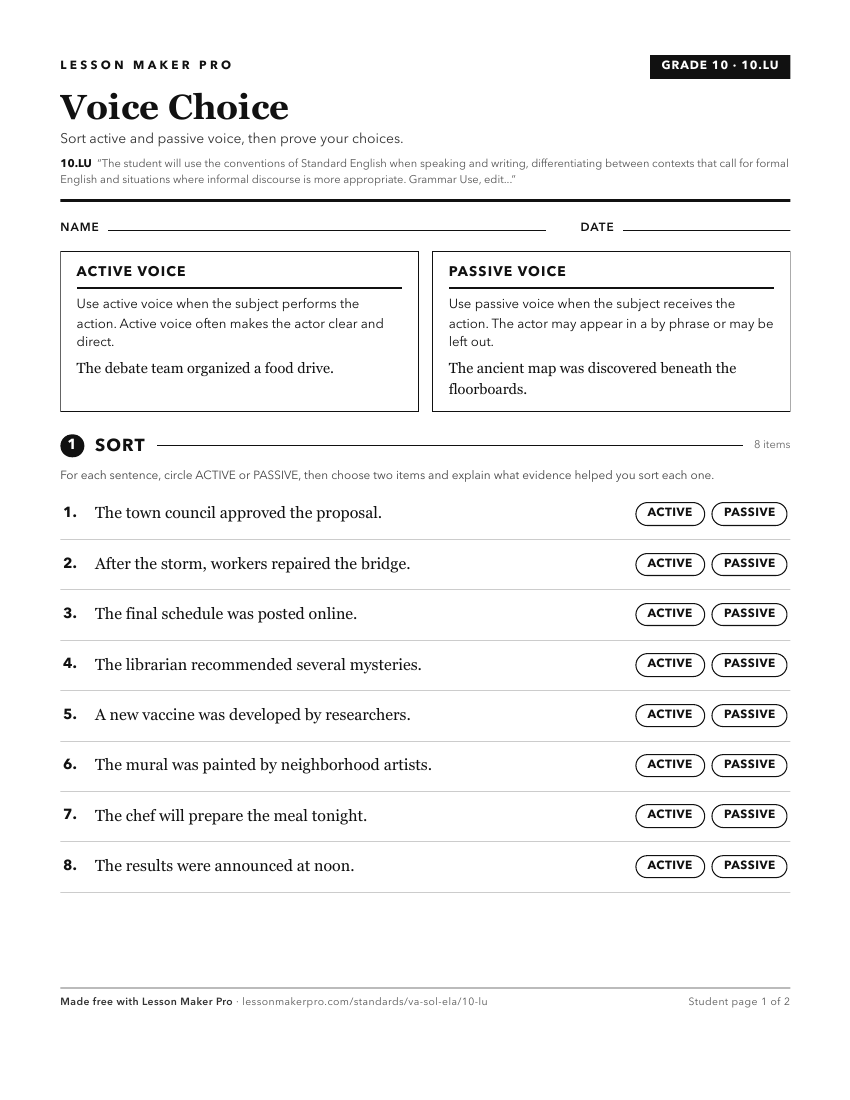
A ready-to-print activity worksheet aligned to 10.LU, with an answer key for the teacher on its own page. No account needed.
PDF, US Letter, prints cleanly in black and white.
Download the worksheetKeep exploring
Related Standards
Turn this cluster into a lesson
Grade, subject, topic, and the complete cluster are prefilled. Create one free, no account needed.
Also for this cluster:Make a WorksheetMake a QuizMake a Sub Lesson