Texas TEKS 7.6.B
The Standard
- 7.6
- History. The student understands how individuals, events, and issues shaped the history of Texas from Reconstruction through the beginning of the 20th century. The student is expected to:
identify significant individuals, events, and issues, including the development of the cattle industry from its Spanish beginnings and the cowboy way of life
Texas Essential Knowledge and Skills for Social Studies
Teacher's field guide
What This Standard Means
What Students Need to Do
- Students trace how Spanish ranching traditions developed into the Texas cattle industry and cowboy culture. They identify people such as vaqueros, Charles Goodnight, and Richard King, then explain key events and conflicts.
What Mastery Looks Like
- Students can place Spanish ranching, cattle drives, railroads, and barbed wire in a clear sequence. They can connect people, tools, and traditions to changes in ranching and cowboy life.
Common Misconceptions
- Students may think the cattle industry began after the Civil War or that all cowboys were white Anglo men. They may also confuse fictional gunfighters with working cowboys and overlook how railroads and barbed wire ended major cattle drives.
How to Assess It
- Exit ticket: Put Spanish ranching, cattle drives, railroads, and barbed wire in order. Explain how one person or group shaped the industry.
Lesson moves
Ways to Teach It
Students use yarn, a Texas map, and event cards to build a cattle trail from a Spanish mission ranch to a railhead.
Write one paragraph explaining how vaquero traditions shaped Texas cowboy work, clothing, tools, and language.
Run a card-sorting race matching people, events, tools, and issues to Spanish ranching, cattle drives, or the closing open range.
Compare a current Texas ranch website with an 1870s cattle-drive account, then list two continuities and two changes.
Free download
Printable 7.6.B Worksheet
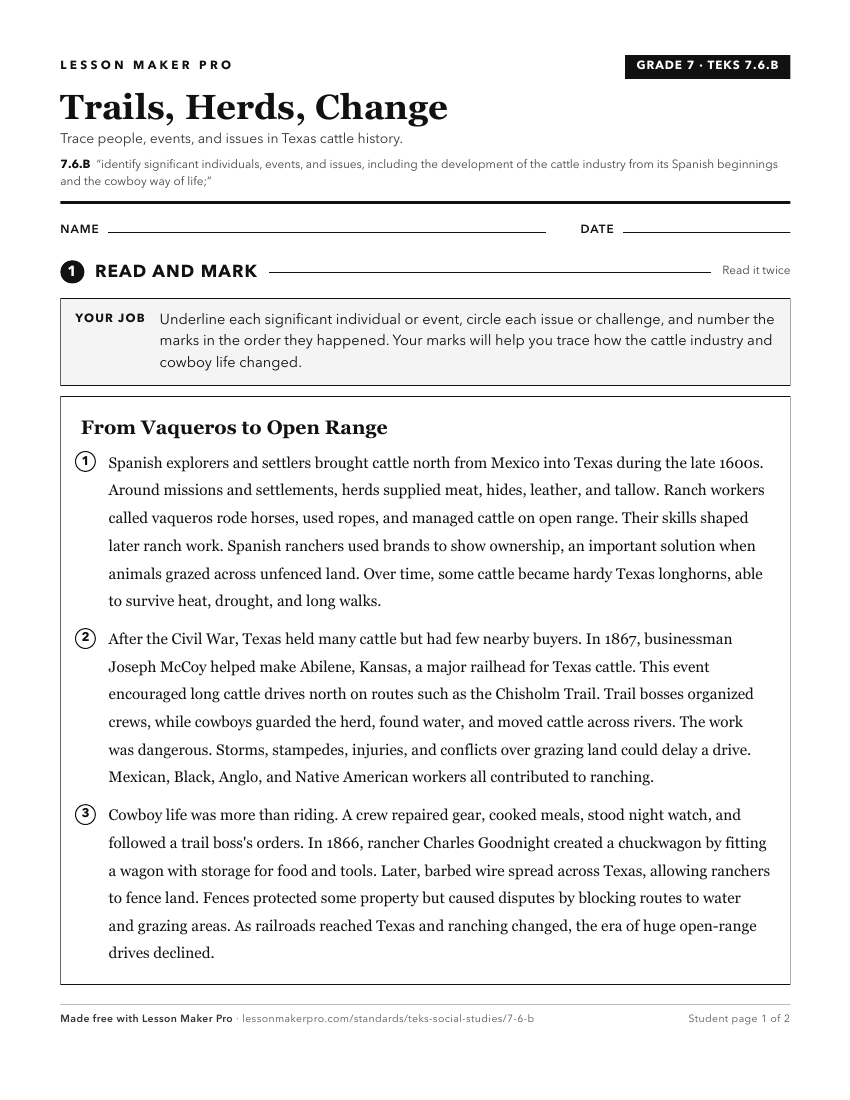
A ready-to-print activity worksheet aligned to 7.6.B, with an answer key for the teacher on its own page. No account needed.
PDF, US Letter, prints cleanly in black and white.
Download the worksheetKeep exploring
Related Standards
- 7.6.A
identify significant individuals, events, and issues, including the factors leading to the expansion of the Texas frontier, the effects of westward expansion on...
- 4.4.B
explain the growth, development, and impact of the cattle industry such as contributions made by Charles Goodnight, Richard King, and Lizzie Johnson
- 7.2.B
identify important individuals, events, and issues related to European exploration of Texas such as Alonso Álvarez de Pineda, Álvar Núñez Cabeza de Vaca, the se...
- 7.2.C
identify important individuals, events, and issues related to European colonization of Texas, including the establishment of Catholic missions, towns, and ranch...
Turn this exact standard into a lesson
Grade, subject, topic, and the complete standard are prefilled. Create one free, no account needed.
Also for this standard:Make a WorksheetMake a QuizMake a Sub Lesson