Texas TEKS 7.12.A
The Standard
- 7.12
- Organisms and environments. The student understands that ecosystems are dependent upon the cycling of matter and the flow of energy. The student is expected to:
diagram the flow of energy within trophic levels and describe how the available energy decreases in successive trophic levels in energy pyramids
Texas Essential Knowledge and Skills for Science
Teacher's field guide
What This Standard Means
What Students Need to Do
- Students build and read energy pyramids with producers at the base and consumers above them. They use arrows and labels to show where energy moves and explain why less energy reaches each higher level.
What Mastery Looks Like
- Given a food chain, a student can draw and label an accurate energy pyramid. They identify the base as having the most energy and explain that organisms use energy for life processes and release heat.
Common Misconceptions
- Students may point arrows toward the food instead of the organism receiving energy. They may think top predators have the most energy because they are larger or stronger. Some think all energy passes upward or cycles through the ecosystem.
How to Assess It
- Exit ticket: Draw an energy pyramid for grass, grasshopper, frog, and hawk. Label each level and explain why the hawk level has the least available energy.
Lesson moves
Ways to Teach It
Students transfer 10 percent of 1,000 mL colored water at each step through four labeled cups, then sketch an energy pyramid.
Students write a claim explaining why a grassland supports many grasshoppers but few hawks, using energy transfer as evidence.
Give pairs organism cards and energy value cards, then have them race to build a correct pyramid with decreasing values.
Students compare a corn meal with beef from corn-fed cattle and explain which food chain has fewer energy transfers.
Free download
Printable 7.12.A Worksheet
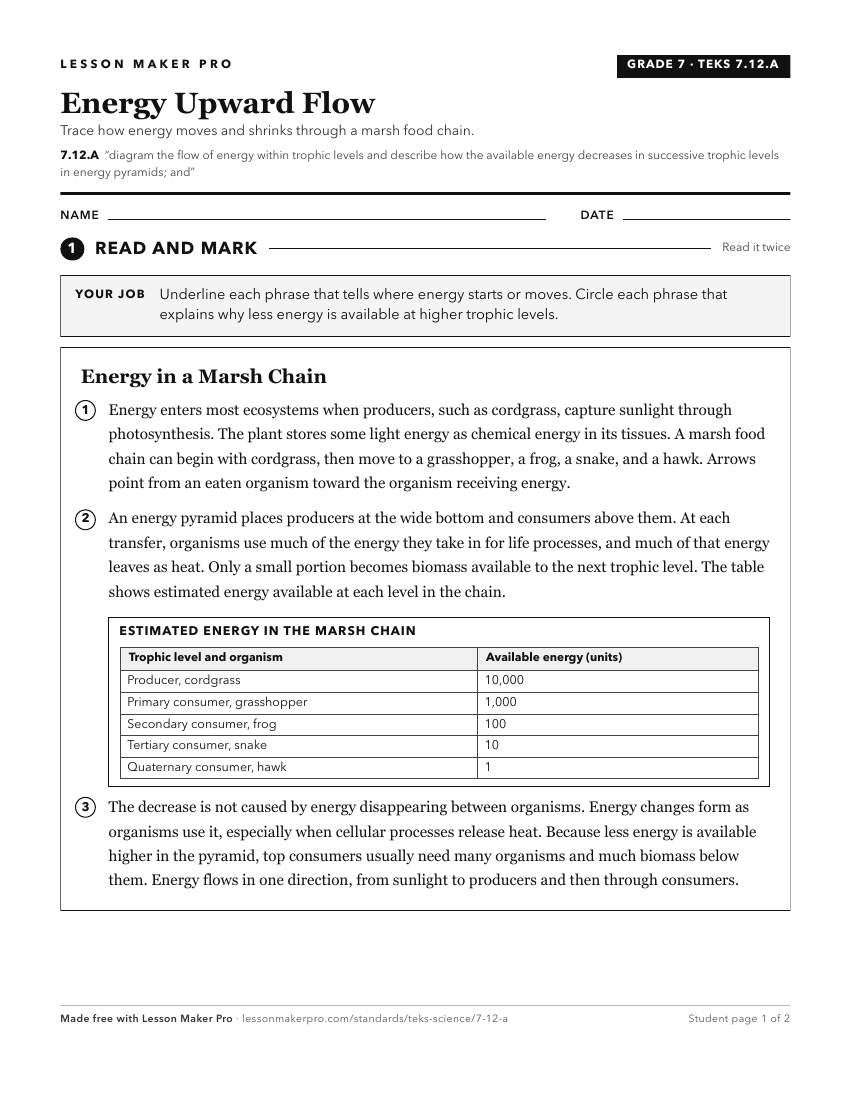
A ready-to-print activity worksheet aligned to 7.12.A, with an answer key for the teacher on its own page. No account needed.
PDF, US Letter, prints cleanly in black and white.
Download the worksheetKeep exploring
Related Standards
- 1.12.C
identify and illustrate how living organisms depend on each other through food chains.
- 4.12.B
describe the cycling of matter and flow of energy through food webs, including the roles of the Sun, producers, consumers, and decomposers
- 2.12.B
create and describe food chains identifying producers and consumers to demonstrate how animals depend on other living things
- 3.12.B
identify and describe the flow of energy in a food chain and predict how changes in a food chain such as removal of frogs from a pond or bees from a field affec...
Turn this exact standard into a lesson
Grade, subject, topic, and the complete standard are prefilled. Create one free, no account needed.
Also for this standard:Make a WorksheetMake a QuizMake a Sub Lesson