Texas TEKS 3.1.G
The Standard
- 3.1
- Scientific and engineering practices. The student asks questions, identifies problems, and plans and safely conducts classroom, laboratory, and field investigations to answer questions, explain phenomena, or design solutions using appropriate tools and models. The student is expected to:
develop and use models to represent phenomena, objects, and processes or design a prototype for a solution to a problem.
Texas Essential Knowledge and Skills for Science
Teacher's field guide
What This Standard Means
What Students Need to Do
- Students build, draw, or use a model to show how something works, changes, or is arranged. They use observations to explain and revise the model or prototype.
What Mastery Looks Like
- Students include parts that help explain the object, event, or process. They can explain how the parts connect, test their work, and name one limitation or needed change.
Common Misconceptions
- Students may treat a model as a decoration or exact copy instead of an explanation. They may think a prototype must work on the first try or include details unrelated to the problem.
How to Assess It
- Exit ticket: Draw a model showing what happens when a puddle dries. Add labels and arrows, then write one sentence explaining the change.
Lesson moves
Ways to Teach It
Use clay, cups, and straws to build a model showing how water flows downhill, then revise it after a test.
Show two seed dispersal models and ask, "Which parts explain movement, and what does each model leave out?"
Play Model Match: students pair picture models with phenomena cards, then justify each match using one visible feature.
Design a foil shade prototype that keeps an ice cube cool, test it under a lamp, and improve one feature.
Free download
Printable 3.1.G Worksheet
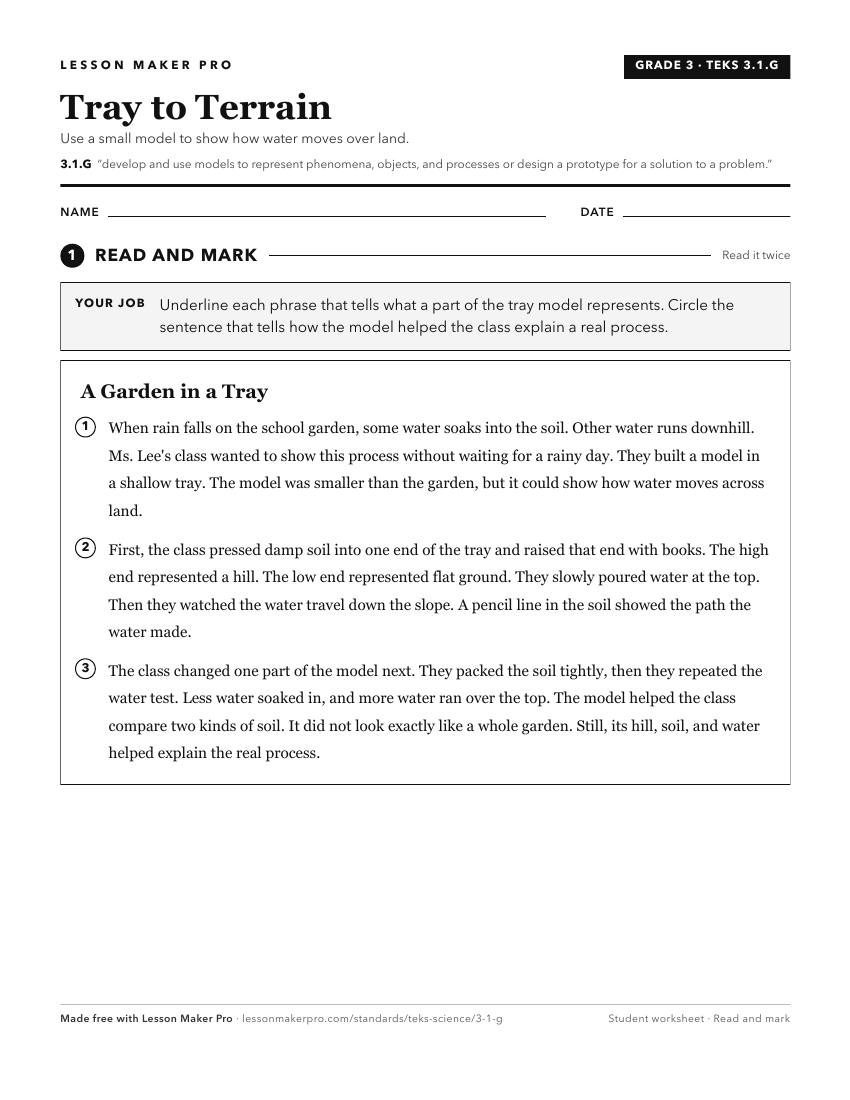
A ready-to-print activity worksheet aligned to 3.1.G, with an answer key for the teacher on its own page. No account needed.
PDF, US Letter, prints cleanly in black and white.
Download the worksheetKeep exploring
Related Standards
Turn this exact standard into a lesson
Grade, subject, topic, and the complete standard are prefilled. Create one free, no account needed.
Also for this standard:Make a WorksheetMake a QuizMake a Sub Lesson