TEKS Math 3.5.E
The Standard
represent real-world relationships using number pairs in a table and verbal descriptions
Texas Essential Knowledge and Skills for Mathematics
Teacher's field guide
What This Standard Means
What Students Need to Do
- Students find two quantities in a real situation and record matching values in a labeled table. They explain in words what the pairs mean and how the quantities are connected.
What Mastery Looks Like
- Students create a labeled table with accurate matching values from a given situation. They explain what each pair means and describe how one quantity changes with the other.
Common Misconceptions
- Students may reverse the columns or pair values from different rows. They may add the same amount when the situation calls for equal groups, or describe one row instead of the overall pattern.
How to Assess It
- Give this exit ticket: “A notebook costs $3. Complete a table for 1, 2, and 4 notebooks, then explain how the columns are connected.”
Lesson moves
Ways to Teach It
Build 1 to 5 bags with 4 counters each, then record bags and total counters in a two-column table.
Show a table for tricycles and wheels; ask, “What does each pair mean, and how are the columns connected?”
Play a matching game using situation cards, completed tables, and relationship descriptions; students justify each three-card match.
Use a classroom snack menu to calculate and table the cost of buying 1, 2, 3, or 4 identical items.
Free download
Printable 3.5.E Worksheet
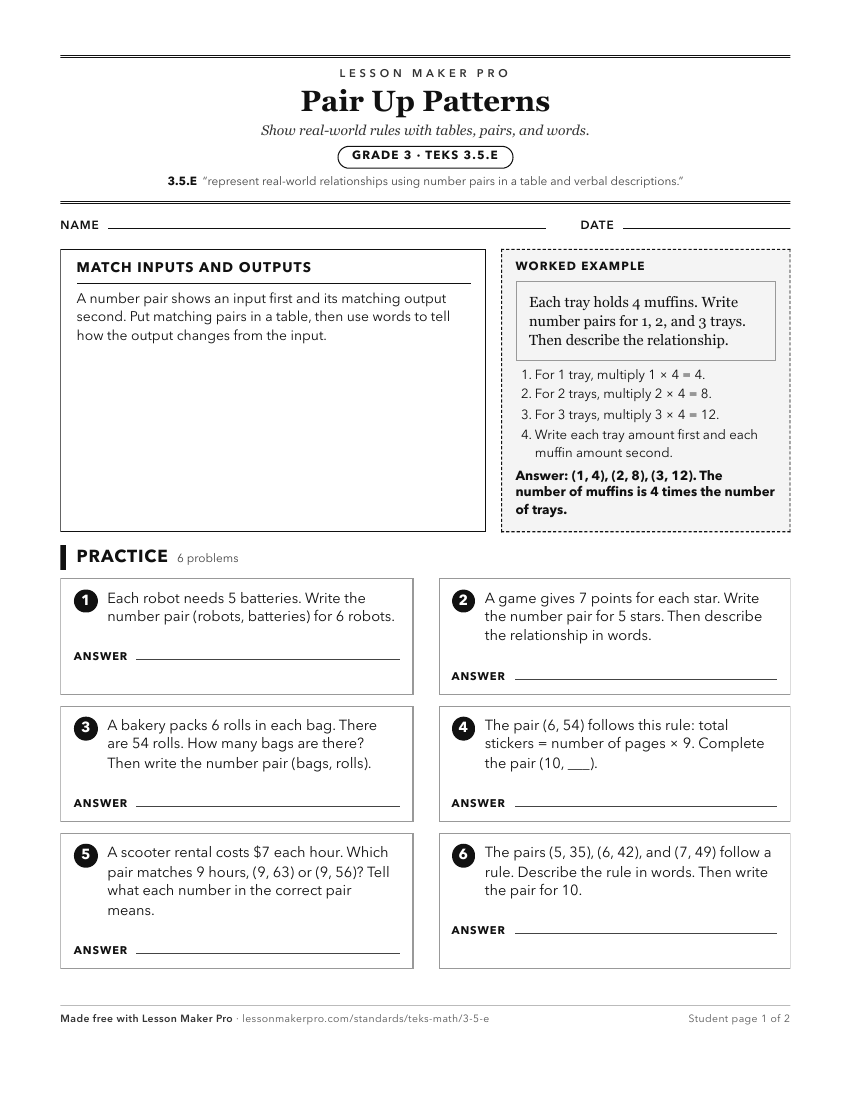
A ready-to-print activity worksheet aligned to 3.5.E, with an answer key for the teacher on its own page. No account needed.
PDF, US Letter, prints cleanly in black and white.
Download the worksheetKeep exploring
Related Standards
- K.1.F
analyze mathematical relationships to connect and communicate mathematical ideas
- 6.6.C
represent a given situation using verbal descriptions, tables, graphs, and equations in the form y = kx or y = x + b
- 7.1.F
analyze mathematical relationships to connect and communicate mathematical ideas
- 8.5.G
identify functions using sets of ordered pairs, tables, mappings, and graphs
Turn this exact standard into a lesson
Grade, subject, topic, and the complete standard are prefilled. Create one free, no account needed.
Also for this standard:Make a WorksheetMake a QuizMake a Sub Lesson