TEKS Math 2.8.A
The Standard
create two-dimensional shapes based on given attributes, including number of sides and vertices
Texas Essential Knowledge and Skills for Mathematics
Teacher's field guide
What This Standard Means
What Students Need to Do
- Students make flat, closed shapes from clues about sides and vertices. They count straight sides and identify each corner where two sides meet.
What Mastery Looks Like
- Students draw a closed shape that matches the clues. They correctly count and label its sides and vertices, even when the shape is turned or uneven.
Common Misconceptions
- Students may count curved edges as sides or confuse sides with vertices. They may think a turned or stretched shape becomes a different shape.
How to Assess It
- Give students this exit ticket: “Draw a closed shape with six straight sides. Mark each vertex and write the total.”
Lesson moves
Ways to Teach It
Give students craft sticks and clay balls to build shapes, using the sticks as sides and clay balls as vertices.
Ask, “Can two shapes have four sides but look different?” Have students draw examples and explain their thinking.
Play Shape Clue Match by pairing cards showing shapes with cards listing their numbers of sides and vertices.
Take a classroom shape hunt, then sketch one object and label the sides and vertices on its flat face.
Free download
Printable 2.8.A Worksheet
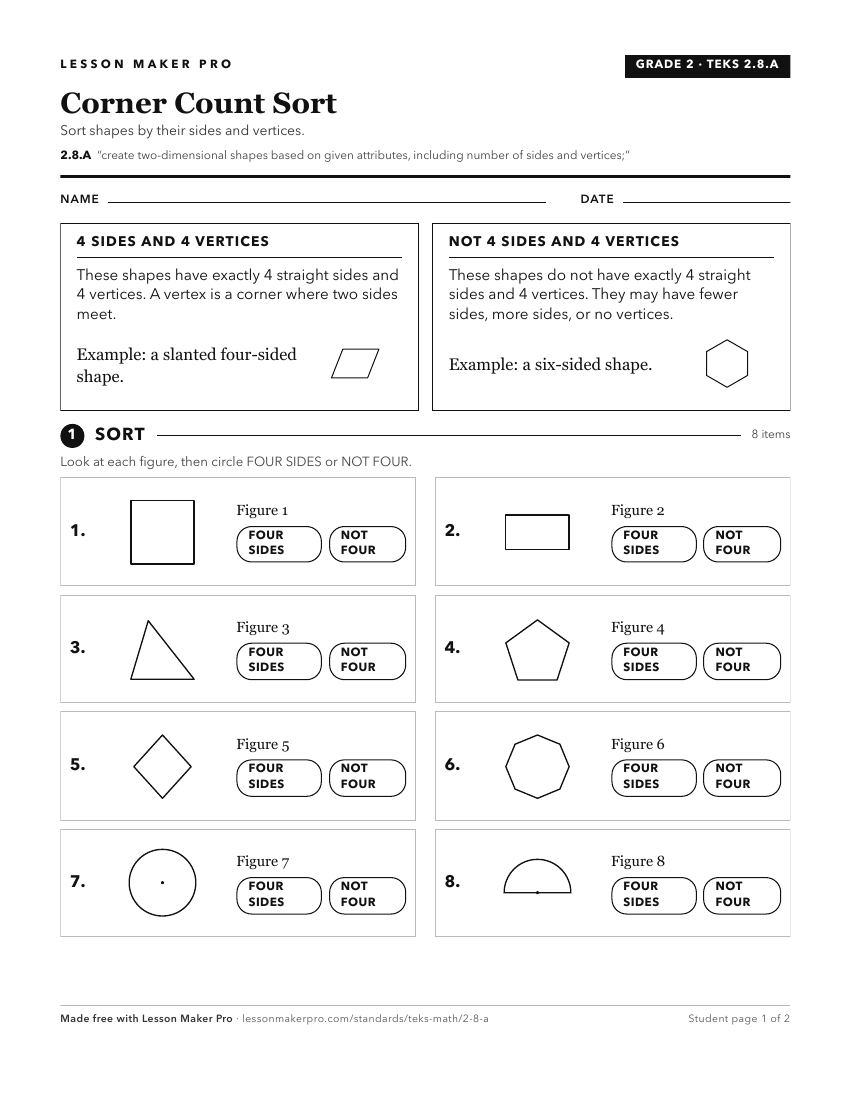
A ready-to-print activity worksheet aligned to 2.8.A, with an answer key for the teacher on its own page. No account needed.
PDF, US Letter, prints cleanly in black and white.
Download the worksheetKeep exploring
Related Standards
- 2.8.D
compose two-dimensional shapes and three-dimensional solids with given properties or attributes
- K.6.F
create two-dimensional shapes using a variety of materials and drawings
- 1.6.C
create two-dimensional figures, including circles, triangles, rectangles, and squares, as special rectangles, rhombuses, and hexagons
- 1.6.A
classify and sort regular and irregular two-dimensional shapes based on attributes using informal geometric language
Turn this exact standard into a lesson
Grade, subject, topic, and the complete standard are prefilled. Create one free, no account needed.
Also for this standard:Make a WorksheetMake a QuizMake a Sub Lesson