TEKS Math 2.1.C
The Standard
select tools, including real objects, manipulatives, paper and pencil, and technology as appropriate, and techniques, including mental math, estimation, and number sense as appropriate, to solve problems
Texas Essential Knowledge and Skills for Mathematics
Teacher's field guide
What This Standard Means
What Students Need to Do
- Students choose a useful tool or strategy before solving a math problem. They may use objects, drawings, mental math, estimation, or a digital tool, then explain why the choice fits.
What Mastery Looks Like
- A student matches a problem with an efficient tool or strategy, uses it correctly, and gets a reasonable answer. The student explains the choice and switches methods when needed.
Common Misconceptions
- Students may use counters for every problem or assume a digital tool is always faster. They may estimate when an exact answer is needed or skip checking whether an answer is reasonable.
How to Assess It
- Give this prompt: “There are 47 red beads and 26 blue beads. How many beads are there?” Students choose a method, solve, and explain their choice.
Lesson moves
Ways to Teach It
Set out counters, base-ten blocks, number lines, and grid paper. Students choose one to solve 38 + 24 and defend their choice.
Post three problems and ask, “Which needs an exact answer, which allows an estimate, and what tool would you choose for each?”
Play Tool Match. Pairs draw a problem card, select a tool card, solve, then earn a point for a clear justification.
Give a party list with 36 cups and 28 plates. Students choose a method to find how many items are needed altogether.
Free download
Printable 2.1.C Worksheet
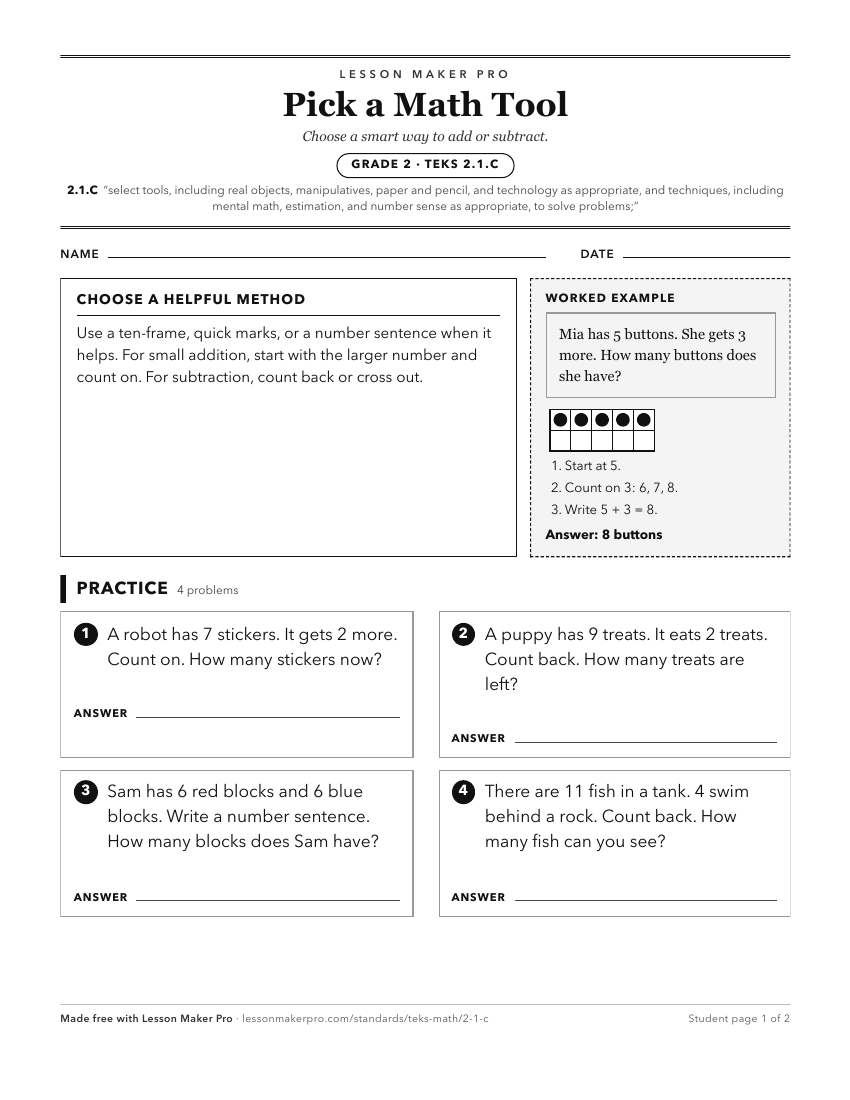
A ready-to-print activity worksheet aligned to 2.1.C, with an answer key for the teacher on its own page. No account needed.
PDF, US Letter, prints cleanly in black and white.
Download the worksheetKeep exploring
Related Standards
Turn this exact standard into a lesson
Grade, subject, topic, and the complete standard are prefilled. Create one free, no account needed.
Also for this standard:Make a WorksheetMake a QuizMake a Sub Lesson