TEKS ELAR K.10.D.vii
The Standard
capitalization of the first letter in a sentence and name
Texas Essential Knowledge and Skills for English Language Arts and Reading · The student uses the writing process recursively to compose multiple texts that are legible and uses appropriate conventions.
Teacher's field guide
What This Standard Means
What Students Need to Do
- Students reread their drafts with an adult and look closely at sentence beginnings and names. They replace lowercase letters with the correct uppercase forms where needed.
What Mastery Looks Like
- Students can review a short draft and find letters that need to be uppercase. With an adult reminder, they correct sentence beginnings and names without changing other letters.
Common Misconceptions
- Students may use a capital letter for every word or choose a large lowercase letter instead. They may also capitalize sentence beginnings but miss names.
How to Assess It
- Give students: “my friend ben has a dog.” Ask them to rewrite it, fixing the two letters that need capitals.
Lesson moves
Ways to Teach It
Give students letter tiles to rebuild a lowercase sentence, replacing the first letter and name initial with uppercase tiles.
Ask, “Why do Mia and the first word need capital letters?” and have students explain their choices to a partner.
Play Capital Detective by showing short sentences and having students hold up a capital card when they spot an error.
Read classroom name tags and signs, then list where capital letters appear and why they are used.
Free download
Printable K.10.D.vii Worksheet
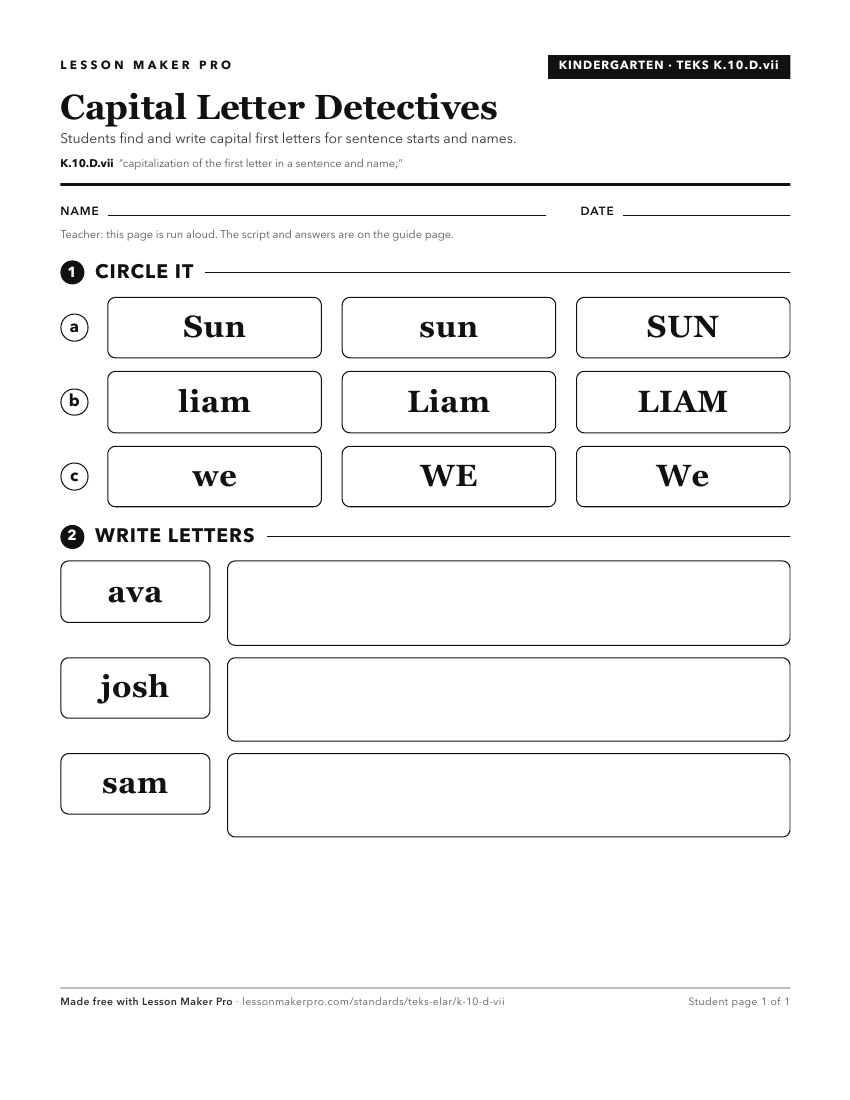
A ready-to-print activity worksheet aligned to K.10.D.vii, with an answer key for the teacher on its own page. No account needed.
PDF, US Letter, prints cleanly in black and white.
Download the worksheetKeep exploring
Related Standards
- 8.10.D.v
correct capitalization;
- 6.10.D.vii
capitalization of proper nouns, including abbreviations, initials, acronyms, and organizations;
- 2.11.D.ix
capitalization of months, days of the week, and the salutation and conclusion of a letter;
- 1.11.D.viii
capitalization for the beginning of sentences and the pronoun "I";
Turn this exact standard into a lesson
Grade, subject, topic, and the complete standard are prefilled. Create one free, no account needed.
Also for this standard:Make a WorksheetMake a QuizMake a Sub Lesson