TEKS ELAR K.10.D.iii
The Standard
singular and plural nouns
Texas Essential Knowledge and Skills for English Language Arts and Reading · The student uses the writing process recursively to compose multiple texts that are legible and uses appropriate conventions.
Teacher's field guide
What This Standard Means
What Students Need to Do
- Students check nouns in their drafts to see whether they name one person, place, animal, or thing, or more than one. With adult help, they change the noun so it matches the amount shown or described.
What Mastery Looks Like
- A student can point to a noun and tell whether it names one or more than one. The student revises simple plurals, such as dog to dogs, and rereads the sentence to check the match.
Common Misconceptions
- Students may add s when the noun names only one item, or leave it off when the noun names several. They may use an apostrophe before s, or focus on the last letter without checking the picture or sentence meaning.
How to Assess It
- Show a picture of three frogs beside the sentence “I see a frog.” Ask students to circle the noun, rewrite it correctly, and read the revised sentence aloud.
Lesson moves
Ways to Teach It
Give students picture cards and noun labels; they sort them into one and more than one, then add or remove s.
Use the prompt, “How should cat change when the picture shows three?” and have students explain before revising a sentence together.
Play noun match: students pair a singular picture card with its plural card and say both words aloud.
Read a classroom supply list, circle nouns, and revise each label to match the number of objects present.
Free download
Printable K.10.D.iii Worksheet
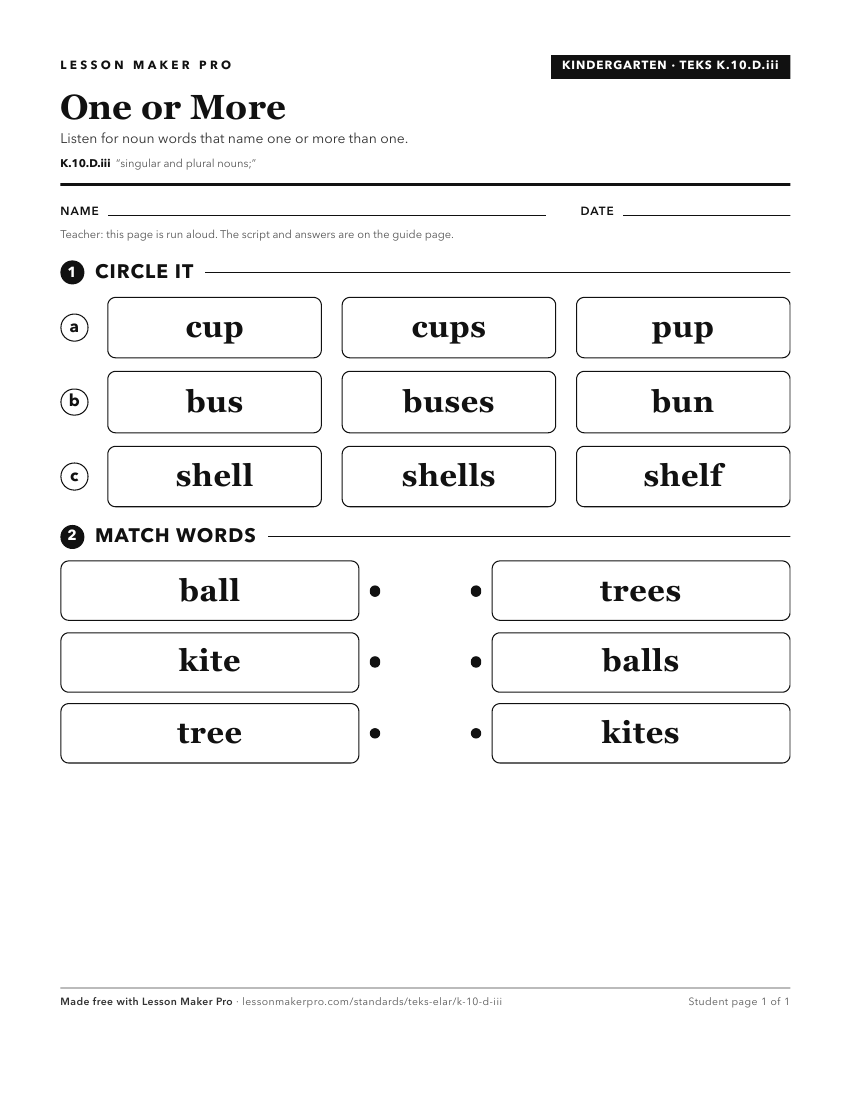
A ready-to-print activity worksheet aligned to K.10.D.iii, with an answer key for the teacher on its own page. No account needed.
PDF, US Letter, prints cleanly in black and white.
Download the worksheetKeep exploring
Related Standards
Turn this exact standard into a lesson
Grade, subject, topic, and the complete standard are prefilled. Create one free, no account needed.
Also for this standard:Make a WorksheetMake a QuizMake a Sub Lesson