TEKS ELAR 8.8.E.i
The Standard
identifying the claim and analyzing the argument
Texas Essential Knowledge and Skills for English Language Arts and Reading · The student recognizes and analyzes genre-specific characteristics, structures, and purposes within and across increasingly complex traditional, contemporary, classical, and diverse texts.
Teacher's field guide
What This Standard Means
What Students Need to Do
- Students determine what the author wants readers to believe or do. They trace how reasons, evidence, and responses to opposing views build that position.
What Mastery Looks Like
- Students state the author’s position accurately in their own words. They connect each reason to relevant evidence and point out weak links, missing support, or unanswered opposing views.
Common Misconceptions
- Students may name the topic instead of the author’s position. They may list evidence without explaining how it supports a reason. They may judge an argument by personal agreement rather than the quality of its reasoning and evidence.
How to Assess It
- Give students a short editorial and ask: “State the author’s position, name one supporting reason, and explain how one detail supports that reason.”
Lesson moves
Ways to Teach It
Give groups mixed sentence strips from an editorial and have them arrange the position, reasons, evidence, and opposing view into a logical map.
After reading a school policy editorial, ask students to write which reason is strongest and explain why its evidence works.
Run an argument sorting relay where teams label cards as position, reason, evidence, or opposing view and defend each choice.
Analyze a product advertisement and list what it wants buyers to believe, the reasons given, and the evidence that is missing.
Free download
Printable 8.8.E.i Worksheet
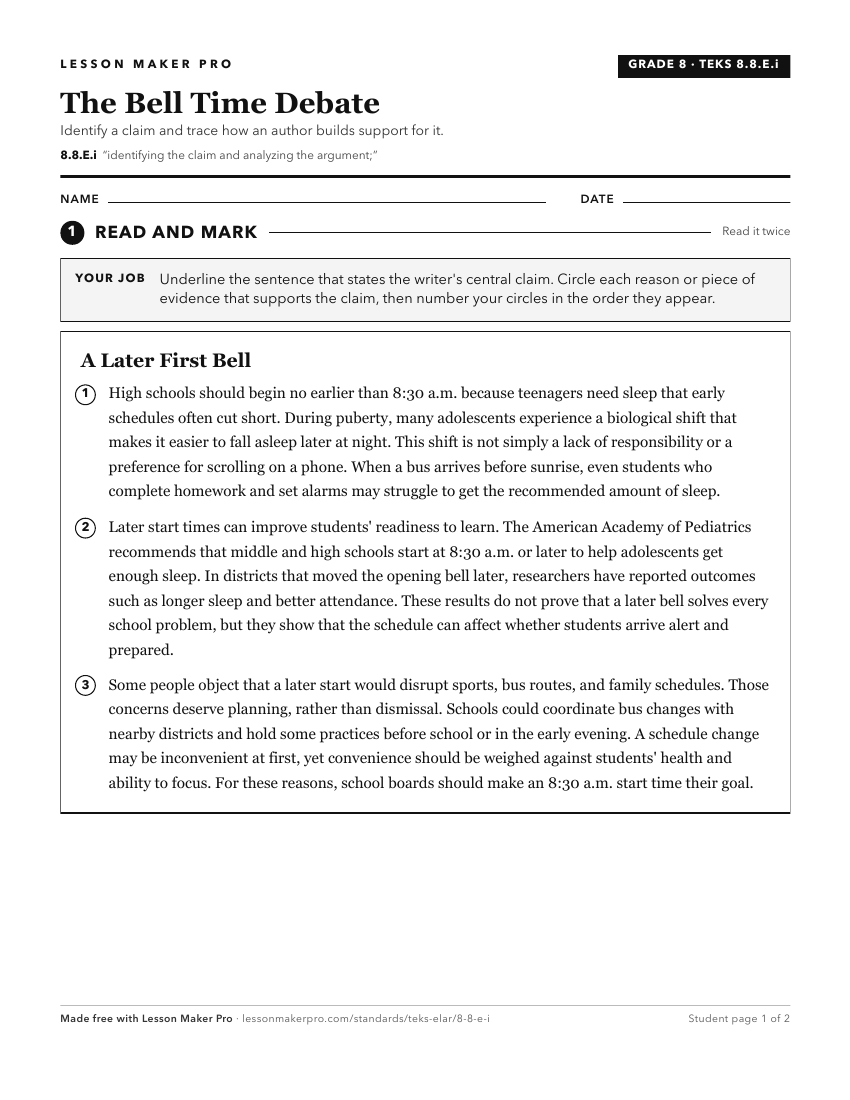
A ready-to-print activity worksheet aligned to 8.8.E.i, with an answer key for the teacher on its own page. No account needed.
PDF, US Letter, prints cleanly in black and white.
Download the worksheetKeep exploring
Related Standards
Turn this exact standard into a lesson
Grade, subject, topic, and the complete standard are prefilled. Create one free, no account needed.
Also for this standard:Make a WorksheetMake a QuizMake a Sub Lesson